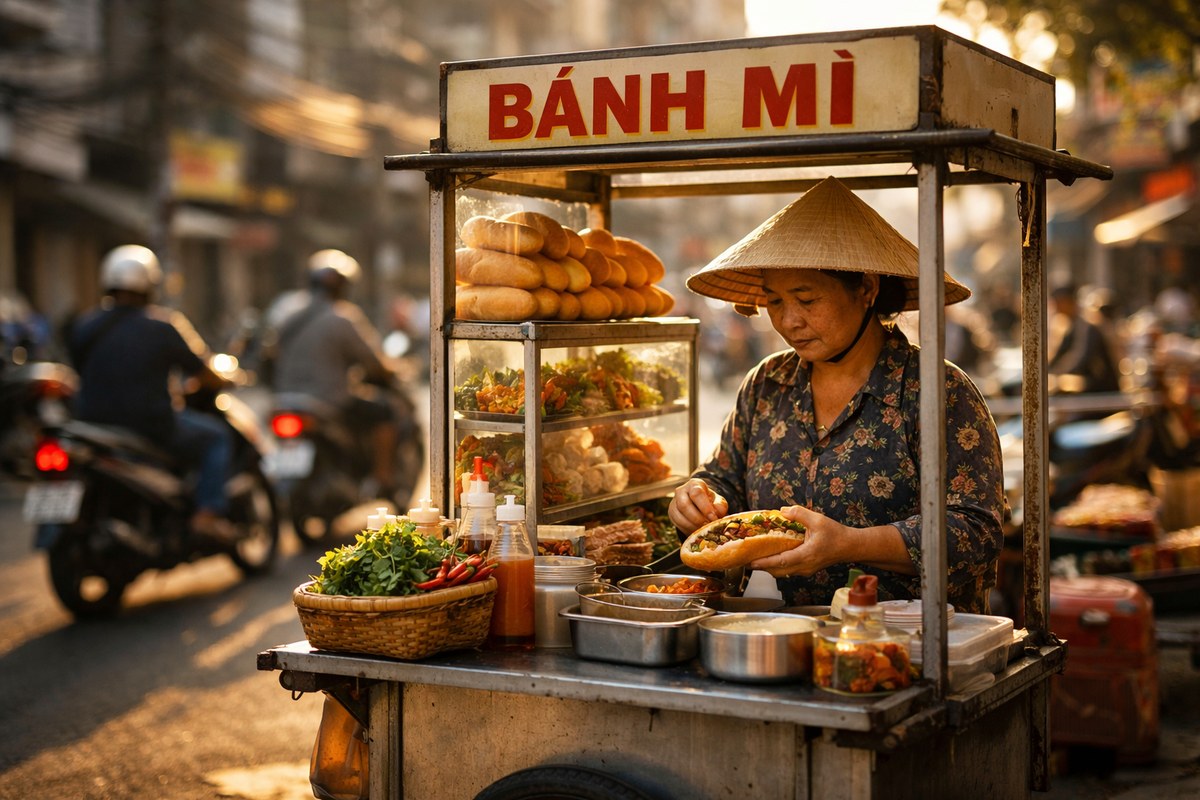
Bánh mì Vietnam is, quite simply, one of the greatest sandwiches the world has ever produced. Sold from carts on every corner for less than a dollar, this crackling-crusted baguette stuffed with pâté, herbs, pickled vegetables and grilled meat is the result of a culinary collision between French colonialism and Vietnamese genius — and Vietnam won. If you eat only one thing during your time in this country, make it a bánh mì.
Street vendors begin selling them at dawn. By 7am, the queues are already forming. By noon, the best carts have sold out. This is not fast food — this is a way of life.
From Baguette to Icon: The History of Bánh Mì in Vietnam
The story of bánh mì begins in 1859, when French forces captured Saigon and began transforming southern Vietnam into a colonial outpost. Along with administrative buildings, railway lines and coffee plantations, the French brought their baguette. Wheat flour was imported, colonial bakeries were established, and the Vietnamese learned to bake.
But here is where the story gets interesting. The Vietnamese did not simply adopt the baguette — they reinvented it. They made the bread shorter and lighter, replacing some of the wheat flour with rice flour to create a crust that shatters like glass but gives way to an interior as airy as a cloud. The French baguette is a dense, chewy thing. The Vietnamese bánh mì is something else entirely — a vehicle for flavour, not the star of it.
For decades, it remained a simple snack: a roll split open and spread with butter and sugar, sold to schoolchildren and factory workers. Then came 1975, and reunification, and the explosion of street food culture that followed in its wake. Vendors began filling their breads more ambitiously — sliced cold cuts from the charcuterie tradition, fragrant herbs from the garden, pickled vegetables for brightness and heat from sliced chilli for fire. By the 1980s, the bánh mì as we know it today had taken shape.
It spread globally with the Vietnamese diaspora. By the 1990s, bánh mì shops were opening in Paris, Sydney, London and Los Angeles. Anthony Bourdain called it a “symphony in a sandwich.” Today, it is recognised internationally as one of the world’s great street foods — and it still costs next to nothing on the streets of its homeland.
Inside the Bánh Mì: What Goes Into Vietnam’s Most Perfect Sandwich
Understanding a bánh mì is like understanding a great orchestra. Each component plays its part, and the result is greater than the sum of its parts. Remove any one element and the harmony breaks down.
The bread comes first. That slim, golden baguette — crisped in a coal or charcoal oven until the crust shatters at the first bite — must be fresh. Bánh mì vendors receive deliveries from local bakeries two or three times a day. Bread that sat out an hour too long loses its crunch and becomes something else entirely. You want to hear that snap when the vendor splits it.
The spreads form the foundation. A thin layer of margarine or butter goes on first, followed by a smear of pâté — liver paste, rich and savoury, a direct inheritance from the French charcuterie tradition. Some vendors add a swipe of Maggi soy sauce or mayonnaise too. These layers are what make a bánh mì more than bread and filling.
The proteins are where regional and personal variation begins. Chả lụa (Vietnamese steamed pork roll) is the classic. Thịt nướng (grilled pork, often marinated in lemongrass and fish sauce) is a favourite in the south. Fried egg — trứng — transforms it into a breakfast sandwich. Some carts specialise in sardines or canned tuna. In Hội An, roast pork with crispy skin is the signature. Tofu makes it vegetarian without sacrificing substance.
The fresh components are non-negotiable. A generous handful of fresh coriander and spring onion goes in, along with julienned cucumber for crunch. Then come the pickled vegetables — đồ chua — shredded daikon and carrot brined in rice vinegar and sugar until bright pink and properly sour. They cut through the richness of the pâté like a knife through silk.
The heat completes the picture. Sliced fresh chilli — red, green, or bird’s eye if the vendor is feeling generous — sits on top. You can ask for extra or none at all. That’s the beauty of a bánh mì: it is always personal.

Regional Bánh Mì Styles Across Vietnam
Vietnam is a long country — stretching 1,650 kilometres from north to south — and its regional food cultures are distinct enough that a bánh mì in Hanoi tastes meaningfully different from one in Saigon. Travel the length of the country and you will collect a different sandwich at every stop.
Saigon (Ho Chi Minh City) is bánh mì heartland. The sandwiches here are generous, lavish affairs — overstuffed with multiple proteins, swimming in sauce, crammed with herbs. This is where the fully loaded version of the sandwich was perfected, and where the greatest concentration of legendary bánh mì shops can be found. A classic Saigon bánh mì will have chả lụa, sliced chả (headcheese), grilled pork, pâté, butter, cucumber, coriander, pickled daikon and at least two types of chilli. If you can close it properly, the vendor hasn’t put enough in.
Hội An has produced what many consider the world’s most famous bánh mì. Bánh Mì Phương — a small, chaotic shop on Phan Châu Trinh Street — has been name-checked by Anthony Bourdain and featured in virtually every travel publication on earth. Their signature uses slow-roasted pork with crackling skin, a double layer of pâté and an extraordinary house sauce. Queues form an hour before opening.
Hanoi takes a more restrained approach. Northern bánh mì tends to be simpler — often just chả lụa, butter and a few herbs — with the quality of the bread itself taking centre stage. The rolls here are sometimes slightly different in shape, a little chewier, the crust less explosive. It’s a subtler pleasure.
Da Lạt, up in the Central Highlands, is known for its bánh mì with pâté de foie — a particularly rich liver paste that reflects the cooler climate and French alpine influences of this mountain town. Pair it with a cup of Da Lạt coffee and you have one of the finest breakfasts in Southeast Asia.
Da Nang serves its bánh mì spicier, reflecting the central Vietnamese love of heat. If you’re exploring the region after reading our Da Nang travel guide, start your morning with a local bánh mì before heading out to the beaches.
Where to Find the Best Bánh Mì in Vietnam
The honest answer to “where is the best bánh mì?” is: outside. On a street corner. From a cart with a coal-fired oven and a vendor who has been doing this for 25 years. No restaurant can replicate what a skilled street vendor does with a pair of tongs and 45 seconds of assembly.
That said, a few standouts have earned legendary status. Bánh Mì Phương at 2B Phan Châu Trinh, Hội An, is the most famous bánh mì shop in Vietnam — open from 6:30am until sold out, usually around noon. The full version with pork, pâté, egg and extra sauce is the move. If you’re visiting after reading our Hội An travel guide, make this your first stop on Day 1.
Bánh Mì Hùynh Hoa at 26 Lê Thị Riêng in Ho Chi Minh City is a Saigon institution — the sandwiches are almost comically overstuffed, wrapped in paper to hold everything together. Open evenings only from around 3pm until midnight, it’s the city’s great late-night option. Bánh Mì 37 Nguyễn Trãi in District 1 is a quieter, less tourist-facing option that locals frequent; their grilled pork version is exceptional.
For street carts everywhere else, the key markers of quality are: a steady stream of local customers (not tourists), a small charcoal oven keeping the bread warm, and a vendor who assembles quickly and confidently. If there’s a queue of motorbikes, join it.

How to Order Bánh Mì Like a Local
Ordering a bánh mì is one of the most approachable street food transactions in Vietnam. Most vendors understand a few simple requests, and pointing works beautifully when language fails.
A few useful phrases: bánh mì thịt (bánh mì with meat — the classic), bánh mì trứng (egg bánh mì, excellent for breakfast), bánh mì chay (vegetarian), không cay (no chilli), cay nhiều (extra chilli), and thêm ngò (more coriander). Point at what you want, say thêm (more) or bớt (less), and you’ll get what you need.
A bánh mì should cost between 15,000 and 30,000 VND — roughly $0.60–$1.20 USD. If you’re paying more than 35,000 VND from a street cart, you’re in tourist territory. This makes it one of the great budget travel foods in Asia; if you’re travelling Vietnam on a budget, a bánh mì a day can fuel you through a city for under $2. Morning and lunchtime are peak bánh mì hours — the bread is freshest early in the day, and vendors often receive new deliveries around 10am.
Taking Bánh Mì Home: Classes, Recipes and the Global Sandwich
If Vietnam’s food culture has gripped you — and after a few days here, it will — you may find yourself wanting to recreate these flavours at home. The bánh mì is deceptively achievable for the home cook. The pickled vegetables (đồ chua) take just 20 minutes to prepare, the pâté can be replaced with a quality French liver pâté from a deli, and chả lụa can be found in Vietnamese grocery stores in most major cities worldwide. The hardest element is the bread itself — that shattering crust requires rice flour and practice.
The easier route is to take a cooking class in Vietnam before you leave. Several excellent operators in Hội An and Hanoi teach full bread-making alongside classics like phở and bánh xèo. Our guide to Vietnamese cooking classes covers the best options across the country. And if you want to understand the full landscape of Vietnamese street food before you go, our breakdown of Saigon’s street food scene will recalibrate your sense of what street food can be.
The bánh mì has, in the decades since the Vietnamese diaspora carried it to every continent, become a global food. You’ll find it in Paris and Melbourne, in London and New York. But nothing prepared in any of those cities will match the one you eat standing on a Saigon pavement at 7am, grease on your fingers and coriander in your teeth, watching the city wake up around you. That sandwich — that particular, unrepeatable sandwich — is worth flying to Vietnam for.
What is bánh mì in Vietnam?
Bánh mì is Vietnam’s iconic sandwich — a short, crispy-crusted baguette made with a blend of wheat and rice flour, filled with pâté, butter, various proteins (such as grilled pork, Vietnamese sausage or fried egg), fresh herbs, pickled daikon and carrot, and chilli. It evolved from the French baguette introduced during colonial rule and has since become one of the world’s most celebrated street foods.
How much does a bánh mì cost in Vietnam?
A bánh mì from a street cart typically costs between 15,000 and 30,000 VND (approximately $0.60–$1.20 USD). Famous spots like Bánh Mì Phương in Hội An may charge slightly more (around 30,000–40,000 VND), but anything over $2 for a street vendor’s sandwich suggests a tourist premium.
Where is the best bánh mì in Vietnam?
Bánh Mì Phương in Hội An (2B Phan Châu Trinh Street) is considered by many — including Anthony Bourdain — to be the best in Vietnam. Bánh Mì Hùynh Hoa in Ho Chi Minh City (26 Lê Thị Riêng, open evenings) is famous for its overstuffed sandwiches. However, skilled street cart vendors in any Vietnamese city regularly serve sandwiches that rival these famous names.
Is it safe to eat bánh mì from street vendors in Vietnam?
Generally yes — bánh mì is one of the safer street foods in Vietnam because the bread is freshly baked, the pâté and cold cuts are pre-packaged from licensed producers, and the pickled vegetables are preserved in vinegar. Look for busy carts with high turnover, and avoid vendors who leave assembled sandwiches sitting open in the sun.
What does bánh mì mean in Vietnamese?
In Vietnamese, “bánh” means bread or cake, and “mì” refers to wheat. So bánh mì literally translates to “wheat bread.” In everyday usage, however, bánh mì refers specifically to the filled sandwich — the baguette with all its toppings — rather than plain bread.
Leave a Reply