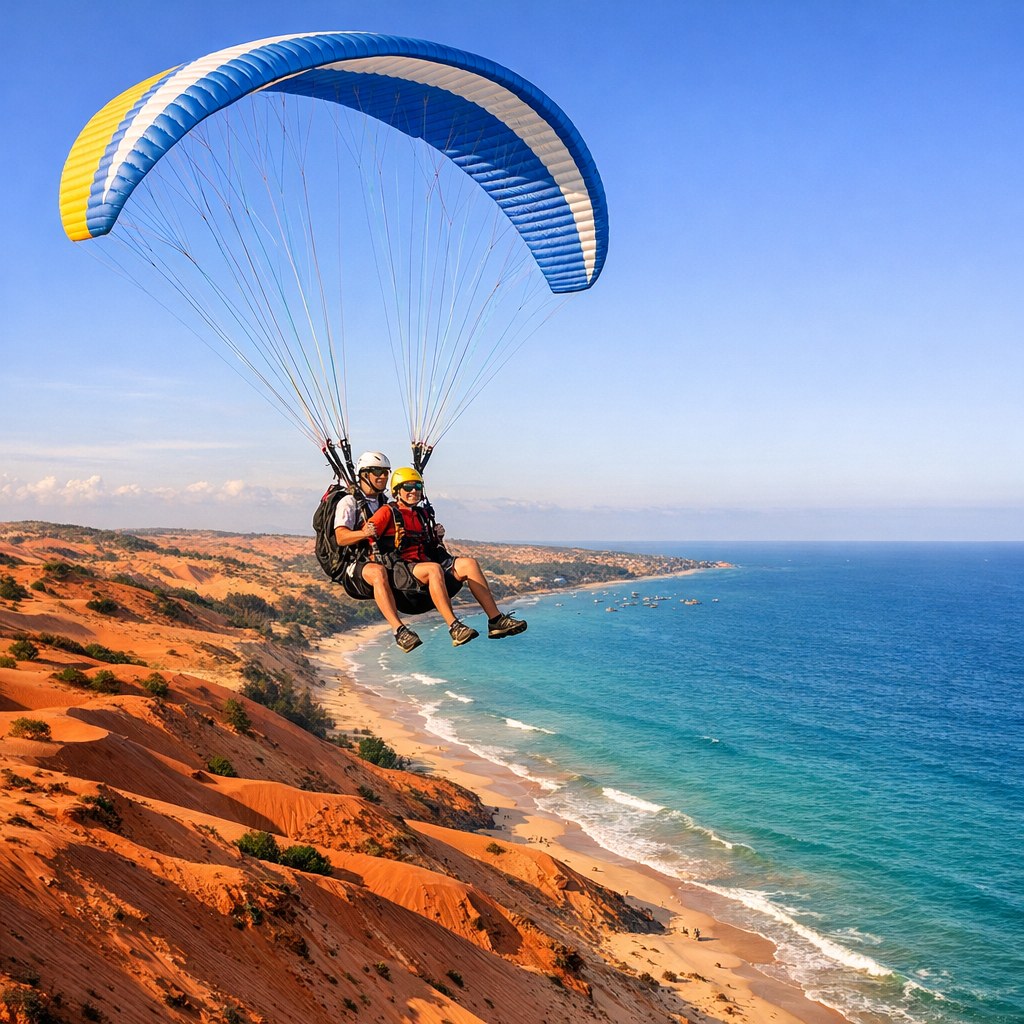
Paragliding in Vietnam is one of Southeast Asia’s most exhilarating and underrated experiences, and Mui Ne is where it happens. Imagine running off a rust-red sand dune with nothing but a canopy above you and 200 metres of warm coastal air below — then turning to see the South China Sea glittering to the horizon while the wind holds you effortlessly aloft. This is not extreme sport. This is flying, pure and simple, available to anyone willing to take one running step off a dune.
Vietnam’s adventure tourism has grown significantly in recent years, and while rock climbing in Cat Ba and kayaking through Ha Long Bay attract their own devotees, paragliding over Mui Ne remains one of the country’s most singular thrills. The logistics are easy. The cost is modest. The memory lasts considerably longer than the 10-minute flight.
Why Mui Ne Is Vietnam’s Paragliding Capital
Mui Ne is a narrow sand spit on Vietnam’s southeastern coast, about 200 kilometres northeast of Ho Chi Minh City in Bình Thuận province. It has been a centre for wind sports since the 1990s, when kitesurfers first discovered that the geography here creates some of the most reliable thermal and sea-breeze conditions in mainland Southeast Asia.
The key to Mui Ne’s wind is its position. The peninsula juts into the South China Sea at an angle that catches both the northeast monsoon (November to April) and the southwest monsoon (May to September). Between November and April — the dry season — consistent offshore winds of 15 to 25 knots blow steadily from the northeast, creating ideal conditions for kitesurfing at water level and paragliding from the dunes above. The wind here is not the gusting, unpredictable kind that makes pilots nervous. It is smooth, layered, and remarkably consistent.
The terrain helps too. The famous Red Dunes (Đồi Cát Đỏ) and White Dunes (Đồi Cát Trắng) rise 20 to 50 metres above the surrounding plain, providing natural launch ramps that face directly into the prevailing wind. Pilots run downhill into a headwind, which means lift comes quickly — usually within two or three steps. There’s no need for a cable tow or a steep mountain launch. You simply run, and you fly.
The landing zone is equally forgiving. Wide, flat sandy areas at the base of the dunes mean that even for first-timers, touch-downs are soft and there’s little to collide with. For tandem passengers — those flying with a certified instructor — this setup makes Mui Ne one of the most beginner-friendly paragliding locations in Asia.
Tandem Paragliding in Vietnam: What to Expect on Your First Flight
If you have never paraglided before, tandem is the way to go. You are harnessed in front of an experienced pilot who handles all the controls — you simply sit back, take in the view, and try not to grin too wide into the wind. The whole experience from briefing to landing typically takes 45 minutes to an hour, but the actual airtime is usually 10 to 20 minutes depending on wind conditions and the operator’s flight window.
The briefing is brief. A good instructor will explain the running start required for launch (three to five fast steps downhill), the position to adopt once airborne (seated back in the harness, feet up), and the landing procedure (run it out on your feet when the instructor says). That’s genuinely all you need to know as a passenger. Everything else — reading the wind, steering the canopy, managing altitude — is handled by the pilot behind you.
The launch itself is the moment of highest adrenaline. You stand at the dune’s crest, the canopy inflated and pulling behind you, the wind pressing against your chest. The instructor says “run”, and you run. Within three steps the ground drops away and you’re flying — weightless, the dune falling beneath you, the sea spreading out ahead. Most first-timers describe the first 30 seconds of flight as the most startling experience of their travels. Then it settles into something else: a profound, improbable calm.
At altitude, the view over Mui Ne is extraordinary. The Red Dunes glow rust-orange against the blue sea; fishing boats dot the water; the sand spit tapers away to the northeast. On a clear day you can see all the way to the fishing village of Mũi Né town. The pilot will often perform gentle turns and spirals if you indicate you want more movement. If you’d prefer to simply drift and stare, that’s equally valid.

When to Go Paragliding in Vietnam: Best Season and Conditions
The paragliding season in Mui Ne broadly follows the dry season: November through April. Within this window, January to March is widely considered the peak period. The northeast winds are most consistent, the skies are clearest, and the combination of good thermals off the warm sand and steady sea breezes creates the longest and most reliable flight windows of the year.
Avoid the southwest monsoon season (roughly May to October). While Mui Ne remains drier than most of Vietnam during this period — the Bình Thuận coast sits in a rain shadow — the wind reverses direction and becomes more turbulent. Most paragliding operators scale back or suspend flights during these months. Some kitesurfing schools continue operating on the south-facing beaches where the southwest wind works, but paragliding from the dunes is far less reliable.
Within a given day, morning is generally better than afternoon. Thermals build as the sand heats up through the day, which creates lift but also instability by mid-afternoon. Most operators prefer to fly from 7am to 11am and again briefly around 4–5pm, avoiding the midday thermal turbulence. If you arrive and are told conditions aren’t suitable, trust the pilot — they fly every day and understand this particular sky far better than any forecast.
For a deeper dive into how Vietnam’s seasons affect travel planning across the country, our month-by-month weather and festival guide breaks down what to expect in each region at each time of year. And if you’re building a longer itinerary around Mui Ne, our Mui Ne travel guide covers beaches, sand dunes, kitesurfing and the best places to stay.
How Much Does Paragliding Cost in Vietnam?
Paragliding in Vietnam is significantly more affordable than equivalent experiences in Europe or Australia, making it accessible to most travellers on a standard budget. For tandem flights in Mui Ne, expect to pay in the range of 800,000 to 1,500,000 VND (approximately $32–$60 USD) for a 10–20 minute flight, depending on the operator, the length of the session and whether photo or video packages are included.
Most operators offer a standard tandem flight at the lower end of that range, with premium options adding GoPro footage, extended flight time (weather permitting), or transport from your accommodation to the dune launch site. Always confirm what’s included before paying — some advertised prices cover only the flight, while transport and video are add-ons.
There are a handful of established operators working the Red and White Dunes. Look for instructors with CIVL (Fédération Aéronautique Internationale) certification or equivalent national credentials, and ask to see their equipment — a well-maintained, modern wing and harness system is non-negotiable. Legitimate operators will not fly in unsafe conditions, even under pressure from eager customers; be wary of anyone who seems eager to fly regardless of wind or weather.
Booking in advance is generally not necessary except during the busy Christmas–New Year period (late December to early January). Outside those weeks, you can show up at the dunes in the morning and find flights departing throughout the day. If you’re keeping a tight travel budget, our guide to travelling Vietnam for under $50 a day shows how to incorporate experiences like this without breaking the bank.

Other Adventure Sports Near Mui Ne
Paragliding is Mui Ne’s most dramatic offering, but the adventure doesn’t stop at the dunes. The region has built an international reputation as Vietnam’s premier wind sports destination, and the concentration of activities here means you can fill several days without repeating yourself.
Kitesurfing is the activity that put Mui Ne on the map, and it remains exceptional. The same northeast winds that lift paragliders create perfect kitesurfing conditions on the flat, shallow water off Bãi Sau (Back Beach). Dozens of schools offer lessons from beginner to advanced — most international-standard courses run over three days and take complete novices to independent riding.
Sandboarding on the Red and White Dunes is a more accessible alternative for those who prefer their thrills closer to the ground. Boards can be rented from vendors at both dune sites for around 30,000–50,000 VND per session. The White Dunes (about 50km from town) are larger, more dramatic and less crowded than the Red Dunes. Visit at sunrise if you can — the light turns the sand shades of pink and gold that make every photograph look like a painting.
For those drawn to water rather than air, Vietnam’s coastal waters offer exceptional kayaking and snorkelling. Our guide to kayaking in Vietnam covers the best waterways from the Mekong Delta to the northern limestone karsts. And if scaling rock faces appeals more than flying above them, our rock climbing guide for Cat Ba and Ha Long Bay covers one of Vietnam’s finest vertical landscapes.
Mui Ne itself is compact enough to explore in two to three days, making it an ideal add-on to a longer southern Vietnam itinerary. From here, the Mekong Delta is four hours south, Da Lat is three hours northwest, and Ho Chi Minh City is four hours down the coastal highway.
Can beginners go paragliding in Vietnam?
Yes — tandem paragliding in Mui Ne is ideal for beginners. You fly harnessed in front of a certified instructor who handles all the controls. No experience or training is required. The dune launch sites are forgiving and the landing zones are wide and flat. Most first-timers describe it as surprisingly accessible and far less scary than they expected.
How much does paragliding cost in Mui Ne, Vietnam?
Tandem paragliding flights in Mui Ne typically cost between 800,000 and 1,500,000 VND (approximately $32–$60 USD) for a 10–20 minute flight. Prices vary by operator and whether photo or video packages are included. This is significantly cheaper than equivalent experiences in Europe or Australia.
What is the best time of year to go paragliding in Mui Ne?
The best season for paragliding in Mui Ne is November through April, with January to March considered the peak months. During this period, consistent northeast winds and clear skies create ideal conditions. Avoid the southwest monsoon season (May to October) when wind direction reverses and becomes less reliable for dune launches.
Is paragliding in Vietnam safe?
Tandem paragliding in Mui Ne is generally safe when conducted with a certified instructor and properly maintained equipment. Choose operators whose pilots hold recognised international certifications (such as CIVL credentials), check that the wing and harness are modern and well-maintained, and never fly with someone who seems willing to launch in genuinely unsafe conditions. Reputable operators will cancel or delay if conditions are unsuitable.
Where exactly do you paraglide in Mui Ne?
Most paragliding in Mui Ne takes place from the Red Dunes (Đồi Cát Đỏ), located about 7km north of Mui Ne town centre, and sometimes from the larger White Dunes (Đồi Cát Trắng) about 50km further north near Bàu Trắng. Both sites provide natural elevation above flat coastal terrain and face into the prevailing northeast wind, making them ideal natural launch ramps.
Leave a Reply