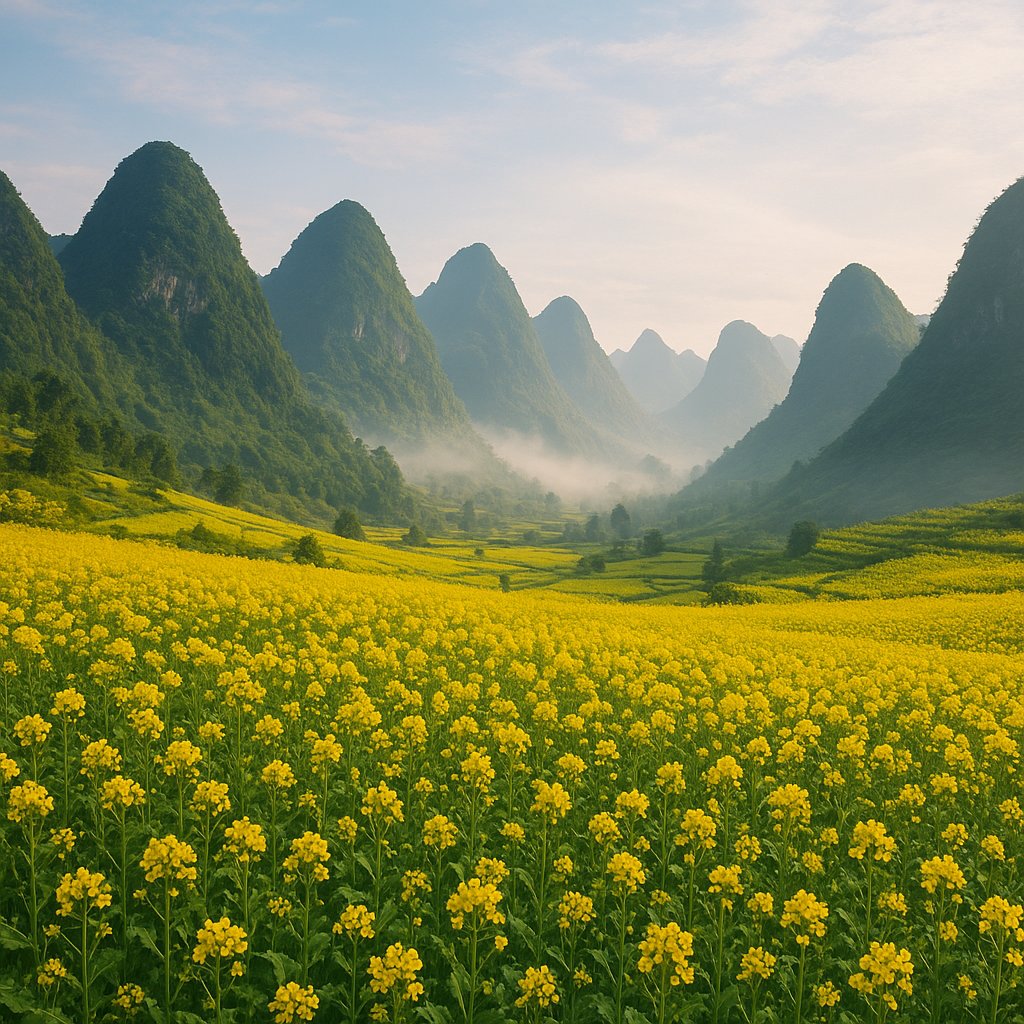
Vietnam flower season transforms a country already rich in beauty into something that feels almost impossibly alive. From the golden mustard fields of Ha Giang in the far north to the lotus lakes shimmering outside Hue, Vietnam’s landscapes bloom in vivid succession across the months — if you know when and where to look. This is a country where the timing of your visit can mean the difference between a good trip and one you’ll spend a lifetime talking about.
Whether you’re a photographer chasing the perfect shot of terraced hillsides carpeted in yellow, a romantic planning a honeymoon among cherry blossoms, or simply a traveller who wants to see Vietnam at its most wildly beautiful, this guide maps every bloom, every season, and every destination worth chasing.
Vietnam Flower Season: The Year at a Glance

Vietnam’s flower seasons don’t follow a single calendar — they cascade across the country from north to south, from highlands to delta, in a rolling sequence that means there is always somewhere in bloom. The country’s dramatic range of climates, from the cool highlands of the north to the tropical south, creates an extraordinary diversity of flowering plants that would be impossible in a more climatically uniform country.
Here is the broad rhythm of Vietnam’s flower year:
January–February (Tết season): This is the peak season for peach blossoms (hoa đào) in the north and yellow apricot blossoms (hoa mai) in the south. Both flowers are deeply significant symbols of Tết, the Lunar New Year festival, and the entire country erupts with them in the weeks surrounding the holiday. Hanoi markets overflow with potted peach branches; Ho Chi Minh City goes golden with apricot. It is one of the most visually spectacular times to visit Vietnam, coinciding with the country’s most important cultural celebration.
February–April: The mustard flower season peaks in the northern highlands, particularly in Ha Giang, Mộc Châu, and Cao Bằng. Hillsides and valley floors turn an astonishing electric yellow, the colour so intense it almost seems artificial against the grey limestone karsts. This is also the season for plum and apricot blossoms in Sapa, and the famous cherry blossoms of the Northwest. For travellers chasing that iconic Ha Giang Loop scenery, February through March is the moment — see our full guide to the Ha Giang Loop for planning details.
April–May: Bauhinia blossoms (hoa ban) blanket the hills of the Northwest, their white and purple flowers covering the slopes like snow. In Da Lat, the city’s famous flower gardens reach peak bloom in April. Across the country, the transition between cool and hot seasons produces some of the most dramatic landscapes of the year.
June–August: Lotus season arrives, and it is magnificent. Vietnam’s national flower blooms across lakes, ponds, and paddies from June through August, most famously around Hue, Hanoi’s West Lake, and the Mekong Delta. Sunrises over a lotus lake in full bloom are among the great photographic opportunities in Southeast Asia.
September–November: The tam giác mạch — buckwheat flower — blooms across the northern highlands in October and November, turning entire hillsides a deep crimson and purple. Ha Giang is again the destination of choice, this time for the buckwheat harvest season. Rice terraces across Sapa and Mu Cang Chai also turn gold during the September–October harvest, a spectacle that attracts photographers from around the world.
November–December: Wild sunflowers bloom along the roads of Nghe An and Ha Tinh provinces, and the highlands cool into a quieter beauty. Late November brings the first of the winter blooms to Da Lat.
Mustard Flowers in Ha Giang: Vietnam’s Most Dramatic Bloom
If there is one vietnam flower season that defines the country’s reputation for extraordinary natural beauty, it is the mustard flower bloom in Ha Giang. In February and March, the limestone karst landscape of Vietnam’s far north turns gold — and not the polite, speckled gold of a few scattered wildflowers, but the overwhelming, all-consuming gold of entire valleys and hillsides buried under a thick blanket of tiny yellow blooms.
The flowers grow between the rice terraces and along the narrow mountain roads, creating a visual contrast with the grey rock formations that makes every turn of the famous Ha Giang Loop feel like a painting. Local Hmong and Dao villages, with their bright traditional costumes, add another layer of colour to a landscape already straining with it. It is, by any measure, one of the most beautiful sights in Asia.
The peak is roughly mid-February to mid-March, though altitude and weather variation mean the exact timing shifts year to year. Higher elevations tend to bloom a week or two earlier than the valley floors. Checking local reports in the week before your visit is worth doing. Accommodation in Ha Giang fills quickly during peak bloom — book well in advance if you’re targeting this season specifically.
For logistics on getting to Ha Giang and riding the Loop, our detailed Ha Giang Loop guide covers everything from route options to homestay recommendations.
Cherry Blossoms and Da Lat’s Year-Round Gardens

Da Lat is Vietnam’s flower city — a place where horticulture is both an industry and an obsession. Sitting at 1,500 metres above sea level in the Central Highlands, Da Lat enjoys a cool, misty climate that makes it uniquely suited to growing flowers that would wilt immediately in the tropical lowlands. The city supplies cut flowers to the entire country, and its hillsides are perpetually dotted with greenhouses and open-air flower gardens.
But it is in January and February, during and after Tết, that Da Lat truly comes into its own. The city’s famous cherry blossoms — actually a species of cherry native to Vietnam’s highlands, distinct from the Japanese sakura but similarly breathtaking — burst into pink bloom along the main boulevards and around Xuan Huong Lake. The Da Lat Flower Festival, held biennially in December (even years), transforms the city into an elaborate floral exhibition, with enormous installations, competitions, and the participation of flower growers from across the country.
The Da Lat Flower Park (Vườn Hoa Thành Phố) is the best single location to see the city’s cultivated blooms in one place, with roses, hydrangeas, dahlias, and countless other species on display year-round. But the most memorable flower experience in Da Lat is simply wandering the road between the city and the surrounding countryside in February, when private gardens and roadside plantings are all in simultaneous bloom.
Da Lat’s cool climate and flower culture make it one of Vietnam’s most romantic destinations. For a full guide to the city, including where to stay, what to eat, and how to spend your time, see our Da Lat travel guide. Couples visiting during flower season will also find our Vietnam honeymoon guide useful for pairing Da Lat with other romantic destinations.
Lotus Season: Vietnam’s National Flower at Its Peak

The lotus — hoa sen — is Vietnam’s national flower, and its symbolism runs deep through Vietnamese culture, religion, and art. Rising from murky water to bloom in perfect purity, it represents the Buddhist ideal of enlightenment amid the suffering of the material world. It appears on temples, in paintings, on currency, and in the national imagination in a way that is hard to overstate. And when it blooms across Vietnam’s lakes and ponds from June through August, the sight is genuinely moving.
The best lotus viewing in Vietnam is around Hue, where the city’s network of moat lakes and the surrounding countryside host an exceptional concentration of lotus ponds. The lotus harvest around Hue is also a cultural event — local women paddle small boats through the blooms to harvest the flowers, seeds, and leaves, all of which are used in traditional cooking and medicine. A Hue lotus pond at sunrise, with mist rising from the water and the pink blossoms just opening in the early light, is one of those images that stays with you long after you’ve left.
Hanoi’s West Lake (Hồ Tây) and Truc Bach Lake are excellent for lotus viewing within the capital, typically peaking in June and July. The lotus ponds near the Temple of Literature are particularly photogenic. In the Mekong Delta, the lotus season overlaps with the floating rice harvest and the annual flood season, creating an extraordinary landscape of flowers, water, and working boats that feels almost surreal.
Timing your visit during lotus season also pairs beautifully with exploring Vietnam’s imperial heritage in Hue — a city whose culture, cuisine, and architecture are as captivating as any flower. For everything you need to know about visiting Hue, see our Vietnam UNESCO World Heritage Sites guide, which covers the Imperial Citadel and surrounding heritage sites in detail.
Buckwheat Flowers: The Hidden Gem of Vietnam’s Autumn
October and November bring a flower season that fewer international travellers know about — and that makes it all the more rewarding for those who do. The tam giác mạch, or buckwheat plant, covers the highlands of Ha Giang province in a carpet of tiny pink and purple flowers during the harvest season, creating a colour palette that is completely different from the golden yellows of spring but equally arresting.
The buckwheat bloom coincides with one of the most culturally rich times in Ha Giang’s calendar, as local Hmong, Dao, and Tay communities hold their post-harvest festivals. Traditional music, markets, and the distinctive embroidered clothing of the highland minorities are all on display. The famous Dong Van Stone Plateau — a UNESCO Geopark — turns purple and pink at this time, its ancient limestone landscape softened by the mass of tiny flowers.
Combine the buckwheat season with the rice terrace harvest in Mu Cang Chai (Yen Bai province), where the golden paddy fields create their own spectacular seasonal show in late September and October, and you have one of the most visually rewarding itineraries possible in the Vietnamese north. Travellers considering this route may also find useful information in our two-week Vietnam itinerary, which covers the northern circuit in detail.
Peach and Apricot Blossoms: The Flowers of Tết
No discussion of vietnam flower season is complete without the flowers of Tết — Vietnam’s Lunar New Year and its most important annual festival. In the weeks surrounding the holiday (which falls in late January or February), two flowers dominate the country’s visual landscape in a way that is deeply connected to culture, superstition, and celebration.
In the north, the hoa đào — peach blossom — is the flower of Tết. Its delicate pink blossoms appear on branches that are carried home from market, placed in living rooms and offices, and strung with gold and red decorations. Flower markets across Hanoi, including the famous Quảng Bá market near West Lake, sell enormous quantities of peach branches in the days before the holiday, and the scent of the blossoms mingles with the smoke of incense and the sound of firecrackers.
In the south, the equivalent is the hoa mai — yellow apricot blossom — which carries the same cultural weight but a completely different visual impact. Where the north goes pink and fragrant, the south goes gold and exuberant. Ho Chi Minh City markets overflow with mai trees in full bloom, their bright yellow flowers catching the tropical sunshine in a way that feels jubilant rather than delicate.
Visiting Vietnam during Tết is an extraordinary cultural experience, though it requires some practical planning — many businesses close for several days around the holiday, and transport can be crowded. Our best time to visit Vietnam guide covers the Tết period and other festival dates in detail.
When is the best time to see flowers in Vietnam?
Vietnam’s flower seasons run year-round in different regions. February–March is peak season for mustard flowers in Ha Giang and cherry blossoms in Da Lat. June–August is lotus season across the country. October–November brings buckwheat flowers back to Ha Giang. Tết (late January or February) is the season for peach and apricot blossoms nationwide.
Where can I see mustard flowers in Vietnam?
The best mustard flower viewing in Vietnam is in Ha Giang province, particularly along the Ha Giang Loop route, in February and March. The flowers turn the hillsides and valleys a vivid golden yellow, creating one of the most spectacular landscapes in Southeast Asia. Mộc Châu and Cao Bằng also have excellent mustard flower displays in the same season.
Does Vietnam have cherry blossoms?
Yes — Vietnam has its own native cherry blossom species that blooms in the highlands, particularly in Da Lat and the Northwest provinces. They are distinct from Japanese sakura but similarly beautiful, with delicate pink blossoms that appear in January and February. The Da Lat Flower Festival (held biennially in December) also showcases the city’s remarkable flower-growing culture.
When does lotus flower season occur in Vietnam?
Lotus season in Vietnam typically runs from June through August, with peak bloom varying slightly by location. The best lotus viewing is around Hue, Hanoi’s West Lake, and the Mekong Delta. Sunrise over a lotus pond in full bloom is one of the most photogenic sights in Vietnam.
What is the national flower of Vietnam?
Vietnam’s national flower is the lotus (hoa sen). It holds deep cultural and spiritual significance in Vietnamese Buddhism and traditional culture, symbolising purity and enlightenment. The lotus blooms across Vietnam’s lakes, ponds, and paddies from June through August, most spectacularly around Hue and Hanoi.
Leave a Reply