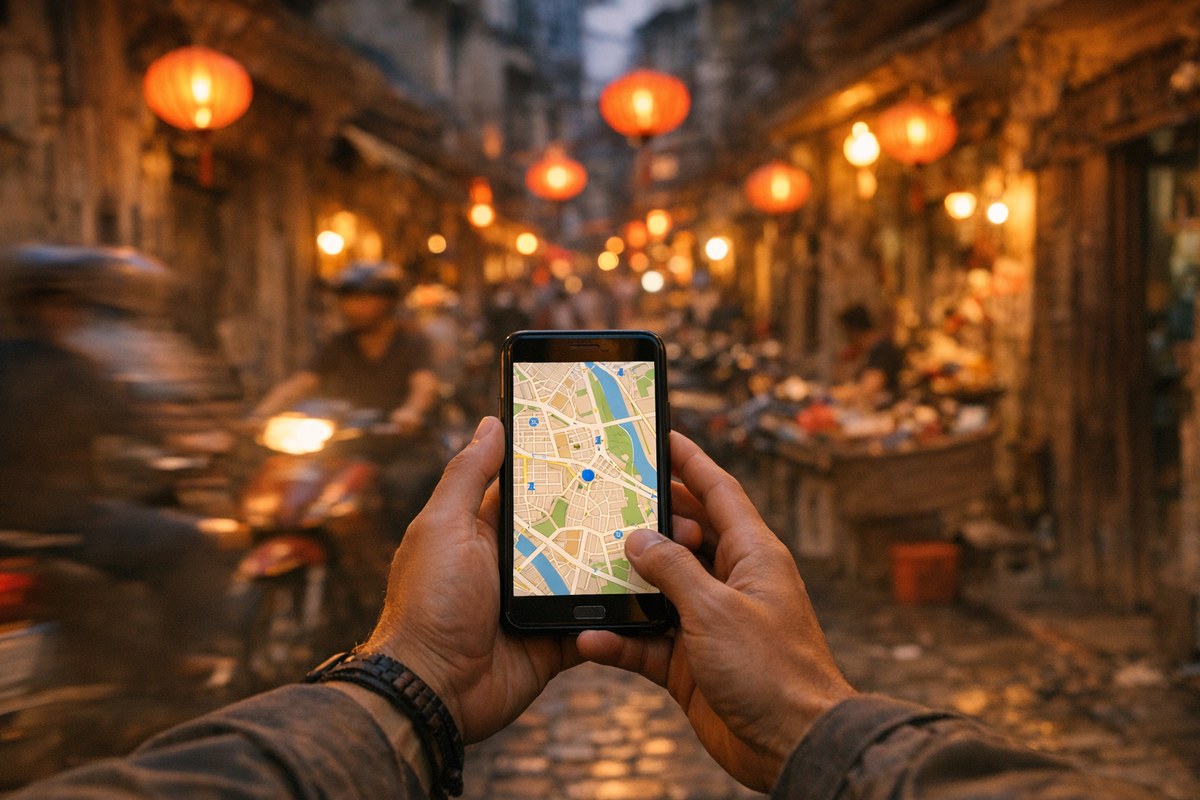
Sorting out a Vietnam SIM card is one of those small decisions that quietly shapes your whole trip. Get it right and you will glide from the airport to your hotel with a live map, summon a Grab ride in a downpour, and message your new friends from a Ha Long Bay cruise deck. Get it wrong and you will spend your first evening hunting for café Wi-Fi while the scent of grilled pork drifts tantalisingly out of reach. This guide walks you through the real options for 2026: physical SIMs, eSIMs and roaming, so you can land confident and connected.
Vietnam is a wonderfully connected country. Fibre-fast data reaches rice-terrace villages, remote island piers and mountain passes, and a local plan costs a fraction of what your home carrier charges for roaming. Whether you are following our 2-week Vietnam itinerary or improvising as you go, here is everything you need to know.
Vietnam SIM Card vs eSIM: Which Is Better for Travellers?
Before you pack, you face one big fork in the road: a traditional plastic SIM bought in Vietnam, or an eSIM installed digitally before you fly. Both work beautifully. The right choice depends on your phone, your patience and how much you value convenience over price.
A physical Vietnam SIM card is the classic route. You collect it at the airport or a phone shop, a friendly assistant swaps it into your handset, and within minutes you are online. It is typically the cheapest way to get a generous data allowance, and the major networks sell tourist-friendly bundles with several gigabytes, or even unlimited data, for a week, a fortnight or a month. The trade-off is that you swap out your home SIM, so you may miss calls or two-factor codes sent to your usual number unless your phone has dual-SIM support.
An eSIM removes that friction. It is a downloadable profile that lives alongside your normal SIM, so you keep your home number active while using local data. You buy a plan online, scan a QR code, and you can switch it on the moment you land. The convenience is real: no queues, no tiny SIM tray pins, no language barrier at the counter. The downside is a somewhat higher price per gigabyte and the fact that your phone must be eSIM-compatible and unlocked. Most phones released since around 2018 are, but check your settings before you rely on it.
- Choose a physical SIM if you want the lowest price, plan a longer stay, or own an older handset.
- Choose an eSIM if you value landing online instantly, want to keep your home number, or dislike airport queues after a long flight.
- Use roaming only for a short hop or as an emergency fallback, since daily roaming fees can add up quickly.
Best Vietnam SIM Card Providers: Viettel, Vinaphone and Mobifone
Three state-linked giants dominate Vietnam’s mobile landscape: Viettel, Vinaphone and Mobifone. For visitors, all three are dependable, but each has its own personality.
Viettel is the network most travellers swear by, and for good reason. It has the widest coverage in the country, reaching deep into the northern mountains, the Central Highlands and many offshore islands. If your route includes the thrilling switchbacks of the Ha Giang Loop or a trek through remote border country, Viettel is the safest bet for holding a signal when the road curls into the clouds.
Vinaphone offers strong city and tourist-area coverage with competitive pricing, and its tourist bundles are popular at the airports. Signal quality is excellent in Hanoi, Ho Chi Minh City, Da Nang and the beach resorts, though it can thin out in the most isolated valleys.
Mobifone rounds out the big three. It often presents good-value data packages and performs well in urban centres. Many travellers find little practical difference between it and Vinaphone for a standard city-and-coast itinerary.
Smaller operators exist too, but for a first-time visitor the trio above is the sensible shortlist. If you can only choose one and your journey leaves the beaten path, pick Viettel. If you will mainly hop between cities and resorts, any of the three will serve you well.

Where to Buy a SIM Card in Vietnam
The easiest place to buy a Vietnam SIM card is the airport. Arrivals halls at Noi Bai in Hanoi, Tan Son Nhat in Ho Chi Minh City, Da Nang and Cam Ranh all have carrier counters or licensed kiosks, usually open for most arriving international flights. You will walk out of customs, spot the glowing red, blue or orange signs, and be connected before your luggage reaches the taxi rank.
Airport prices are sometimes a little higher than in town, but the convenience is hard to beat, especially when you are tired, jet-lagged and need a ride-hailing app right now. If you prefer to shave a few dollars off, official carrier stores in the city centre offer the same SIMs at standard prices. Look for the branded storefronts of Viettel, Vinaphone or Mobifone rather than unmarked stalls, which can sell mismatched or unregistered cards.
Whichever you choose, bring your passport. Vietnamese regulations require SIM cards to be registered to a verified identity, which means the assistant will scan your passport page and activate the number for you. In recent years the rules have tightened, and you may be asked to complete a quick identity check on the spot. It takes just a few minutes, and the staff handle the process daily, so simply follow their lead. For up-to-date arrival information, the official tourism portal at vietnamtourism.gov.vn is a trustworthy place to start.
- Have your passport and an unlocked phone ready.
- Ask the assistant to install the SIM, activate the data pack and send a test message before you leave the counter.
- Keep your original SIM in a safe place, such as the little card holder in your wallet.
Vietnam SIM Card Prices and Data Plans in 2026
Mobile data in Vietnam is delightfully inexpensive. Exact prices shift with promotions and carriers, so treat the following as a rough guide rather than a promise. A short tourist SIM with a healthy allowance, enough for maps, ride-hailing and social media, commonly costs somewhere between 100,000 and 300,000 Vietnamese dong, which is only a few US dollars. Longer plans with more data cost modestly more, and unlimited packages are widely available for those who stream or work online.
Think about how you will actually use your phone. Navigation and messaging barely sip data. Uploading videos from a sunrise at Ninh Binh, video-calling home, or running a hotspot for a laptop will drink it far faster. As a rule of thumb, 3 to 5 gigabytes a week suits light users, while heavy users should look at 20 gigabytes or more, or unlimited bundles.
If you are staying a month or longer, a tourist SIM may still be the most economical choice, though some visitors graduate to a regular prepaid plan that they top up. Budget travellers will appreciate how little connectivity costs against other expenses, a theme we explore in our guide to Vietnam on a budget. Remember, too, to carry cash for small purchases; our Vietnam money guide covers ATMs and exchange tips.

How to Set Up a Vietnam eSIM Before You Fly
If the eSIM route appeals, the setup is pleasantly simple. First, confirm that your phone supports eSIM and is not locked to your home carrier. On most modern iPhones and Android handsets you can find this under the mobile or cellular settings. Next, choose a plan covering Vietnam, either a dedicated Vietnam eSIM or a regional Asia bundle if you are visiting neighbouring countries. Pay online, then scan the QR code you receive by email.
Here is the crucial tip: install the eSIM before departure while you still have reliable Wi-Fi, but do not activate the data until you land. When the wheels touch down, switch on the eSIM line, turn on data roaming for that line only, and you will see a local network appear within moments. Keep your home line on for calls and texts if you like, but disable its data to avoid unexpected roaming charges.
Some local carriers now sell eSIMs as well, and these can be collected or activated in Vietnam if your phone supports them. Availability varies, so if you are set on a local eSIM, check the provider’s current process ahead of time. Whatever you choose, take a screenshot of your QR code and plan details in case you need to reinstall.
- Check your phone is unlocked and eSIM compatible.
- Install the profile on Wi-Fi before you travel.
- Activate data on arrival and turn off data on your home line.
Staying Connected: Wi-Fi, VPNs and Tips for Remote Areas
Beyond the SIM itself, Vietnam is generous with Wi-Fi. Cafés, guesthouses, homestays and even humble noodle stalls frequently post their password on a wall, and a free connection often accompanies your coffee. Hotels and hostels almost always offer reliable Wi-Fi, which is a boon for uploading photos at day’s end.
In the mountains, signal can vary. On a trek in the Fansipan range, or in a remote valley such as Pu Luong, expect patchy coverage between villages. Download offline maps and translation packs in advance, so you can navigate even when the bars vanish. Digital nomads will want a plan with generous data and a sensible backup; our Vietnam digital nomad guide covers co-working spaces and reliable connections in detail.
Some travellers also use a VPN to protect their data on public networks or to reach services they use at home. It is a sensible habit on open Wi-Fi, particularly when logging into banking apps. Finally, remember a portable power bank. Navigation, photos and ride-hailing drain batteries quickly on long, magical days, and a charged phone is the best connection of all.
Frequently Asked Questions
Can I buy a Vietnam SIM card at the airport?
Yes. Major airports including Hanoi, Ho Chi Minh City, Da Nang and Cam Ranh have carrier counters or kiosks in the arrivals hall. Bring your passport so the SIM can be registered and activated on the spot.
Which is the best SIM card provider in Vietnam?
Viettel is widely considered the best for coverage, especially in remote mountain and island areas. Vinaphone and Mobifone are also reliable and often competitively priced, particularly in cities and tourist hubs.
Is an eSIM better than a physical SIM in Vietnam?
An eSIM is more convenient because you can set it up before you fly and keep your home number active. A physical SIM is usually cheaper per gigabyte. Both work well, so choose based on your phone and priorities.
How much does a tourist SIM card cost in Vietnam?
Prices change, but a tourist SIM with several gigabytes of data commonly costs roughly 100,000 to 300,000 VND, which is only a few US dollars. Larger and unlimited plans cost somewhat more.
Do I need my passport to buy a SIM in Vietnam?
Yes. Vietnamese rules require SIM cards to be registered to a verified identity, so staff will scan your passport and may ask for a quick identity check before activating the number.
Land Connected, Wander Free
A good Vietnam SIM card or eSIM turns the country from a beautiful puzzle into a place you can explore with ease. Decide between plastic and digital, pick a network that suits your route, register with your passport, and you are ready for the first steaming bowl of pho and the first headlong plunge into a motorbike-filled boulevard. Pair your connection with a solid plan, such as our guide to getting around Vietnam, and let the road do the rest. Your adventure is only a signal away.
Leave a Reply