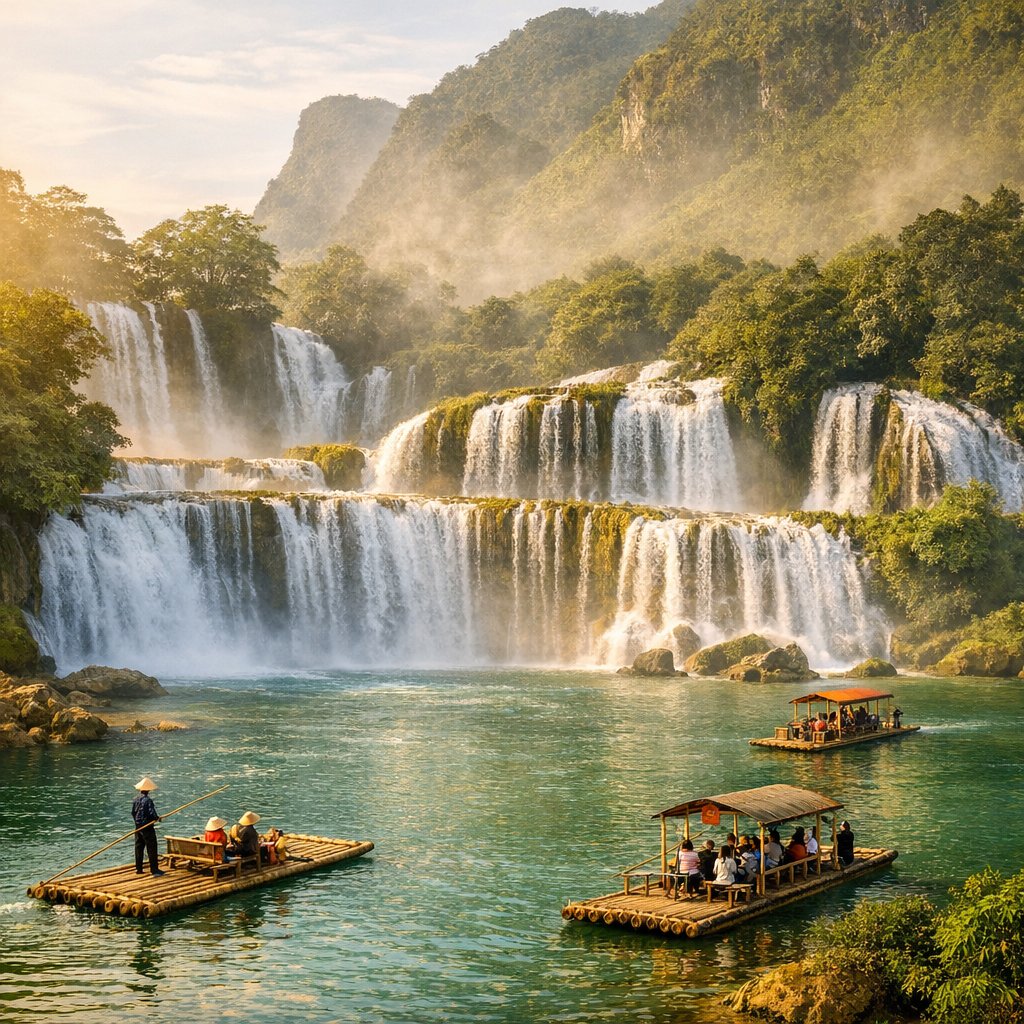
The Cao Bang travel guide you’ve been waiting for starts with a single image: a curtain of white water three hundred metres wide crashing over terraced limestone into a jade-green pool, bamboo rafts drifting beneath the spray, and not another tourist in sight. Welcome to Cao Bang province — Vietnam’s wildest, least-visited northern frontier, where the limestone karst scenery rivals Ha Long Bay, the caves swallow cathedrals whole, and the road itself is the adventure.
Most travellers who make it this far come for northern Vietnam’s motorbike routes and never think to push another four hours north-east to Cao Bang. That’s their loss — and your gain. Here is everything you need to plan your trip.
Why Visit Cao Bang? Vietnam’s Most Spectacular North
Cao Bang sits at the very top of Vietnam, sharing a long border with China’s Guangxi province. It is one of the country’s poorest and most sparsely populated provinces — which is exactly why it looks the way it does: ancient, untouched, and staggeringly beautiful.
The province is built on a foundation of karst limestone that has been folding and dissolving for 300 million years. Rivers have carved their way through it, leaving behind sheer cliffs, hidden valleys, cave systems of unimaginable scale, and the jewel in the crown — the Ban Gioc waterfall system on the Vietnamese-Chinese border. The Tay, Nung, Hmong and Dao ethnic minority communities who live here have been farming these steep valleys for centuries, their wooden stilt houses and patchwork rice terraces stitched into the landscape as naturally as the limestone itself.
Cao Bang rarely appears in mainstream travel itineraries. Infrastructure is improving — the road from Hanoi is now largely sealed — but services remain limited compared to tourist hotspots. This is a destination for travellers who want to feel like explorers again, who are happy to sleep in a simple guesthouse and eat at a family-run roadside stall. If that sounds like you, Cao Bang will reward you more generously than almost anywhere else in Vietnam.
Ban Gioc Waterfall: Vietnam’s Thundering Natural Wonder

Ban Gioc — known in Chinese as Detian — is the largest waterfall in Asia located on an international border, and by most reckonings the fourth-largest waterfall by volume in the entire world. Standing on the Vietnamese bank and watching this wall of water collapse in slow motion over three tiers of travertine limestone, you understand immediately why superlatives are unavoidable.
The falls are at their most dramatic between July and September when the Quay Son River is running high after the summer rains, turning the water from emerald to a churning chocolate-brown and doubling the roar that hits you from 500 metres away. In the dry season (November to April) the water is lower but far clearer — a luminous jade that makes for better photographs and more pleasant bamboo raft rides.
Those bamboo rafts are non-negotiable. For a few dollars, a local ferryman will pole you right to the base of the falls, the spray soaking everything, the noise shutting out all thought. You can drift right up to — and technically across — the border mid-river, where Vietnamese and Chinese tourists mingle in one of the world’s more unusual shared spaces. Stay as long as you want; there is no rush here.
The area around Ban Gioc rewards slow exploration. The Quay Son River upstream is dotted with karst islands and fishing villages. At dawn, before any other visitors arrive, the mist sits in the valley and the falls glow in the first light — it is one of the most beautiful scenes in Vietnam. Stay overnight in nearby Ban Gioc village rather than returning to Cao Bang town, and you’ll have the falls almost entirely to yourself in the golden hours.
Nguom Ngao Cave: Into the Heart of the Mountain

Just two kilometres from Ban Gioc, the entrance to Nguom Ngao (Tiger Cave) opens in the side of a limestone cliff with the understated drama of a stage curtain rising. Inside, the cave stretches for nearly three kilometres and contains some of the most spectacular speleothem formations in Vietnam — towering stalactites, translucent flowstones, columns that took a million years to grow and look like something from a fever dream of cathedrals and coral reefs.
Nguom Ngao is significantly less visited than the famous caves of Phong Nha, which means the experience is more intimate and the atmosphere more genuinely mysterious. Guides carry torches that pick out details the permanent lighting misses: a flowstone curtain thin enough to backlight with a phone, a cluster of cave pearls the size of golf balls, a passage where the stalactites mesh so densely that they look like frozen rain caught mid-fall.
The cave is open daily and a local guide is compulsory (and worth every dong for the stories they tell about the Tay people who sheltered here during the wars). Allow at least 90 minutes to walk the accessible section properly. Wear shoes with grip — the paths are paved but the humidity makes every surface slick — and bring a light jacket, since the temperature drops sharply the moment you step inside.
Together, Ban Gioc and Nguom Ngao form a natural pairing for a full day’s excursion. Start at the cave in the cool of the morning (it opens at 7am), reach the falls before the tour groups from Cao Bang town arrive around 10am, take a raft ride, lunch at one of the simple restaurants that line the riverside, and return in the golden hour when the light sets the water on fire.
Cao Bang Travel Guide: Getting There and Around

Getting to Cao Bang is part of the experience. The most popular route from Hanoi (270km) follows National Highway 3 north through Thai Nguyen and Bac Kan, a journey of around five to six hours by motorbike and four to five hours by private car or sleeper bus. The road is largely good, with a few stretches of twisting mountain pass that reward careful driving with views of cascading rice terraces and blue-haze valleys.
Bus services run daily from Hanoi’s My Dinh station — the sleeper bus overnight is the most comfortable option, depositing you in Cao Bang town by dawn and saving a night’s accommodation. From Cao Bang town, Ban Gioc and Nguom Ngao are 86km to the north-east, roughly two hours on a motorbike or 2.5 hours by car along Route 3 and then 217.
A motorbike is the ideal way to explore Cao Bang province. The roads are well-surfaced on the main routes, the traffic is light by Vietnamese standards, and the freedom to stop wherever the scenery demands is invaluable. Rentals are available in Cao Bang town from around 150,000–200,000 VND per day for a semi-automatic; check brakes and tyres carefully on mountain bikes. If you are not a confident rider, hire a local motorbike taxi driver (xe om) for the day — they know every shortcut and viewpoint on the route.
For travellers connecting Cao Bang with Ha Giang province, a scenic back-road loop via Tra Linh and the northern border counties is possible (allow an extra day), creating one of the most spectacular road-trip circuits in all of Vietnam — comparable to the Ha Giang Loop but with far fewer riders on the road.
Where to Stay in Cao Bang
Cao Bang town has a growing range of accommodation, from comfortable mid-range hotels to simple family guesthouses. Standards have improved significantly in recent years, though you will not find the international chain hotels that dot Hanoi or Ho Chi Minh City.
In Cao Bang town itself, the best-value options cluster near the main market: expect clean rooms, strong wi-fi and helpful staff who can arrange motorbike rentals and guided day trips. Budget travellers will find guesthouses for 200,000–350,000 VND; mid-range rooms with air-conditioning and private bathrooms run 400,000–700,000 VND.
For the most immersive experience, stay overnight near Ban Gioc village rather than commuting from the town. A handful of homestays operated by local Tay families offer simple but charming accommodation in traditional stilt houses — dinner is served at the family table, usually featuring fresh river fish, home-grown vegetables and sticky rice steamed in bamboo tubes. Book ahead via local tour operators in Cao Bang town, as these homestays are in high demand during peak season.
There are no five-star resorts in Cao Bang, and that is precisely as it should be. The accommodation here exists to support the landscape, not to compete with it. Pair the right guesthouse with the right hour at the falls and you’ll find the combination more luxurious than any spa hotel.
Best Time to Visit Cao Bang, Vietnam
Cao Bang has two distinct seasons, each with compelling reasons to visit. Understanding them helps you match your trip to your priorities — and connects naturally with the broader question of the best time to visit Vietnam as a whole.
Wet season (May to October) is when Ban Gioc is at its most thunderous. The Quay Son River swells, the falls roar at full volume, and the surrounding terraces glow an impossible green. The downside: roads can wash out after heavy storms, especially on the minor routes, and mist sometimes obscures the mountain views for days at a time. Travel with flexibility and a contingency day built in.
Dry season (November to April) offers clearer skies, navigable roads and photogenic water clarity at the falls. December through February brings genuine cold — Cao Bang is mountainous, and temperatures can drop to 5°C at night — so pack warm layers you won’t need elsewhere in Vietnam. March and April are arguably the best compromise: the air is warming, the first rains haven’t arrived, and the waterfalls are still running well from the spring melt.
Avoid major Chinese public holidays (Golden Week in early October and Chinese New Year in January/February) if you want Ban Gioc to yourself — the falls straddle the border, and Chinese tourists cross from Detian in large numbers during these periods.
Day Trips and Hidden Gems Around Cao Bang
Cao Bang province contains far more than the waterfall and cave that draw most visitors. For travellers with time and curiosity, the region rewards deeper exploration.
The Pac Bo Revolutionary Site, just 55km north of Cao Bang town near the Chinese border, is where Ho Chi Minh lived in a cave while planning the resistance against the French in the early 1940s. The site is now a park with a small museum; the cave, a mountain stream (which Ho Chi Minh named Lenin Stream), and surrounding forest are preserved much as he left them. The site carries a quiet, powerful atmosphere that resonates whether or not you have a particular interest in Vietnamese history.
The Thang Hen Lake System consists of 36 interconnected lakes scattered across a karst plateau north of Cao Bang town, linked by underground streams and surrounded by forest. Local fishermen paddle flat-bottomed wooden boats between the lakes; the area is virtually unknown to foreign visitors. A half-day hired motorbike trip from Cao Bang town is enough to reach the main cluster.
The town of Trung Khanh, the district capital nearest Ban Gioc, has a weekly market on Sunday mornings that draws Tay, Nung, and Hmong traders from the surrounding villages — a vivid, photogenic affair of fresh produce, live animals, and embroidered traditional clothing that is entirely unlike the tourist-oriented markets you’ll find in Sapa or Ha Giang. Get there early; by 10am it is winding down.
If you’re planning a longer northern Vietnam journey, consider combining Cao Bang with Sapa or linking it into the full circuit that takes in Ha Giang before looping back to Hanoi. A two-week Vietnam itinerary that includes Cao Bang is challenging to fit in without rushing, but travellers who make it work consistently rate it as the highlight of their trip.
How do I get from Hanoi to Cao Bang?
Overnight sleeper buses depart nightly from Hanoi’s My Dinh station, taking around 6–7 hours and costing roughly 150,000–250,000 VND. Private car or self-drive motorbike via National Highway 3 takes 5–6 hours. There is no train or flight service to Cao Bang.
Can I visit Ban Gioc Waterfall as a day trip from Hanoi?
Technically possible but not recommended — the round trip is over 550km and you’d have only a few hours at the falls. Plan at least two to three nights in the Cao Bang region to do justice to the waterfall, Nguom Ngao Cave, and the surrounding area.
Is Ban Gioc Waterfall on the Vietnamese or Chinese side?
The falls straddle the border. The larger cascade is on the Vietnamese side; a smaller section is in China’s Guangxi province (known there as Detian Falls). Vietnamese visitors access from the Cao Bang side; Chinese visitors cross from Daxin County. The mid-river border is informally open during bamboo raft rides.
Do I need a special permit to visit Cao Bang near the Chinese border?
No special permit is required for foreign tourists to visit Ban Gioc Waterfall or Nguom Ngao Cave. The area is fully open to tourism. You will need to register your passport at accommodation in the border districts, which guesthouses handle automatically.
What is the entry fee for Ban Gioc Waterfall and Nguom Ngao Cave?
As of 2026, Ban Gioc charges a small entrance fee of around 45,000 VND per person; bamboo raft rides cost roughly 60,000–80,000 VND per person. Nguom Ngao Cave admission is approximately 40,000 VND; a guide (compulsory) costs an additional 50,000–100,000 VND. Prices are subject to change — confirm locally.
Plan Your Cao Bang Trip
Cao Bang is the Vietnam that most travellers sense exists but never quite find — raw, unhurried, and so visually extraordinary that it borders on the surreal. The falls will move you. The cave will humble you. The roads in between will make every kilometre feel earned. And when you arrive at a family homestay that evening, smelling of spray and mountain air with a pocketful of photographs that don’t quite do justice to what you saw, you’ll understand why the people who make it here almost always say the same thing: I wish I’d come sooner.
For practical logistics, see our guide to getting around Vietnam and our complete 2-week Vietnam itinerary for ideas on how to fit the north into a longer journey.
Leave a Reply