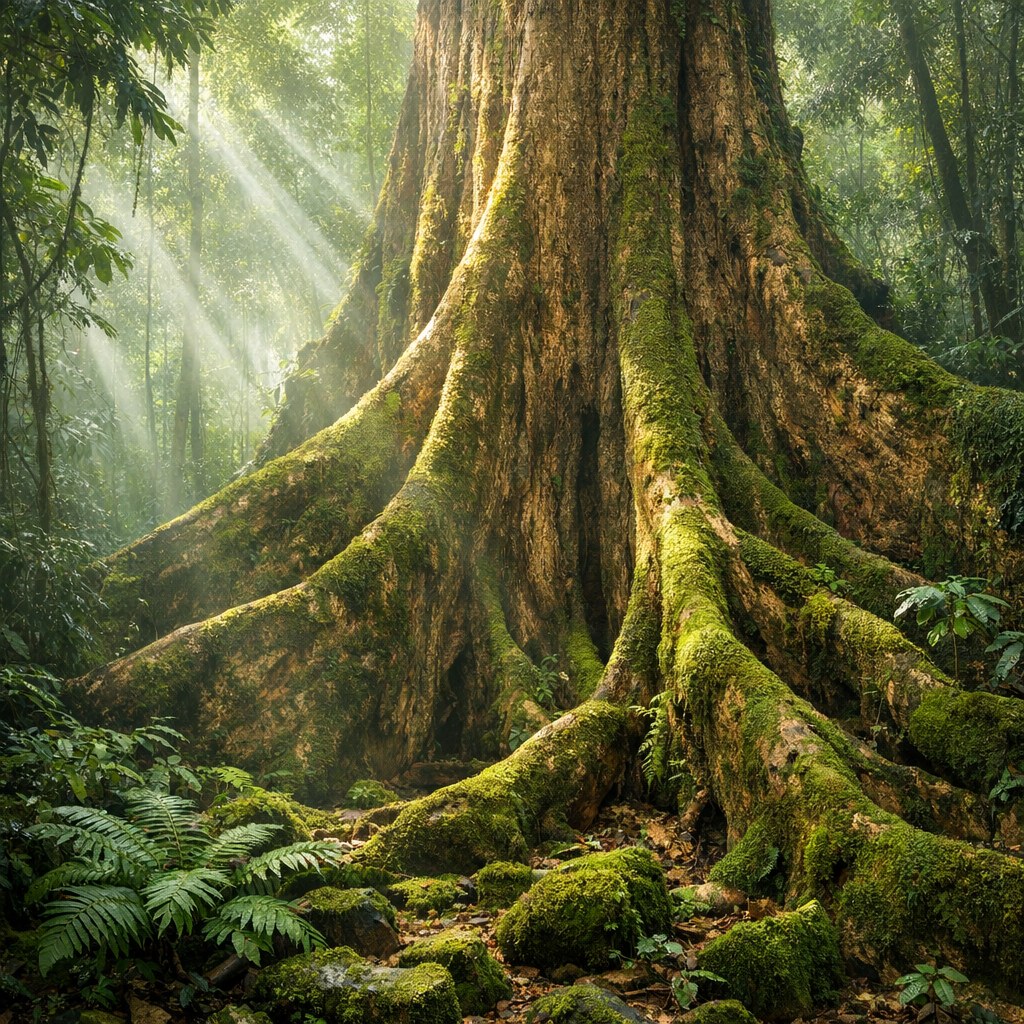
Cuc Phuong National Park is unlike anywhere else in Vietnam. Established in 1962 as the country’s first national park, this vast ancient forest in Ninh Binh Province has been growing, largely undisturbed, for tens of millions of years. Walk beneath the canopy and the scale of time becomes almost tangible: trees 1,000 years old with buttress roots taller than a person, limestone caves sealed with millennia of stalactites, and the calls of birds and insects woven together into a soundscape that has played here long before humans arrived. For travellers who have seen Vietnam’s beaches and street food and urban energy, Cuc Phuong offers something altogether different — a window into the country’s wild, ancient, deeply alive interior.
What Is Cuc Phuong National Park Vietnam?
Cuc Phuong National Park covers approximately 22,200 hectares of tropical limestone forest in the southern reach of Ninh Binh Province, roughly 45km from Ninh Binh city and about 130km south of Hanoi. The park was gazetted by President Ho Chi Minh himself in 1962, making it Vietnam’s oldest national park and one of the most biodiverse areas in Southeast Asia.
The park’s terrain is defined by dramatic karst limestone formations — the same kind that shape Ha Long Bay and Ninh Binh’s famous landscape — draped in dense primary rainforest. The elevation ranges from lowland valley floor to peaks of around 650 metres, creating multiple distinct habitats. More than 2,000 plant species have been recorded here, alongside 135 mammal species, 307 bird species, and over 120 reptile and amphibian species. Much of this biodiversity is threatened globally; Cuc Phuong is one of the last places on earth where some of these species survive.
What makes Cuc Phuong especially compelling for visitors is the combination of raw natural beauty and genuine conservation work. Three internationally recognised wildlife rescue centres operate within the park — for primates, turtles and pangolins — giving visitors a rare close encounter with animals they would never see in the wild, while supporting the efforts to return those animals to their natural habitat. Cuc Phuong is not a zoo; it is a place where conservation is happening in real time.
Cuc Phuong National Park Wildlife: Primates, Pangolins and Turtles

The Endangered Primate Rescue Center (EPRC) at Cuc Phuong is one of the most important primate conservation facilities in Asia. Founded in 1993 by Tilo Nadler, a German primatologist, the centre houses over 150 individuals across 15 species — many of them critically endangered, some of them found nowhere else on earth. The golden-headed langur, the Delacour’s langur, the red-shanked douc langur and several species of gibbon all live within the centre’s semi-wild forested enclosures, recovering from injury, confiscation from the illegal wildlife trade, or being bred for eventual release.
Walking through the EPRC on the guided tour is a moving experience. You hear the gibbons before you see them — a haunting, operatic call that carries through the forest like something between a song and a lament. Then you round a path and there they are: long-armed, graceful, utterly alien in their beauty, watching you with the same curious intelligence you bring to watching them. The information boards at each enclosure explain the species, the threats it faces, and the centre’s efforts to protect it. The EPRC charges a small entrance fee (around 40,000 VND) and tours run at set times in the morning.
The Turtle Conservation Center (TCC) focuses on Vietnam’s 25 native turtle species, 17 of which are under threat. Many of the turtles were confiscated from illegal traders and restaurants; the centre rehabilitates them and releases them into protected habitats when possible. Walking along the outdoor turtle pools, you will see species that look like they have emerged from the Cretaceous — ancient, armoured, deeply unhurried — while information panels describe the ongoing battle against turtle poaching that makes this work necessary.
The Save Vietnam’s Wildlife programme at Cuc Phuong focuses on pangolins, the most trafficked mammal in the world. Pangolins are nocturnal and extremely difficult to observe in the wild; here, in carefully designed enclosures, you may see one curled into its characteristic ball, or foraging with its extraordinary tongue. Learning about the pangolin crisis — and seeing the animals in person — makes the abstract statistics of the wildlife trade suddenly very concrete.
Trekking in Cuc Phuong National Park Vietnam

Cuc Phuong’s trail network ranges from easy 2-hour walks to demanding multi-day treks through the park’s interior. The trails wind through primary forest that has never been cleared — walking them feels markedly different from secondary forest: the trees are enormously tall, the understorey is dense and dark, and the silence between bird calls has a particular quality of depth. This is forest that has had millions of years to achieve its complexity, and it shows.
The most popular short walk leads to the 1,000-Year-Old Tree — a specimen of Terminalia myriocarpa with a trunk circumference of around 5 metres and a height of 45 metres. The trail takes about 45 minutes each way from the park’s visitor centre, passing through increasingly impressive forest. Standing at the base of the tree, looking up into its crown, provokes the same instinctive awe that ancient stone monuments do. This is a living thing that was already centuries old when the first European explorers arrived in Asia.
For more serious trekkers, the trail to the Muong village of Con Moong — an ancient cave settlement inhabited for thousands of years — passes through some of the park’s most intact forest. The 8km route requires a guide (arranged at the visitor centre) and takes around 4–5 hours one way. Overnight camping is possible at Con Moong for those who want to experience the forest at night, when the nocturnal species are active and the soundscape changes completely.
Birdwatchers will find Cuc Phuong exceptionally rewarding. The park is home to the endemic Vietnamese Laughingthrush, the rare Bar-bellied Pitta, several globally threatened species of hornbill, and many migratory birds that pass through in spring and autumn. Dawn walks, arranged with the park rangers, offer the best chances of sightings — the first hour after sunrise is when Cuc Phuong is most alive with movement and sound.
The 1,000-Year-Old Tree and the Ancient Muong People
Cuc Phuong is not only a story of ecology — it is also a story of human habitation going back thousands of years. The Muong ethnic minority have lived within and around the forest for as long as memory reaches. Their villages dot the boundaries of the park and, in a few cases, exist within it. The Con Moong Cave, near the village of the same name, was occupied by prehistoric humans more than 7,500 years ago — stone tools and human remains found here during excavations in the 1960s pushed back the known history of human settlement in the region significantly.
The park’s visitor centre has a small but interesting museum with exhibits on the Muong culture, traditional forest use and the archaeology of Con Moong. The Muong people had a sophisticated relationship with the forest — using it for medicine, materials and food while managing it in ways that allowed it to regenerate. That relationship is now under pressure from the same forces that threaten the wildlife: illegal logging, hunting and the expansion of agricultural land. The park’s creation in 1962 brought the Muong people and the conservation authorities into a complex negotiation about land use that continues today.
For travellers interested in Vietnam’s ethnic minorities and cultural complexity, a visit to the Muong village of Bong village — accessible from the park’s main road — offers a genuine encounter with this distinct culture: traditional stilt houses, hand-woven textiles and a way of life shaped by the forest that surrounds it. The Sapa region is Vietnam’s most famous destination for hill tribe culture, but Cuc Phuong offers a different and equally authentic perspective.
Getting to Cuc Phuong National Park and Where to Stay
Cuc Phuong is most easily reached from Ninh Binh city, which lies about 45km to the northeast. From Ninh Binh, motorbikes and taxis make the journey in about 1 hour; hired motorbike taxis from the city cost around 200,000–300,000 VND ($8–12 USD) each way. The road from Ninh Binh to the park passes through the flat agricultural lowlands of the Red River Delta before climbing into the limestone hills — a pleasant drive in its own right.
From Hanoi, the journey is around 130km (2.5–3 hours by car or bus). Direct tourist buses run from Hanoi’s Giap Bat bus station to Ninh Binh, from where onward transport to the park is available. Many visitors combine Cuc Phuong with Ninh Binh’s other attractions — Tam Coc, Tràng An, Bích Động cave and Hoa Lu ancient capital — in a two or three-day itinerary.
Accommodation within the park is basic but well-suited to the experience: the park authority operates a guesthouse and bungalow complex near the visitor centre, with rooms from around $20–40 per night. Staying inside the park is strongly recommended — it allows you to walk the trails at dawn and dusk when wildlife activity peaks, and to experience the forest at night when the sounds and atmosphere are extraordinary. Food is available at the park’s simple restaurant; bring snacks for the longer treks.
Entry to Cuc Phuong National Park costs 60,000 VND ($2.40 USD) per person. The EPRC and TCC each charge separate fees (around 40,000 VND each). Guided treks are priced at 200,000–400,000 VND depending on length. The park is open year-round, but the dry season from November to April is the most comfortable for trekking — the wet season (May to October) brings heavy rainfall that can make trails muddy. However, the forest is at its most lush and alive in the wet season, and birdwatching can be excellent.
For practical advice on how to structure a trip to northern Vietnam that includes Cuc Phuong, see our 2-week Vietnam itinerary. If you are travelling independently, our guide to getting around Vietnam covers all the transport options in detail.
Cuc Phuong National Park Vietnam: Frequently Asked Questions
How do I get to Cuc Phuong National Park from Hanoi?
Cuc Phuong National Park is about 130km south of Hanoi — roughly 2.5 to 3 hours by car. Take a bus from Hanoi’s Giap Bat station to Ninh Binh city (about 2 hours, 80,000–100,000 VND), then hire a taxi or motorbike taxi for the 45km to the park entrance (around 200,000–300,000 VND). Many day tours from Hanoi are also available, though staying overnight inside the park is highly recommended.
What animals can I see at Cuc Phuong National Park?
Cuc Phuong is home to 135 mammal species, 307 bird species and over 120 reptile and amphibian species. At the Endangered Primate Rescue Center you can see multiple langur and gibbon species, many critically endangered. The Turtle Conservation Center houses 25 native turtle species. Save Vietnam’s Wildlife rehabilitates pangolins. In the wild, with patience and luck, you may encounter sambar deer, civets, and extraordinary birdlife including hornbills and the endemic Vietnamese Laughingthrush.
Is Cuc Phuong National Park suitable for a day trip?
A day trip is possible but limiting. You can visit the rescue centres and the 1,000-Year-Old Tree on a long day from Ninh Binh or a very early start from Hanoi. However, staying at least one night inside the park is strongly recommended — dawn and dusk walks are when wildlife activity peaks, and the night sounds of the forest are remarkable. A minimum of two days allows you to explore the rescue centres properly and do at least one serious trek.
What is the best time to visit Cuc Phuong National Park Vietnam?
The dry season from November to April is generally the most comfortable for trekking, with cooler temperatures and less mud on the trails. The wet season (May to October) brings heavy rainfall but the forest is at its most lush and birdwatching can be excellent. Avoid Vietnamese national holidays when the park can become busy with domestic visitors.
How much does it cost to visit Cuc Phuong National Park?
Park entry costs 60,000 VND ($2.40 USD) per person. The Endangered Primate Rescue Center and Turtle Conservation Center each charge around 40,000 VND separately. Guided treks cost 200,000–400,000 VND depending on length and route. Accommodation in the park guesthouse or bungalows starts at around $20–40 per night. Overall, Cuc Phuong is one of the most affordable conservation experiences in Southeast Asia.
Leave a Reply