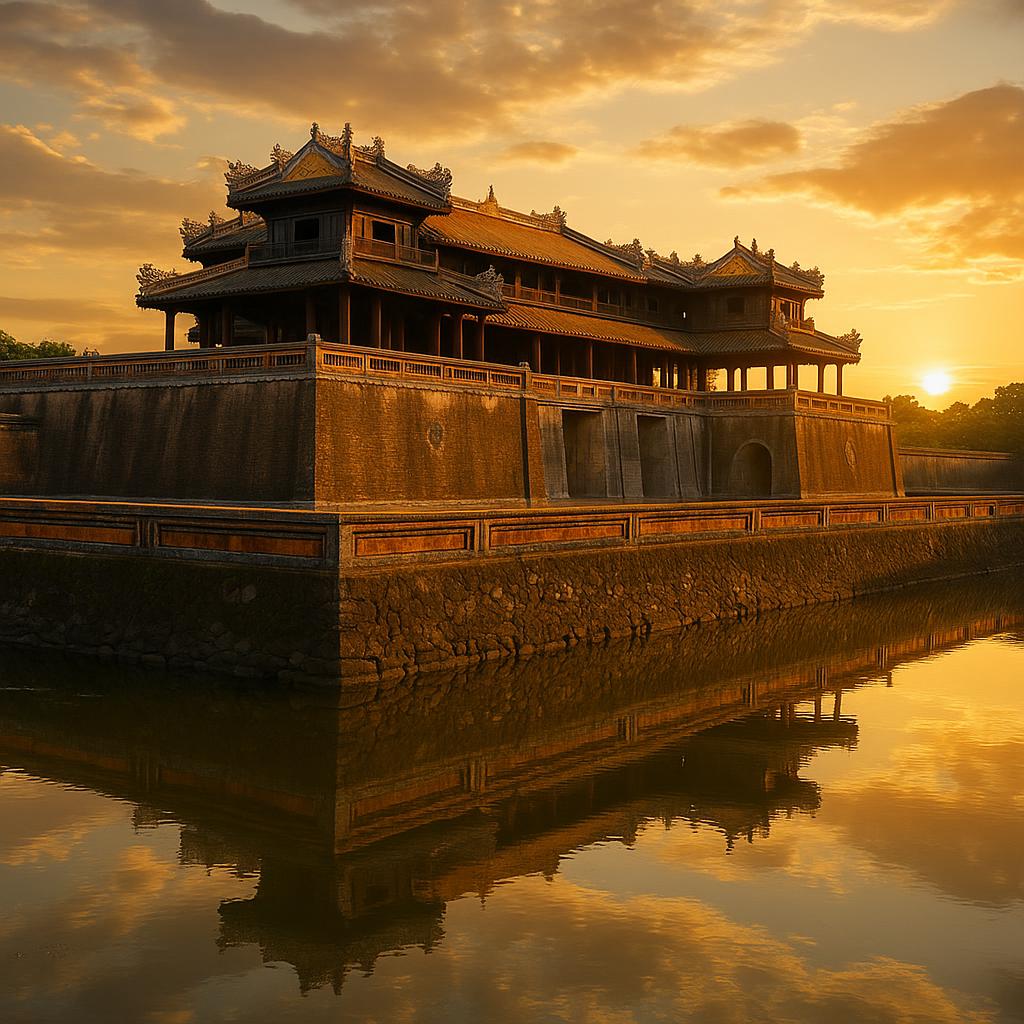
Hue Travel Guide: Exploring Vietnam’s Imperial City on the Perfume River
The Hue travel guide starts, as all roads in this city eventually do, at the river. The Perfume River — Sông Hương in Vietnamese — drifts through the heart of the former imperial capital in a slow, jade-green curve, its banks lined with willow trees, royal tombs and the crumbling ochre walls of one of Asia’s most extraordinary citadels. Hue was Vietnam’s last imperial capital, seat of the Nguyễn dynasty from 1802 to 1945, and its legacy is everywhere: in the scale of the ancient walled city, in the ornate royal tombs scattered through the pine-forested hills south of town, in the dishes of the royal court that shaped what many consider Vietnam’s most refined regional cuisine. This is a city that rewards slow travel, patient curiosity and an appetite for the layered past.

Hue Imperial City: Inside the Forbidden Purple City
The Hue Imperial Citadel — listed by UNESCO as a World Heritage Site — is the obvious first stop, and it is larger and more complex than most visitors expect. The outer wall encloses 520 hectares; within it, the Imperial Enclosure contains palaces, temples, pavilions, gardens and ceremonial gates arranged along a central axis facing the Perfume River. At the very centre lies the Purple Forbidden City, the private domain of the emperor and his family, mostly ruined by bombing during the 1968 Tet Offensive and the 1975 reunification fighting.
The main entrance is through the Ngọ Môn Gate (Meridian Gate), a towering five-arched portal surmounted by a pavilion from which emperors once reviewed troops and watched festivals. Walk through into the vast courtyard beyond and the scale of the original complex becomes apparent — even in partial ruin, the citadel conveys the ambition of a dynasty that sought to model itself on the Forbidden City of Beijing while adapting that template to Vietnamese aesthetics and geography.
Allow at least half a day for the citadel. The Thái Hoà Palace (Palace of Supreme Harmony) is the best-preserved structure — its lacquered columns, gilded altar and elaborate wooden screens have been restored to something close to their original splendour. The Hưng Miếu and Thế Miếu (Ancestral Temples) contain altars dedicated to the Nguyễn emperors and are still used for ceremonial purposes. In the northeastern corner, the Duyệt Thị Đường (Royal Theatre) hosts live performances of nhã nhạc — Vietnamese court music recognised by UNESCO as an Intangible Cultural Heritage of Humanity — most afternoons from 10am to 3pm.
Audio guides are available at the gate and are worth hiring; the citadel’s signage in English is sparse, and understanding what you’re seeing requires some context. For the broader picture of Vietnam’s imperial heritage, the article on the Imperial Citadel of Thang Long in Hanoi offers a useful comparison between the two dynasties’ approaches to royal architecture.
Hue Royal Tombs: A Day Among the Nguyễn Emperors

South of the city, strung along a 16-kilometre arc through pine forest and farmland, the royal tombs of the Nguyễn emperors are among the most atmospheric historical sites in Vietnam. Each emperor designed his own tomb during his lifetime — a complex of palace buildings, courtyards, lotus ponds, stele houses and a sealed burial mound — and the results reflect the personality of the man who commissioned them.
Minh Mạng’s Tomb is the most harmonious: a symmetrical composition of lakes, bridges, bonsai pines and carved stone mandarins arranged across a broad, quiet hillside. The emperor who built it was a Confucian scholar-ruler who also fathered 142 children; his tomb has the serene authority of a man who took the long view. Tự Đức’s Tomb is the most romantic — an intimate complex of pavilions and pavilioned lakes where the emperor (who was childless and reputedly spent long hours here composing poetry) retreated from court life. Bougainvillea spills over its walls; the reflection of the pavilions in the lotus pond is one of Hue’s most beautiful images.
Khải Định’s Tomb, built in the 1920s by the penultimate Nguyễn emperor, is the most extraordinary and the most debated. Built in a mashup of Baroque, Gothic and traditional Vietnamese styles with an interior entirely encrusted in glass and ceramic mosaic, it is maximalist, strange and completely unlike anything else in Vietnam. Opinions divide sharply between those who find it a magnificent eccentricity and those who see it as the architectural expression of a collaborationist emperor who spent the French colonial period collecting honours and titles. Either way, it is unmissable.
The most efficient way to visit is by bicycle or motorbike along the southern bank of the Perfume River. A well-signed cycle path connects several tombs; most guesthouses in Hue rent bikes for $3–5/day. Alternatively, hiring a dragon boat from the city pier to float upriver and visit the tombs by landing stage is a slower, more theatrical approach that locals and long-term Hue visitors recommend enthusiastically.
Hue Food: The Royal Cuisine of Central Vietnam
If Hanoi’s food is austere and Saigon’s is exuberant, Hue’s is ceremonial. The city’s cuisine evolved in the royal courts of the Nguyễn emperors, where hundreds of dishes were prepared for a single meal, each one small, intricate and visually precise. That tradition persists in the elaborate presentation of Hue cooking — dishes arrive garnished with carved vegetables and edible flowers, colours are deliberately vivid, flavours are complex and layered.
Bún bò Huế is the city’s signature noodle soup and one of Vietnam’s great bowls — a broth of lemongrass, shrimp paste and chilli with thick round noodles, sliced beef and pork, and a heat that builds slowly from the back of the throat. The version served in Hue bears little resemblance to the diluted adaptations found elsewhere in the country. Seek it out before 8am at the cluster of breakfast stalls around Nguyễn Bỉnh Khiêm Street.
Bánh khoái — crisp turmeric-yellow crêpes stuffed with shrimp, bean sprouts and sliced pork, eaten by wrapping in rice paper with mustard leaf and dipping in a peanut-sesame sauce — is a Hue speciality that appears on most tourist menus but is best eaten at a street-side fryer on Đinh Tiên Hoàng Street. Cơm hến, a deceptively light rice dish topped with tiny river clams, peanuts, sesame and a dozen condiments arranged around the bowl, is the local breakfast for anyone not having bún bò. It is one of the stranger and more addictive dishes in Vietnamese cooking.
For a more formal introduction to Hue cooking, several restaurants in the old quarter serve cơm hoàng gia — royal court cuisine — with multiple small dishes presented in lacquered boxes and eaten to live nhã nhạc music. The experience is theatrical rather than strictly authentic (the original court meals lasted hours and involved hundreds of courses) but gives a vivid sense of the attention Hue’s royal kitchens paid to beauty as well as flavour. For context on Vietnamese cooking traditions more broadly, the Vietnamese cooking classes guide covers hands-on learning options across the country.
Hue Pagodas and Temples: The City’s Spiritual Landscape

Hue is one of Vietnam’s most important Buddhist cities, and its pagodas deserve at least as much attention as the imperial tombs. The most famous is Thiên Mụ Pagoda (Pagoda of the Celestial Lady), a seven-tiered octagonal tower rising above the western bank of the Perfume River on a site that legend holds has been sacred since the 16th century. The best approach is by boat from the city pier at dawn, when the tower catches the first light against a sky still flushed from night.
Within the pagoda complex, a small museum displays the light blue Austin car that drove the monk Thích Quảng Đức from Hue to Saigon in 1963, where he burned himself alive in protest at the persecution of Buddhism by President Diệm’s government. The photograph of that act, taken by AP photographer Malcolm Browne, became one of the most iconic images of the twentieth century. The car’s presence here, in the courtyard of this quiet pagoda beside its river, gives the place an unexpected gravity.
Từ Đàm Pagoda, built in 1695 and set in a garden of ancient jackfruit and fig trees south of the city, is Hue’s most revered active monastery — monks and nuns still live and study here, and the atmosphere is one of genuine practice rather than tourist exhibition. Dress modestly (shoulders and knees covered), speak quietly, and the experience of sitting in the courtyard as the monks chant the evening ceremony is quietly unforgettable.
Getting to Hue and Getting Around
Hue sits roughly at the midpoint of the country on the coast of central Vietnam, equidistant from Hanoi (700km north) and Ho Chi Minh City (1,000km south), making it a natural staging post on any north-to-south itinerary. The two-week Vietnam itinerary positions Hue between Da Nang and Hoi An — a logical sequence that uses the Hải Vân Pass as a geographical and atmospheric dividing line between central and southern Vietnam.
Phú Bài International Airport (25 minutes south of the city by taxi) receives flights from Hanoi, Ho Chi Minh City and Da Nang. The Reunification Express train stops at Hue station, making it easy to arrive by rail from either direction — the overnight sleeper from Hanoi is particularly pleasant, arriving in the cool morning air of the Perfume River basin. Buses connect Hue to Hoi An in three to four hours via the coastal highway over the Hải Vân Pass, one of the most scenic road sections in Vietnam.
Within Hue, bicycles are the ideal transport: the city is compact and mostly flat, the roads quieter than Hanoi or Ho Chi Minh City, and many of the best sites are connected by riverside paths. Motorbike taxis and Grab are available for longer hops to the tomb cluster south of the city. The Vietnam transport guide covers the practicalities of intercity connections in detail.
Hue Travel FAQs
How many days do I need in Hue?
Two full days is the minimum for Hue: one day for the Imperial Citadel and city pagodas, one day for the royal tombs along the Perfume River. Three days allows a slower pace — time for a morning dragon boat trip, an evening of court music, and unhurried exploration of the markets and backstreets of the new town. Four or five days suits anyone who wants to venture into the surrounding countryside or day-trip to the Hải Vân Pass or Lăng Cô Beach.
What is the best time to visit Hue?
February to April is the best time: dry, mild temperatures (22–27°C), clear skies for outdoor sightseeing. Hue has a notably different climate from the rest of Vietnam — the city lies in a rain shadow that makes it significantly wetter than Da Nang or Hoi An in autumn and winter. The Hue Festival, held every two years in April (even years), brings royal court performances, lantern processions and cultural events that fill the Imperial Citadel with life.
Is the Hue Imperial Citadel worth visiting?
Absolutely. The Hue Imperial Citadel is among the most significant historical sites in Southeast Asia and is listed as a UNESCO World Heritage Site. While large portions remain ruined, the scale of the complex, the beauty of the surviving palaces and temples, and the poignant gaps left by wartime destruction make it a deeply affecting experience. Allow at least three to four hours; a full day with the royal tombs is ideal.
What food is Hue famous for?
Hue is famous for bún bò Huế (spicy lemongrass beef noodle soup), bánh khoái (crisp turmeric crêpes with shrimp), cơm hến (clam rice with peanuts and herbs), bánh bèo (steamed rice flour cakes with shrimp), and a tradition of royal court cuisine featuring dozens of small, exquisitely presented dishes. The food here is spicier than elsewhere in Vietnam and uses locally distinctive ingredients like river clams and shrimp paste from the coastal lagoons.
How far is Hue from Da Nang and Hoi An?
Hue is approximately 100km north of Da Nang and 120km north of Hoi An. The drive over the Hải Vân Pass between Hue and Da Nang takes about 2.5 hours by car and is one of the most scenic road journeys in Vietnam — worth taking slowly and stopping at the pass summit for views of the coastline on both sides. Buses and private transfers connect all three cities regularly; the stretch between Hue, Da Nang and Hoi An is among the most popular in the country.
Leave a Reply