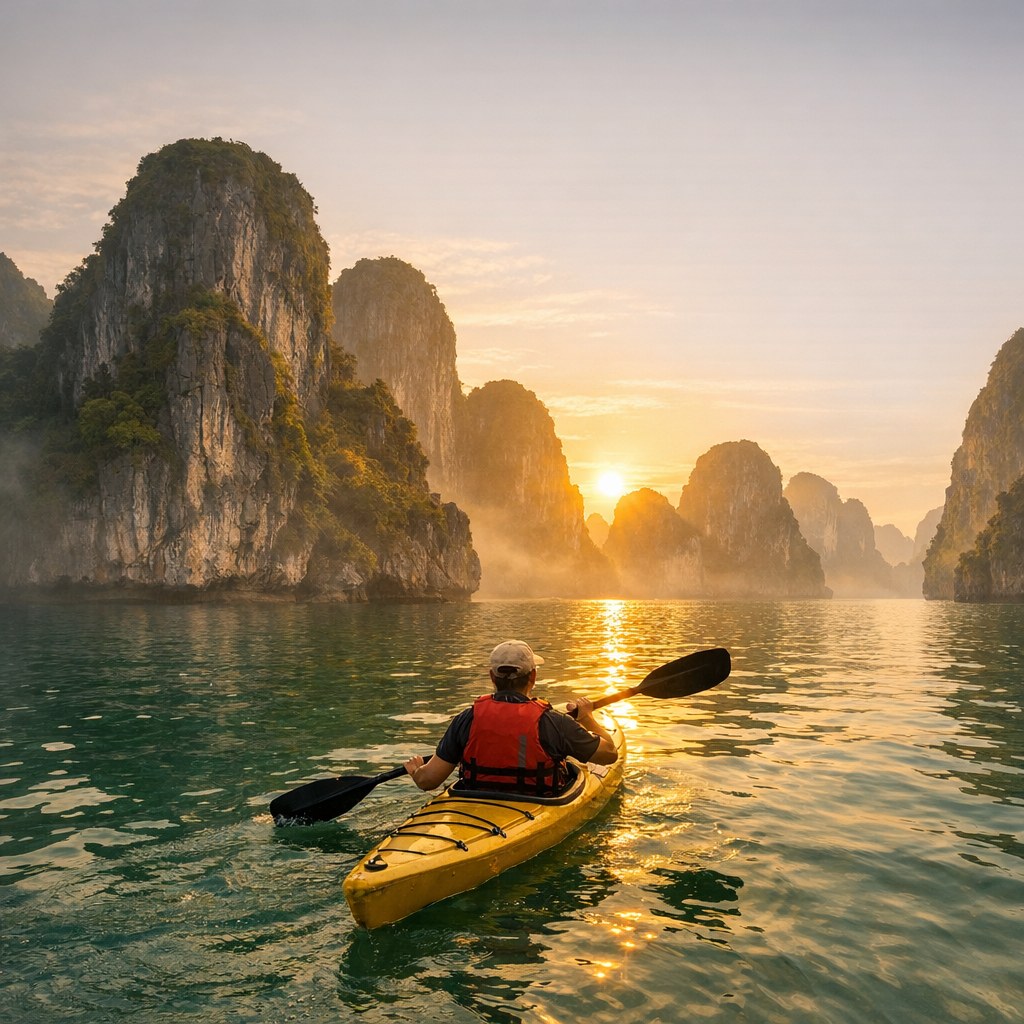

Kayaking in Vietnam is one of the most exhilarating ways to experience a country sculpted by water. From the otherworldly limestone karsts of Ha Long Bay to the labyrinthine canals of the Mekong Delta, Vietnam’s waterways are as diverse as they are breathtaking. Grab a paddle and let the current lead you somewhere unforgettable.
Vietnam has over 3,200 kilometres of coastline, hundreds of navigable rivers, and karst landscapes shaped by millions of years of erosion. For kayakers — whether beginner or seasoned — this translates into an almost infinite menu of routes, from half-day lagoon paddles to multi-day river journeys through remote jungle. This guide covers the best kayaking destinations in Vietnam, what to expect, and everything you need to plan your trip.
Kayaking Ha Long Bay: Vietnam’s Most Iconic Waterway
If there is one image that defines kayaking in Vietnam, it is a paddle dipping silently into the jade-green waters of Ha Long Bay, limestone pillars rising around you like the ruins of a drowned city. Ha Long Bay is a UNESCO World Heritage Site and one of the natural wonders of the world — and a kayak is simply the best way to experience it.
The bay spans nearly 1,500 square kilometres and contains more than 1,600 islands and islets. Most overnight cruises include a kayaking excursion as standard, and these are often the highlight of the trip. You will paddle through sea caves with cathedral-high ceilings, emerge into hidden lagoons the tour boats cannot reach, and drift alongside floating fishing villages where families have lived on the water for generations.
The most coveted kayak route in Ha Long Bay leads into Hang Luon — a flooded cave that opens into a perfectly enclosed lagoon surrounded on all sides by sheer karst rock. The water inside is so still it functions as a mirror, doubling every limestone peak into its own reflection. Early morning is the best time to paddle here, before the tour boats arrive and the mist begins to lift. By 10am the magic is harder to find.
For adventurous paddlers, Cat Ba Island at the southern end of the bay offers more independent kayaking options. Several local operators run self-guided routes around the island’s coastline, and those combining kayaking with rock climbing — another world-class activity in the region — will want at least two or three days on Cat Ba. The rock climbing guide to Cat Ba Island and Ha Long Bay covers the best spots you can pair with a kayaking day.

Ninh Binh: Kayaking Vietnam’s Inland Sea
They call Ninh Binh “Ha Long Bay on land” — and while that comparison does it some justice, it also undersells what makes this place singular. The limestone karsts here rise from flat rice paddies and slow-moving rivers rather than open sea, creating a landscape that feels like a watercolour painting brought to life. And it is all kayakable.
The Trang An Grottoes, also a UNESCO World Heritage Site, are the centrepiece of kayaking in Ninh Binh. Traditional rowboats are the norm here — you will be rowed through low-ceilinged caves by a local guide, ducking your head as stalactites pass inches overhead and emerging into flooded valleys where herons stand motionless in the shallows. Several operators now offer kayaking as an alternative, letting you set your own pace through the nine caves and four valleys of the Trang An route.
Van Long Nature Reserve, about 20 kilometres north of Ninh Binh town, is one of the largest natural wetland reserves in northern Vietnam. Kayaking here at dawn — with the karsts reflected perfectly in still water and the sound of gibbons calling from the cliffs — is an experience that requires no embellishment. The reserve is home to one of the world’s rarest primates, Delacour’s langur, and sightings from a kayak are not uncommon.
Ninh Binh makes an easy overnight stop from Hanoi and fits naturally into a northern Vietnam circuit. If you are planning your route, the two-week Vietnam itinerary from north to south includes Ninh Binh as a natural stopover between Hanoi and the central coast.
Hoi An and the Thu Bon River: Paddling Through History
Hoi An’s ancient trading port has seen millennia of arrivals by water — Chinese merchants, Japanese traders, French colonists — and approaching the old town by kayak on the Thu Bon River feels like re-enacting that history in slow motion. The river is wide, gentle, and dotted with traditional wooden fishing boats. Paddle in the late afternoon and the golden light turns the yellow-washed merchant houses of the old town into something from a dream.
Several kayaking tours depart from Hoi An and paddle upstream through the rural hinterland, past rice fields, water buffalo, and villages where daily life continues as it has for centuries. The most popular route leads to the farming village of Tra Que, famous for its organic vegetable gardens, where you can pull up your kayak, wander the herb plots, and join a cooking demonstration before paddling back to town.
The best season to kayak around Hoi An is November to April, when the central coast is dry and the water is calm. Avoid the October to November typhoon season when the Thu Bon frequently floods. The month-by-month Vietnam weather guide explains regional conditions in detail so you can time your trip perfectly. Hoi An itself deserves more than a day — the Hoi An travel guide covers its ancient town highlights, river routes, and the best ways to spend your time.

Kayaking the Mekong Delta: Southern Vietnam’s Living Waterways
The Mekong Delta is not one river but nine — the “Nine Dragons,” as the Vietnamese call the braids of the Mekong as it fans out across the flat southern plain before dissolving into the South China Sea. This is a landscape defined by water: floating markets, stilt houses, river islands carpeted in dragon fruit and durian orchards, and canals so narrow that overhanging banana leaves brush both gunwales of your kayak simultaneously.
The delta covers some 40,000 square kilometres of flat, intensely cultivated land criss-crossed by approximately 28,000 kilometres of waterways. For a kayaker, this is paradise. Unlike Ha Long Bay, where the drama is vertical, the Mekong Delta’s appeal is entirely horizontal — it is about immersion in daily river life rather than geological spectacle.
Can Tho is the delta’s largest city and the best base for kayaking excursions. Day trips lead into the side canals, where you will paddle past floating gardens, watch riverside kitchens produce banh trang (rice paper), and drift through the famous Cai Rang floating market in the early morning as vendors call prices from boat to boat. Arriving by kayak rather than motorboat gives you access to the narrower channels between the market boats — channels that larger vessels simply cannot enter.
For a more immersive experience, multi-day kayaking tours trace the smaller rivers between Ben Tre, Vinh Long, and Can Tho, overnighting in local homestays where dinner is whatever came out of the river that afternoon. This is slow travel at its most rewarding — and at its most affordable. The Vietnam budget travel guide has useful benchmarks for tour costs across different regions.
Phong Nha: Kayaking Into the World’s Caves
Phong Nha-Ke Bang National Park in central Vietnam is best known as the home of Son Doong, the world’s largest cave. But the park’s waterways offer some of the most spectacular — and most unusual — kayaking in Southeast Asia. Here, you paddle not across a bay or along a river, but into mountains. The caves of Phong Nha are entered by boat, and kayaking is the quietest, most atmospheric way to make that journey.
The Chay River route, leading toward Hang Toi (Dark Cave) and Hang En, is one of Vietnam’s most adventurous kayaking experiences. The river runs turquoise-blue through dense jungle, and the paddle is typically combined with zip-lining, mud baths, and trekking into the cave itself. You will want a full day for this. The Phong Nha travel guide covers all the cave tours and how to choose between them.
Practical Tips for Kayaking in Vietnam
Best time to go: For Ha Long Bay and the north, October to April is ideal with calm seas and good visibility. For the central coast including Hoi An and Phong Nha, February to August offers the best conditions. The Mekong Delta is kayakable year-round, though June to November brings higher water levels that open up more canal routes. The Vietnam weather guide breaks it down region by region.
What to bring: Lightweight, quick-dry clothing; a sun hat with chin strap; reef-safe sunscreen; a dry bag for your phone and camera; water shoes or sandals with a back strap. Most operators provide life jackets and paddles.
Booking a tour: For Ha Long Bay, kayaking is almost always included in overnight cruise packages starting from about 0 to 20 per person for a two-day one-night trip. Standalone half-day kayaking tours in Hoi An or Ninh Binh run 5 to 0 per person. Multi-day expeditions in the Mekong Delta or Phong Nha typically cost 0 to 00. For getting between kayaking destinations, the guide to getting around Vietnam covers buses, trains, and flights.
Safety: Always wear a life jacket, never paddle alone in open water, and check weather forecasts before going out. Squalls can develop quickly in Ha Long Bay. Respect cave systems and follow guide instructions inside caverns.
Is kayaking in Ha Long Bay suitable for beginners?
Yes. Most kayaking in Ha Long Bay is done on stable sit-on-top kayaks in sheltered waters between the karst islands. The paddling is gentle and guides accompany all groups. No prior experience is needed, and life jackets are always provided. Children as young as five regularly join family kayaking tours in the bay.
How much does kayaking in Vietnam cost?
Costs vary by location and format. In Ha Long Bay, kayaking is usually included in overnight cruise packages starting from about 0 to 20 per person. Standalone half-day tours in Hoi An or Ninh Binh cost 5 to 0 per person. Multi-day kayaking expeditions in the Mekong Delta or Phong Nha area typically run 0 to 00 per person depending on duration and inclusions.
What is the best place for kayaking in Vietnam?
Ha Long Bay is the most iconic kayaking destination, offering access to hidden lagoons, sea caves, and floating villages. For river kayaking and cultural immersion, the Mekong Delta is unmatched. Ninh Binh offers spectacular karst scenery without the crowds, and Phong Nha provides unique underground cave kayaking. The best location depends on whether you prefer coastal, river, or cave paddling.
When is the best time to kayak in Vietnam?
For Ha Long Bay and northern Vietnam, October to April offers calm seas and cooler weather. For central Vietnam including Hoi An and Phong Nha, February to August is the dry season. The Mekong Delta is accessible year-round. Avoid typhoon season (September to November) on the central coast.
Can I kayak independently in Vietnam or do I need a guide?
In most locations, guided tours are strongly recommended as they provide local knowledge, safety cover, and access to routes difficult to find independently. In Ha Long Bay, independent kayaking without a licensed vessel is not permitted in most areas. In Cat Ba Island and parts of the Mekong Delta, independent kayak rentals are available for experienced paddlers. For cave kayaking in Phong Nha, guides are mandatory.
Start Paddling: Vietnam Awaits
Whether you are gliding through the mist-shrouded karsts of Ha Long Bay at dawn, threading a kayak through a Mekong canal as children wave from the riverbank, or emerging from a mountain cave into a jungle-fringed river in Phong Nha, kayaking in Vietnam is an experience that stays with you long after the paddle is put away. The country’s waterways are its arteries — its history, its commerce, and its soul have always moved by water. A kayak is simply the most intimate way to travel them.
Start planning your route, get your logistics sorted with the Vietnam transport guide, and get ready to see the country from a completely different perspective — water level.
Leave a Reply