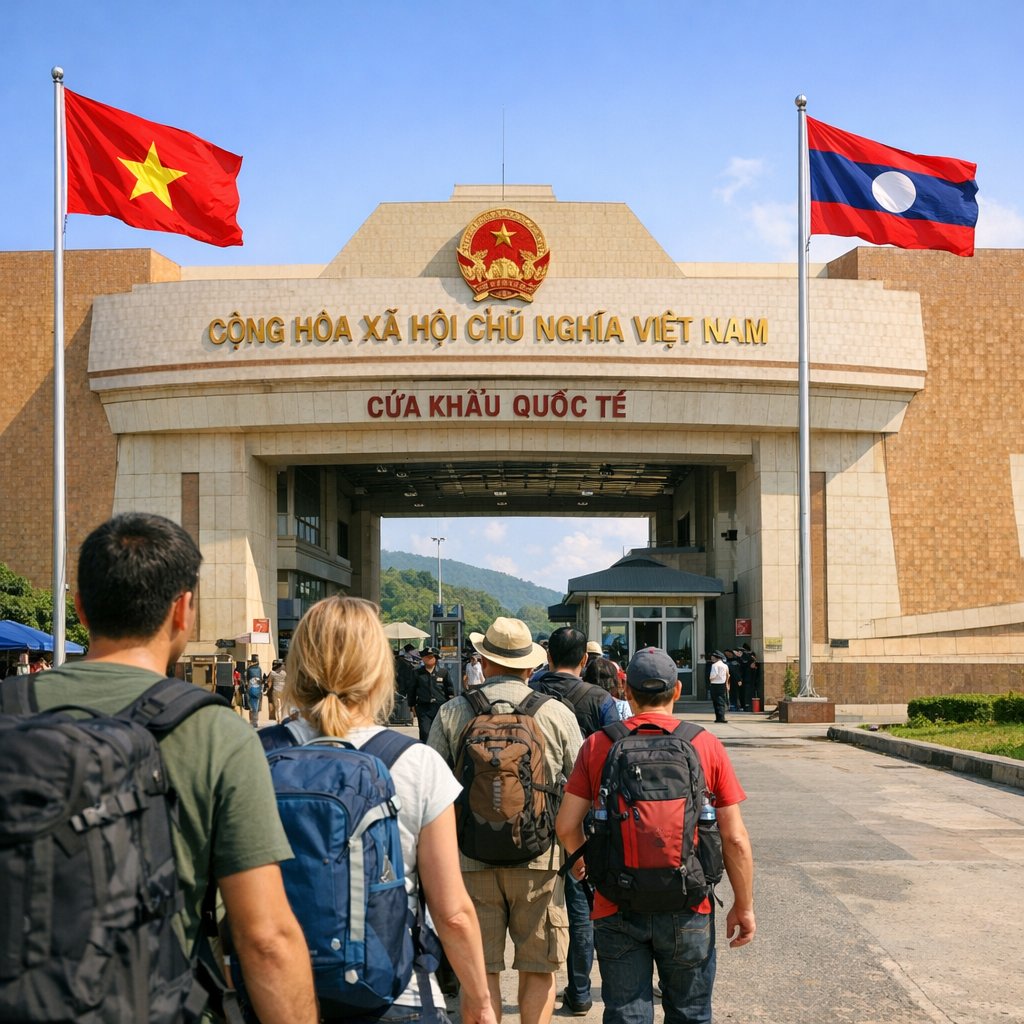
Vietnam border crossings by land are one of travel’s great overlooked adventures — a moment of bureaucratic theatre that deposits you into an entirely different world within a few hundred metres of walking. Whether you’re stepping off a sleeper bus at the Chinese frontier at Lao Cai, crossing the Mekong from Laos on a creaking wooden ferry, or rolling through the Cambodian checkpoint at Moc Bai in a minivan full of backpackers, each crossing has its own character, its own rhythms, and its own particular collection of surprises.
This guide covers all the major land border crossings into Vietnam from China, Laos and Cambodia — which crossings are open to foreigners, how to approach the visa question for each, what transport options serve each point, and the practical details that make the difference between a smooth crossing and a five-hour ordeal in the sun. Read it alongside our Vietnam Visa Guide 2026 for the complete picture.
Vietnam Border Crossings: Visas and Entry Requirements

Before diving into specific crossings, the single most important point: Vietnam’s e-visa system has transformed land border entry. The Vietnam e-visa (applied for online at evisa.xuatnhapcanh.gov.vn — the official government portal) is valid for all international land border checkpoints and allows stays of up to 90 days. As of 2026, the e-visa costs USD $25, is issued within three working days, and is accepted for nationals of almost every country. Apply before you travel — you cannot obtain an e-visa at the border itself.
Citizens of around 25 countries qualify for visa-free entry into Vietnam for stays of 30 to 45 days (nationals of ASEAN countries, several European nations, the UK, and others). Check the current exemption list at vietnamtourism.gov.vn — the list has expanded significantly in recent years.
A note on “visa on arrival”: despite what you may read on unofficial websites, Vietnam does not offer true visa on arrival at land borders. The correct option is the e-visa obtained in advance. Do not pay third-party services promising visa on arrival processing — the official government website is the only legitimate channel.
On the other side of the border, you will also need the appropriate visa for China, Laos or Cambodia depending on your direction of travel. Requirements for each are noted in the relevant sections below. Always check the most current requirements with the respective embassy before travel, as they change.
Vietnam–China Border Crossings
Vietnam and China share an 1,150km border with multiple official crossings, though only a handful are open to foreign nationals. All are in northern Vietnam and connect with China’s Guangxi and Yunnan provinces.
Lao Cai / Hekou — The busiest and most convenient Vietnam-China crossing, on the railway and road corridor connecting Hanoi with Kunming, Yunnan. The Vietnamese town of Lao Cai sits directly opposite Hekou on the Chinese side, connected by the international friendship bridge over the Red River. Sleeper trains run nightly between Hanoi’s Tran Quy Cap station and Lao Cai (8–9 hours); from Lao Cai you walk to the border. This is by far the most comfortable option for crossing into Vietnam from China. The crossing is open daily and processes large numbers of travellers. From Lao Cai, Vietnam’s Sapa is just 38km uphill — an easy onward connection.
Mong Cai / Dongxing — In Quang Ninh province on Vietnam’s far north-east coast, this crossing connects with China’s Dongxing city across the Ka Long River. It’s the natural entry point if you’re coming from Guangxi’s coast or combining a trip with Ha Long Bay. The crossing is busy with cross-border trade; tourist traffic is lighter. Open daily.
Dong Dang / Friendship Pass (Huu Nghi Quan) — In Lang Son province, this was the original colonial-era gateway from China. The Hanoi–Nanning international train crosses here. For travellers not on the train, it’s a straightforward border on a major highway. Lang Son town (18km south) is worth a brief stop for its market and fresh produce from both sides of the border.
Tay Trang / Po Chen — A remote crossing in Dien Bien province connecting with Yunnan. Rarely used by tourists; infrastructure on both sides is limited. Not recommended unless you’re specifically travelling the remote northwest circuit around Ha Giang.
Vietnam–Laos Border Crossings

The Vietnam-Laos border runs along the Annamite mountain range — a long, largely unpopulated barrier that limits crossing points to mountain passes. Several crossings are open to foreigners; which one you use depends on where you’re going in Laos and where you’ve come from in Vietnam.
Lao Bao / Dansavanh — On National Highway 9 in Quang Tri province, this is the busiest and most straightforward Vietnam-Laos crossing and the one recommended for first-timers. Savannakhet on the Laos side is a two-hour bus ride further west; from there, buses and slow boats connect south to the 4,000 Islands and north toward Vientiane. The crossing is reliably open and well set up for tourist traffic. Direct buses from Hue and Da Nang to Savannakhet via this crossing run several times weekly.
Nam Phao / Cau Treo — In Ha Tinh province, this crossing connects with Laos’s Bolikhamsai province and gives access to Vientiane (about 250km). It sees significant tourist traffic from backpackers on the classic Central Vietnam to Laos route. The road on the Lao side has improved considerably. Direct buses from Vinh and Hanoi to Vientiane cross here.
Na Meo / Nam Xoi — Thanh Hoa province, connecting with Sam Neua in Laos. This is the crossing for travellers heading to Laos’s stunning Hua Phan province — remote, spectacular, and almost entirely off the tourist trail. The road on both sides is a mountain adventure, genuinely spectacular but slow. Not for travellers in a hurry.
Tay Trang / Sop Hun — Dien Bien province, the closest crossing to Dien Bien Phu. Connects with Laos’s Phongsali province in the remote north. Well-sealed road; limited public transport on both sides. Best with a private vehicle or organised tour.
Bo Y / Phou Keua — Kon Tum province in the Central Highlands, this crossing connects with Laos’s Attapeu province and offers the most spectacular mountain border scenery of any Vietnam-Laos crossing. Suitable for self-drive and adventurous travellers heading south into Laos from Vietnam’s Central Highlands.
Laos offers an e-visa online or visa on arrival at most border crossings — confirm which option applies at your specific crossing before arrival.
Vietnam–Cambodia Border Crossings

The Vietnam-Cambodia border in the south is the most intensively used by tourists, primarily because it connects the two countries’ most visited destinations: Ho Chi Minh City and the Mekong Delta on the Vietnamese side, and Phnom Penh and Siem Reap on the Cambodian side.
Moc Bai / Bavet — The main highway crossing on National Road 22, about 70km north-west of Ho Chi Minh City. This is Asia’s busiest land border crossing for tourists and handles an enormous volume of direct bus services between HCMC and Phnom Penh. Buses cross seamlessly — you remain on the vehicle while passports are collected and processed; the whole crossing takes 1–2 hours under normal conditions. The crossing is open 24 hours and largely hassle-free. Cambodia offers e-visas online (the official portal is evisa.gov.kh) or visa on arrival at the border.
Vinh Xuong / Kaam Samnor — A scenic river crossing in An Giang province, connecting with Cambodia via the Mekong River. You cross by local ferry and arrive in Kandal province on the Cambodian side. From there, fast boats and buses run to Phnom Penh. This crossing is particularly popular with travellers who have been touring the Mekong Delta — it continues the river journey in the most logical and scenic way.
Tinh Bien / Phnom Den — An Giang province, connecting with Cambodia’s Takeo province. Used mainly by travellers coming from Chau Doc on the Vietnamese side. Direct boats from Chau Doc to Phnom Penh cross through this corridor — a beautiful route through waterways lined with floating villages before reaching the Cambodian checkpoint.
Ha Tien / Prek Chak — On Vietnam’s far south-western coast in Kien Giang province. This crossing is the natural link for travellers combining Phu Quoc island with Cambodia. From Ha Tien, buses and tuk-tuks connect south along the coast toward Kep and Kampot.
Le Thanh / O’Yadaw — Gia Lai province in the Central Highlands, connecting with Cambodia’s Ratanakiri province. For adventurous travellers combining Vietnam’s Central Highlands with Cambodia’s remote jungle northeast. Roads on the Cambodian side are rough. Best with your own vehicle and significant offroad experience.
Practical Tips for All Vietnam Land Border Crossings
A few universal principles apply across every land border crossing into Vietnam, regardless of which one you choose.
Cross in the morning. All crossings work faster in the first hours after opening. Lines build through the late morning and peak in the early afternoon; by 3pm many crossings have processed hundreds of vehicles and queues can form. If you have a choice of bus departure times, take the one that reaches the border before 10am.
Have your documents in perfect order. Vietnam’s border officials are systematic: e-visa printout (or screenshot if allowed), passport valid for at least six months beyond entry, and evidence of onward travel if required. Keep everything accessible in a single document wallet rather than distributed across different bags.
Carry small USD notes. Border areas are transition zones that see multiple currencies; USD is accepted universally on both sides of every crossing. The official fees are fixed, but small dollar bills are useful for taxis, baggage handlers, and the inevitable roadside food stall once you’re through.
Be patient and calm. Vietnamese immigration officers see thousands of travellers per day and move efficiently. Attempts to queue-jump, loud complaints, or visible frustration will slow your own processing. Smile, answer questions clearly, and let the system work.
Research transport prices in advance. Border towns are transition economies where some drivers charge arrivals a premium. Compare prices from at least two drivers. The cost of getting from the border to the nearest town should never be more than a few dollars.
Planning Your Onward Vietnam Journey
Once you’re through the border, Vietnam opens up in every direction. Travellers entering from China via Lao Cai will typically head to Sapa and then south toward Hanoi; those coming via Lao Bao from Laos often continue to Hue, Da Nang and the central coast. Cambodia entrants from Moc Bai are immediately in the orbit of Ho Chi Minh City, the Mekong Delta and Vietnam’s south.
For planning the full journey, our two-week Vietnam itinerary maps a north-to-south route that can be adapted for any entry point. Our getting around Vietnam guide covers transport between destinations in detail — and if this is your first time in the country, the complete Vietnam Visa Guide 2026 is essential reading.
Can I get a Vietnam visa at the land border?
No. Vietnam does not offer visa on arrival at land border crossings. You must obtain a Vietnam e-visa in advance through the official government portal at evisa.xuatnhapcanh.gov.vn before arriving at the border. Citizens of visa-exempt countries do not need to apply but should verify their exemption status before travelling.
What is the easiest Vietnam land border crossing for first-time travellers?
From Cambodia: Moc Bai / Bavet, served by reliable direct buses from Ho Chi Minh City to Phnom Penh. From Laos: Lao Bao / Dansavanh in Quang Tri province. From China: Lao Cai / Hekou, connected by the overnight Hanoi–Lao Cai train. All three handle significant tourist traffic and have established infrastructure.
Are Vietnam land border crossings safe?
Yes. The major crossings listed in this guide are safe and well-managed. Standard precautions apply: keep valuables secure, be alert in crowded border areas, and avoid unofficial money changers. The crossings themselves are policed and orderly; the main risks are logistical (queues, missed buses, transport scams) rather than safety-related.
What are the opening hours for Vietnam land border crossings?
Most major crossings open 7am–10pm local time. Moc Bai / Bavet is open 24 hours. Remote crossings (Tay Trang, Le Thanh, Na Meo) may have more limited hours and close for lunch. Confirm hours with your bus operator or tour company before travel, as hours can change with little notice.
Can I bring a rented motorbike across a Vietnam land border?
Generally no. Rented motorbikes cannot cross international borders — the vehicle registration and insurance do not extend across the frontier. If you’re completing a motorbike circuit, you’ll need to return the bike in Vietnam before crossing, or arrange a specialist tour operator who handles cross-border vehicle documentation (available for some routes into Laos).
Leave a Reply