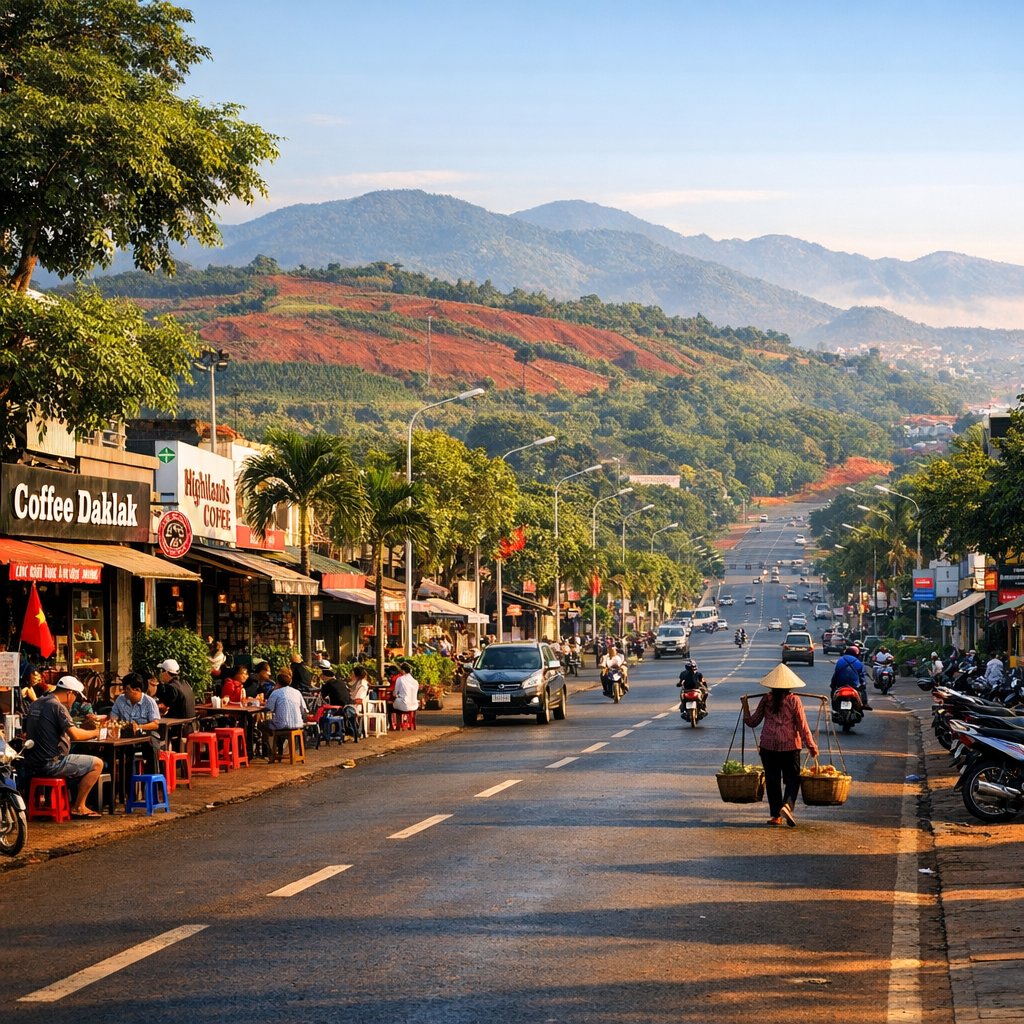
The Buon Ma Thuot travel guide begins, inevitably, with coffee. Specifically with the moment you sit down at a roadside café in this sprawling highland city and receive a small glass of the darkest, most intense coffee you have ever tasted — thick as treacle, served drip-by-slow-drip through a phin filter over sweetened condensed milk — and understand that you have arrived somewhere singular. Buon Ma Thuot, capital of Dak Lak province in Vietnam’s Central Highlands, produces more coffee than most countries on earth. Everything here is shaped by that fact.
But coffee is only the introduction. Behind the city stretches one of Vietnam’s wildest and most underexplored regions: a high plateau of red basalt soil, ancient elephant forests, roaring waterfalls, and ethnic minority villages where the Ede and M’nong peoples have lived since long before the Vietnamese nation existed. Few international tourists find their way here; those who do tend to stay far longer than planned.
Buon Ma Thuot Travel Guide: What to Expect

Buon Ma Thuot (pronounced roughly “boon-ma-twot”) is the largest city in Vietnam’s Central Highlands, sitting at around 500 metres elevation on the Dak Lak plateau. The altitude means temperatures are noticeably cooler than Ho Chi Minh City — rarely above 30°C during the day, dropping pleasantly in the evening — and the air carries a clean quality that feels refreshing after the coastal cities’ heat and humidity.
The city itself is functional rather than beautiful: a sprawling grid of wide boulevards lined with coffee shops, motorbike dealerships, and market halls, built up rapidly during the post-reunification era without much concern for aesthetics. Don’t judge Buon Ma Thuot by its city centre. The draw is what lies outside it: coffee estates, waterfalls, national parks, and minority villages that require a motorbike, a guide, or ideally both to explore properly.
The city is increasingly on the radar for domestic Vietnamese tourists — particularly younger travellers from Ho Chi Minh City and Hanoi seeking cooler temperatures and outdoor adventure. International visitor numbers remain low, which means prices are reasonable, the tourism infrastructure is unspoiled, and local people retain a genuine curiosity about foreign visitors rather than the practised indifference that can develop in heavily touristed places.
Coffee Country: Vietnam’s Central Highlands Plantations
Vietnam is the world’s second-largest coffee producer, and a staggering 40% of that production comes from Dak Lak province alone. The red basalt soil of the Central Highlands, the altitude, and the distinct wet and dry seasons combine to produce robusta beans of exceptional quality — beans that provide the base for much of the world’s espresso blends without anyone knowing it.
Visiting a coffee plantation around Buon Ma Thuot is one of the most distinctive experiences in the Central Highlands. A handful of farms welcome visitors for tours that walk you through the full process: from the cherry-red fruit hanging on dark-leafed bushes, through the pulping and fermenting stages, to the drying terraces where beans spread out in the sun like a brown carpet, and finally to the roasting drum that fills the shed with a scorched, caramelized aroma that will haunt you for days.
Several farms have set up café areas where you can taste different single-origin roasts and compare robusta with the arabica varieties now being cultivated at higher altitudes nearby. For more on the full coffee trail across the highlands, see our guide to Vietnam’s Coffee Farm Trail — Buon Ma Thuot and the Dak Lak plateau are the beating heart of that story.
The Trung Nguyen Coffee Village on the edge of the city is an accessible introduction to coffee culture for those who want context before venturing into the plantations. The complex is part showroom and part cultural experience, and it’s best visited in combination with an independent farm tour rather than as the sole coffee experience.
Dray Nur and Dray Sap Waterfalls: Nature’s Twin Spectacles

About 30km south-west of Buon Ma Thuot, the Serepok River — one of the few rivers in Vietnam that flows west rather than east — tumbles off the plateau in two spectacular cascades that face each other across a gorge less than a kilometre apart. Dray Nur (Female Waterfall) and Dray Sap (Male Waterfall) are natural wonders that most visitors to the Central Highlands somehow miss entirely.
Dray Sap is the more dramatic of the two: in the wet season, it spreads nearly 100 metres wide and plunges 15 metres in a continuous curtain of white water. The spray carries for hundreds of metres, drenching the surrounding forest and making photography both challenging and rewarding. The Ede people regard Dray Sap as sacred, and there is a quality of the place — the sound, the mist, the forest pressing close on every side — that makes their reverence entirely understandable.
Dray Nur is reached by a short riverside walk and is arguably the more photogenic of the two: its multiple horseshoe-shaped tiers create a more structured composition, and the viewing platform puts you at the level of the spray rather than above it. Visit both in a single half-day excursion; they are linked by a forest trail that passes through secondary jungle where you may spot monkeys, hornbills, and, if you are patient and quiet, the occasional peacock.
The best time to visit is between June and November, when the rains have pushed the rivers to full volume. In the dry season the falls are still running but considerably reduced; they retain their atmosphere but lose some of their raw power. A motorbike from Buon Ma Thuot city centre takes about 40 minutes and is the easiest transport option.
Yok Don National Park: Where Wild Elephants Roam
Forty-five kilometres north-west of the city, Yok Don National Park is the largest national park in Vietnam — nearly 120,000 hectares of mixed deciduous forest covering the Serepok River floodplain and rolling highland terrain on the border with Cambodia. It is home to endangered Asian elephants, gaur, banteng, leopards, sun bears and an extraordinary variety of birds.
The elephant situation in Yok Don is complex and worth understanding before you visit. The park became famous for elephant-riding tourism, a practice that has now been banned across the park following sustained advocacy from animal welfare organisations. In its place, Yok Don now offers ethical elephant watching experiences where visitors observe a small group of rescued and semi-wild elephants living in their natural forest environment — behaviour-led, undisturbed, and far more remarkable than anything that came before.
Beyond the elephants, Yok Don rewards trekking, birdwatching and boat trips on the Serepok River. Overnight homestay packages with the M’nong community inside the park buffer zone are available through the park management office and local tour operators in Buon Ma Thuot — these combine forest treks with evening cultural performances, home-cooked M’nong food, and the experience of waking to a dawn chorus that seems to contain every bird in Vietnam.
Getting to Buon Ma Thuot: Flights, Buses and Practical Transport

Buon Ma Thuot is more accessible than most travellers assume, thanks to a well-connected domestic airport that receives multiple daily flights from Hanoi, Ho Chi Minh City and Da Nang. Flight time from Ho Chi Minh City is 55 minutes; from Hanoi about 1 hour 40 minutes. Ticket prices on Vietnam Airlines, Vietjet and Bamboo Airways can be very competitive when booked in advance — check flights as part of your overall Vietnam transport planning using the guidance in our getting around Vietnam guide.
Sleeper buses from Ho Chi Minh City’s Mien Dong station run overnight to Buon Ma Thuot (around 8–9 hours) and are a perfectly comfortable option for budget travellers. From Da Lat (Vietnam’s other Central Highlands city and the subject of our Da Lat travel guide), the drive takes around 4–5 hours and passes through spectacular highland scenery.
Within Buon Ma Thuot and for day trips to the waterfalls and plantations, motorbike is the practical choice. Rentals are widely available in the city centre; a semi-automatic costs around 120,000–180,000 VND per day. For Yok Don National Park and the more remote coffee growing areas, a local guide with their own vehicle is recommended — both for navigation and for the local knowledge that transforms a drive through forest into an education in an ecosystem.
Where to Stay and Eat in Buon Ma Thuot
The city has a reasonable spread of accommodation, from basic guesthouses at 200,000–350,000 VND per night to comfortable mid-range hotels with swimming pools and breakfast included at 600,000–1,200,000 VND. The main hotel district clusters around the city centre and the Victory Monument roundabout. International brand hotels are absent, which keeps prices lower than equivalent quality in Hanoi or Ho Chi Minh City.
Food in Buon Ma Thuot reflects its highland setting: pork, river fish, and vegetables dominate, with a strong Ede and M’nong culinary influence showing up in dishes like lam (food cooked inside bamboo tubes), grilled meats with highland herbs, and glutinous rice wrapped in banana leaves. The city’s central market is the best place to eat breakfast — steaming bowls of bun bo (beef noodle soup) and banh mi stalls open from 6am.
Coffee, naturally, is available everywhere and uniformly excellent. The local preference is for strong Vietnamese drip coffee with sweetened condensed milk (ca phe sua da when served over ice), though single-origin pour-overs have appeared on the menus of newer specialist cafés. Budget at least an hour each morning to work through the ritual properly — in Buon Ma Thuot, rushing your coffee is practically a cultural offence.
Best Time to Visit Buon Ma Thuot, Vietnam
The Central Highlands operates on a clear two-season calendar. The dry season runs from November to April and is by far the more popular time to visit: skies are blue, roads are passable throughout the province, and the coffee harvest (November to February) fills the air with the roasted-cherry smell of drying beans and turns the roadside terraces red and gold.
The wet season (May to October) brings heavy afternoon downpours that make the waterfalls spectacular and the national park lushly alive, but can also turn some dirt tracks and plantation roads into red-mud rivers. If you visit in the wet season, morning excursions and flexible planning are essential.
Coffee harvest time (late November through January) is the ideal combination: dry weather, extraordinary coffee culture on full display, and the cooler highland temperatures that make outdoor exploring a genuine pleasure. For context on planning your Vietnam trip around seasons, see our best time to visit Vietnam guide.
How many days do I need in Buon Ma Thuot?
Allow a minimum of two full days: one for the city, a coffee plantation, and the Trung Nguyen Coffee Village; one for Dray Nur and Dray Sap waterfalls. Three to four days lets you add Yok Don National Park (a full day or overnight) and the remote ethnic minority villages north of the city.
Can I do elephant watching in Yok Don without booking in advance?
Advance booking is strongly recommended, especially during dry season weekends when domestic tourist numbers are high. Contact the Yok Don National Park management office directly or book through a Buon Ma Thuot tour operator. Same-day availability is sometimes possible on weekday mornings in the low season.
Is Buon Ma Thuot safe for solo travellers?
Yes — Buon Ma Thuot is a safe and welcoming city for solo travellers. The main considerations are standard Vietnam travel precautions: secure your belongings, wear a helmet on motorbikes, and exercise care on highland roads in wet conditions. Our solo travel Vietnam guide covers everything you need to know.
What coffee should I buy to take home from Buon Ma Thuot?
Look for single-estate robusta or arabica from local roasters rather than commercial brands. The city’s weekend market and specialist coffee shops sell vacuum-packed whole-bean and ground coffee from named farms. Ask for “ca phe nguyen chat” (pure coffee, no additives) — some pre-ground blends are mixed with butter or other flavourings that don’t travel well.
How do I get from Buon Ma Thuot to Da Lat?
The most scenic route is by motorbike or hired car via National Highway 27, a four-to-five-hour journey through highland passes and pine forests. Sleeper buses connect the two cities in roughly the same time. The route makes a natural two-city Central Highlands circuit — see our Da Lat travel guide for what awaits at the other end.
The Central Highlands Await
Buon Ma Thuot is the kind of destination that rewards travellers who seek out the unlabelled, the unpolished, and the genuinely local. It won’t dazzle you with heritage architecture or beachfront sunsets. What it offers instead is something rarer: a profound sense of place, a landscape shaped by centuries of highland farming and forest culture, and coffee — always coffee — served with the unhurried generosity of people who understand that the best things cannot be rushed.
For planning your wider Vietnam journey, see our guides to Vietnam in two weeks, Vietnam on a budget, and the complete getting around Vietnam transport overview.
Leave a Reply