A good Vietnam health guide will not frighten you out of the trip; it will let you stop worrying and start tasting. Vietnam is, for the vast majority of visitors, a wonderfully healthy place to travel: the food is fresh, the pharmacies are everywhere, and the biggest medical drama most people face is a sunburnt nose or one over-ambitious chilli. But a little preparation, done a few weeks before you fly, turns “I hope it’s fine” into “I’ve got this”. Here is everything worth knowing for 2026, from vaccinations to pharmacies to the quiet art of drinking water safely.
This article is general travel information, not medical advice. Please see a doctor or travel clinic at home, ideally 6–8 weeks before departure, to plan vaccinations and medication for your own health history.
Vietnam Vaccinations: What to Ask Your Doctor Before You Go
No vaccinations are compulsory for most travellers arriving directly from Europe, North America or Australasia, though proof of yellow fever vaccination can be requested if you arrive from a country with yellow fever transmission. Beyond that, the question is what is sensible, and that is a conversation to have with a travel-health professional who knows your age, itinerary and medical history.
Travel clinics commonly discuss the following for Vietnam: routine immunisations being up to date (tetanus, diphtheria, measles and so on), hepatitis A, typhoid, and, for longer stays or rural journeys, hepatitis B, Japanese encephalitis and rabies. Rabies matters because stray and village dogs are a feature of rural life, and the nearest post-exposure treatment may be hours away if you are trekking in the far north. Japanese encephalitis is mostly a concern if you plan weeks among rice paddies and farmland rather than a fortnight of cities and beaches.
- Book early: some vaccines need more than one dose spread over weeks.
- Tell the clinic your route: the Mekong Delta, Central Highlands and Ha Giang loop each carry slightly different considerations than Hanoi and Da Nang.
- Carry your records: a photo of your vaccination card on your phone is plenty.
If you are still piecing together the shape of your journey, our two-week Vietnam itinerary is a handy map to show your doctor, and our Vietnam visa guide covers the paperwork side of things so that health is the only thing left to organise.
Mosquitoes, Dengue and Staying Bite-Free
Evening in Vietnam has a soundtrack: scooters thinning out, a neighbour’s television, cicadas, and, near water, the thin whine of mosquitoes. Dengue fever is spread by day-biting mosquitoes and occurs in Vietnam year-round, with cases generally rising during the wetter months. There is no need for alarm, but a bite-avoidance habit is the single most effective piece of health insurance you can carry in a pocket.
Use an insect repellent containing DEET, picaridin or another recommended active ingredient on exposed skin, especially at dawn and dusk and whenever you are near still water, gardens or leafy cafés. Light, loose, long-sleeved cotton is cooler than you might expect and beats a repellent bottle on a humid afternoon in the Mekong. Air-conditioned rooms and well-screened windows help, and many guesthouses supply a mosquito net or a plug-in repellent on request.
Malaria is not a concern in the main tourist cities, the Red River Delta, the coast around Da Nang, Hoi An or Nha Trang, or the Mekong Delta towns; low risk exists in some remote forested and highland areas. Ask your clinic whether your specific route warrants anything. If you plan to explore wilder terrain, our guides to Cuc Phuong National Park and Pu Luong Nature Reserve are good places to gauge how remote you will be getting.

Safe Water, Street Food and Staying Healthy at the Table
Rule one: do not drink the tap water. Locals boil it or use filtered bottles, and so should you. Sealed bottled water costs very little at every corner shop, and most hotels provide complimentary bottles. Many restaurants serve complimentary iced tea, which is safe, and the ice in cafés and restaurants in tourist areas is typically made commercially from filtered water: the small, cylindrical, hollow-centred cubes are the sign of factory ice. Brush your teeth with bottled water if you have a sensitive stomach, and consider a filter bottle if you want to cut plastic waste.
Rule two: eat where the locals are queueing. A busy stall with high turnover means ingredients are fresh and nothing sits around in the heat. Watch your food being cooked, favour hot dishes that arrive steaming, and peel your own fruit. A bowl of pho at seven in the morning, bubbling away in a stainless-steel pot that has been simmering since four, is about as safe as food gets, and a joy besides. Our full guide to Vietnam street food safety goes deeper into the dos and don’ts, while our rundown of Vietnamese breakfast shows you where to start your day well.
Travellers’ diarrhoea is the most common complaint, usually triggered by a change in bacteria rather than anything wrong with the food. Carry oral rehydration salts (sold in every pharmacy), keep fluids up, and see a doctor if symptoms are severe, include blood, or last more than a couple of days. A slow first day to let your stomach adjust, rather than a street-food marathon on arrival, is the sort of small kindness that pays off all week.
Vietnam Pharmacies and Medicines: What to Buy and Where
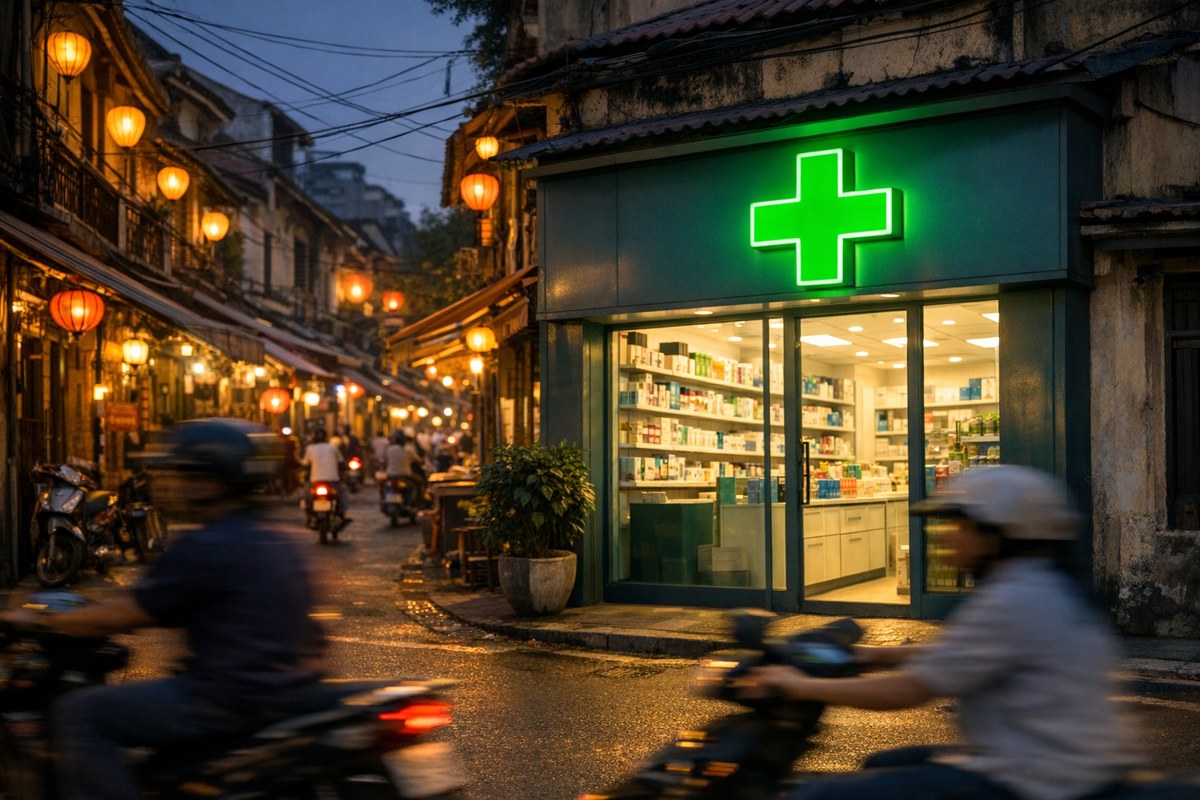
The Vietnamese pharmacy, nhà thuốc, is one of the great conveniences of travel here. You will find one every few streets in any town, usually a tiny glass-fronted shop with a pharmacist who understands a surprising amount of English and a lot of pointing. Basic medicines (painkillers, anti-diarrhoeals, antihistamines, rehydration salts, antiseptic creams, motion-sickness tablets and sunburn relief) are cheap and easy to find. Larger chains in cities are tidy, clearly labelled and a good first stop.
- Bring your own prescription medication in its original packaging, with a copy of the prescription or a doctor’s letter, and enough for the whole trip plus a few spare days.
- Check brand names: the same active ingredient can have a different label here, so write the generic name on your phone.
- Buy sealed packs only from reputable pharmacies, and check expiry dates.
Some medications that are ordinary in your home country are controlled substances elsewhere, so check the rules for anything unusual before you travel. For official information on visiting the country, the national tourism administration at vietnamtourism.gov.vn and the Ministry of Health are the sources to trust.
Hospitals, Clinics and Emergency Numbers in Vietnam
Vietnam’s big cities have excellent private international clinics and hospitals, with English-speaking doctors, modern equipment and direct billing to many insurers. Hanoi, Ho Chi Minh City and Da Nang are best served; elsewhere, quality varies and serious cases are often transferred to a major city or, if necessary, evacuated to Bangkok or Singapore. That is the main reason to take real travel insurance seriously.
Save these numbers before you land: 115 for an ambulance, 113 for the police and 114 for the fire service. Operators may not speak English, so ask your hotel reception to help in an emergency, and keep your accommodation’s name and address written in Vietnamese on your phone. Having mobile data makes everything easier; our Vietnam SIM card and eSIM guide will have you online from the airport.
If you hire a motorbike, remember that road accidents are the most significant danger most visitors face, far more than any microbe. Read our motorbike rental guide for helmet, licence and insurance essentials, and our Vietnam travel safety guide for the common scams and street-smart habits that go hand in hand with staying well.

Heat, Sun, Air Quality and Travel Insurance
Vietnam’s heat is not subtle. From April to September the south and centre can feel like walking through a warm, damp towel, and even Hanoi’s summers are humid enough to make the second shower of the day feel essential. Drink more water than you think you need, add an electrolyte sachet on hot days, wear a hat, and plan sightseeing for early morning and late afternoon, leaving the midday heat to a long lunch and a coconut. Sunscreen is available in cities but often pricier and sometimes contains whitening agents, so bring a favourite SPF from home.
Air quality in Hanoi and Ho Chi Minh City can dip, particularly in the cooler months in the capital, when haze settles over the Red River Delta. If you have asthma or a respiratory condition, bring your inhaler and consider a mask on bad days. Our best time to visit Vietnam guide will help you match the season to your comfort, and our rainy season guide shows how wet months can be surprisingly lovely.
Finally, buy comprehensive travel insurance before you leave. Check that it covers medical treatment, emergency evacuation, trip interruption and, if you plan to ride a scooter, motorbike use with the licence you actually hold. It is the cheapest line in your budget and the one you will most hope never to use. Our Vietnam budget guide shows where it sits among your other costs, and our Vietnam packing list has a full first-aid kit checklist to tuck into your bag.

Your Healthy Vietnam Trip Starts Now
Do the dull things well (vaccines, insurance, repellent, a small kit of medicines) and you can leave the rest to wonder: the smell of grilled pork drifting down a Hanoi alley, the first sip of cold coconut water after a long hike, the hush of a river at dusk. A healthy traveller is a curious one, and curiosity is what Vietnam rewards most. Start your checklist today, book that travel-clinic appointment, and let the road to Vietnam begin.
Vietnam Health Guide: Frequently Asked Questions
Is tap water safe to drink in Vietnam?
No. Stick to sealed bottled water or filtered water, and use it for brushing your teeth if you have a sensitive stomach. Ice in restaurants and cafés in tourist areas is usually made commercially and is generally fine.
Do I need vaccinations to travel to Vietnam?
No vaccines are compulsory for most visitors, but travel clinics commonly discuss routine boosters, hepatitis A, typhoid and, depending on your itinerary, hepatitis B, Japanese encephalitis and rabies. See a doctor 6–8 weeks before you fly.
What is the emergency number in Vietnam?
Dial 115 for an ambulance, 113 for the police and 114 for the fire service. English may not be spoken, so ask your hotel for help whenever you can.
Can I buy medicine easily in Vietnam?
Yes. Pharmacies are everywhere and sell common medicines cheaply. Bring prescription medication from home in its original packaging with a doctor’s letter, and write down generic drug names.
Is dengue fever a risk in Vietnam?
Dengue occurs in Vietnam year-round and tends to rise in the wetter months. Use repellent, wear light long sleeves at dawn and dusk and sleep in screened or air-conditioned rooms.
Leave a Reply