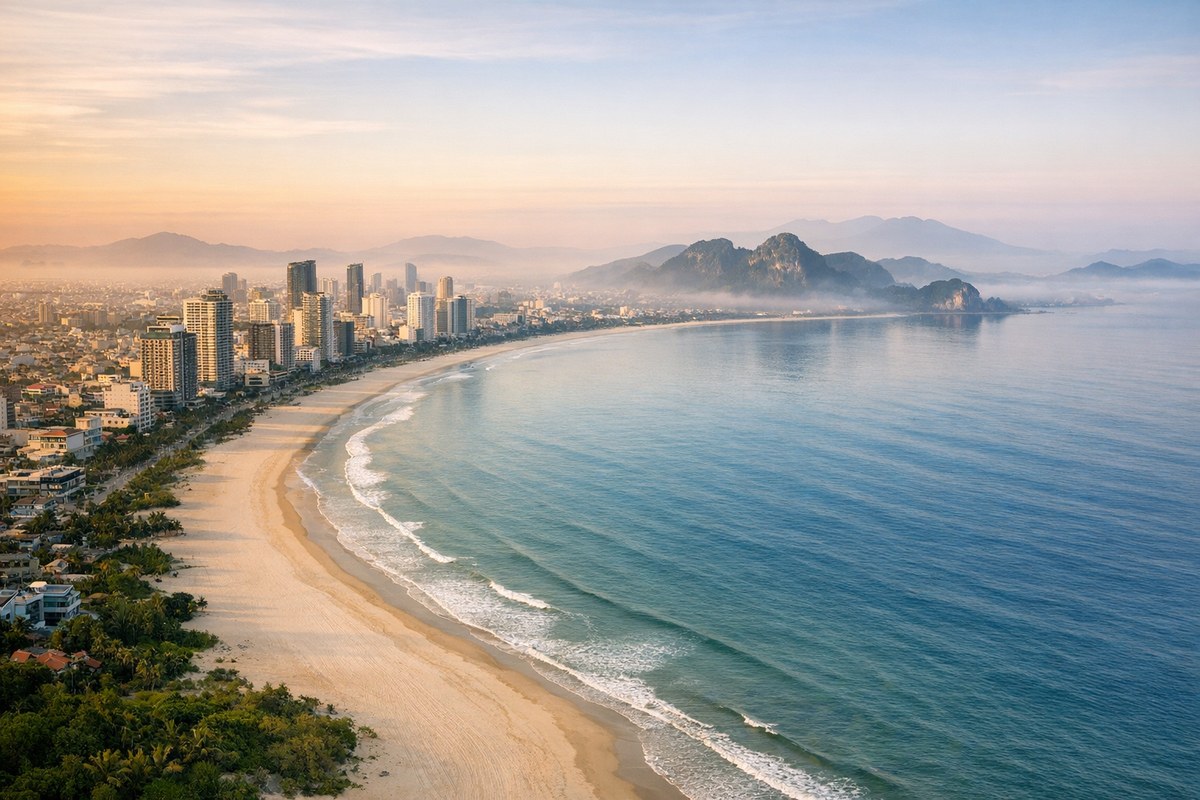

The Da Nang travel guide you didn’t know you needed starts here — at the edge of a city where the mountains tumble into the sea, where a 30-kilometre arc of golden beach runs right through the urban heart, and where the food is so good that locals will argue (loudly, passionately) that their dishes are the finest in Vietnam. Da Nang sits at the country’s waist, equidistant between Hanoi and Ho Chi Minh City, and it has spent the last decade becoming Vietnam’s most startlingly liveable city. The cranes are gone from the skyline, the Dragon Bridge breathes fire on weekends, and still — somehow — the pace of life here feels gentler than you’d expect from a city of over a million people.
This is not a beach resort in the traditional sense. Da Nang is a real, functioning Vietnamese city that happens to have some of the finest white-sand beaches in Southeast Asia. You can surf in the morning, eat a bowl of mì quảng — Da Nang’s own turmeric noodle soup — at a rickety street stall for lunch, ride a cable car over mist-soaked mountains in the afternoon, and watch a fire-breathing bridge from a riverside bar at night. That range — urban energy and natural spectacle folded into a single day — is what sets Da Nang apart from every other destination on Vietnam’s central coast.
Whether you have three days or a week, here is everything you need.
Da Nang Beaches: Where the South China Sea Meets the City

No Da Nang travel guide worth reading lets you skip this part: the beaches here are extraordinary. My Khe Beach — the long, curving stretch that hugs the eastern edge of the city — was once ranked among the most beautiful urban beaches in the world, and while that accolade is decades old, the beach itself has barely changed. The sand is impossibly fine, the water runs through shades of jade and turquoise depending on the season, and the waves roll in with just enough consistency that surfers have been quietly colonising the northern end for years.
My Khe is accessible directly from the city centre — you can walk to the water from most mid-range hotels in under ten minutes. Unlike the island da nang beaches further offshore, My Khe lets you surf at dawn, shower, and be eating bánh mì by 8am. The beachfront promenade runs for kilometres without interruption: coffee stalls open before sunrise, clusters of locals perform tai chi in the peach morning light, and the sea changes colour from grey to gold to blue as the sun climbs.
Further south, Non Nuoc Beach curves away beneath the Marble Mountains in a more sheltered arc. It’s quieter than My Khe, less developed, and backed by a low line of seafood restaurants where the catch arrives in morning boats. This is where Da Nang locals bring their families on Sunday mornings, setting up parasols and lighting portable grills with the casual competence of people who have been doing this their whole lives. If you’re looking for Vietnam’s most beautiful coastal escapes, Da Nang’s beaches belong near the top of any list.
The sea is calmest between March and August. From September through November, typhoon season can bring dramatic swells that close beaches to swimming — though watching storm waves roll in from a covered terrace with a Vietnamese iced coffee is its own kind of pleasure.
Things to Do in Da Nang Beyond the Beach
The things to do in Da Nang extend well beyond sunbathing, and the city rewards those who look past the coastline. The Marble Mountains (Ngũ Hành Sơn) rise from the coastal plain just south of the city — five limestone outcrops named for the five elements — and climbing them is one of the most unexpectedly atmospheric half-days you can spend in central Vietnam. Inside the peaks, Buddhist caves hold ancient shrines where incense smoke drifts through natural skylights, and from the summit you look out over the city rooftops, the curve of the coast, and on clear days the faint outline of the Cham Islands far offshore.
The Dragon Bridge (Cầu Rồng) has become the city’s defining image: a 666-metre span in the shape of a golden dragon stretching across the Han River. On Saturday and Sunday evenings, crowds gather on both banks to watch it breathe actual fire and water at 9pm. It is unabashedly theatrical, and entirely wonderful — the kind of spectacle that makes you forget you’re a supposedly seasoned traveller and just stand there grinning.
Inland from the city, Ba Na Hills is the mountain resort that Vietnam built on a cloud. At 1,487 metres above sea level, the temperature drops nearly ten degrees from the coast, and the French hill-station architecture gives the whole place a fairytale surrealism. The Golden Bridge — held aloft by two giant stone hands emerging from the hillside — has become one of Vietnam’s most photographed structures, and justifiably so. The cable car journey up climbs 5,800 metres over jungle-draped ridges in mountain mist, which is itself worth the trip.
For a more grounded experience, the Museum of Cham Sculpture is the finest collection of Cham art in the world, housing delicate sandstone carvings that predate the Vietnamese kingdoms by centuries. It is quiet, unhurried, and genuinely moving — the kind of museum that sends you back to your hotel with a different understanding of the land you’re standing on.
At night, the Han River becomes the social artery of the city. The Nguyen Van Linh and Tran Phu streets along the riverbank fill with people walking, eating, and watching the lights on the water. Street food vendors set up their carts, and the smell of grilling meat and lemongrass drifts through the warm air.
Da Nang Vietnam 2026: Getting There and Getting Around
Da Nang Vietnam 2026 is easier to reach than ever. Da Nang International Airport (DAD) sits just 3 kilometres from the city centre — one of the closest airport-to-city distances in the country — and serves direct international flights from across Asia, including Singapore, Bangkok, Seoul, Tokyo, and Hong Kong. From within Vietnam, budget carriers VietJet, Bamboo, and Vietnam Airlines run frequent services from both Hanoi and Ho Chi Minh City, often for under $30 one-way if booked ahead.
For travellers arriving overland, the Reunification Express train from Hanoi takes roughly 15–17 hours and is one of the most scenic rail journeys in Southeast Asia, passing through mountain tunnels and hugging coastal cliffs above the South China Sea. The Hải Vân Pass section — just north of Da Nang — is breathtaking. If train travel appeals to you, our guide to navigating Vietnam’s train adventures covers the full route and what to expect on board.
Within Da Nang, the city is flat and compact enough to make cycling a genuine option along the beachfront. Ride-hailing apps Grab and Be operate throughout the city and are cheap, reliable, and far less stressful than flagging down an unmarked taxi. For those wanting more freedom, motorbike rental is widely available for around 150,000–200,000 VND per day. Vietnam on two wheels is a whole different experience — and the coastal road south toward Hội An is easily one of the most beautiful short rides in the country. Taxis from the airport to the city centre cost roughly 80,000–120,000 VND by meter (approximately $3–5 USD).
Where to Eat in Da Nang: Street Stalls, Seafood, and Mì Quảng
Da Nang’s food scene is one of the most underrated in Vietnam, and the Da Nang travel guide that doesn’t linger here is missing the point. The city has its own culinary identity, distinct from the refinement of Hội An or the street-food chaos of Saigon. Start with mì quảng: wide, turmeric-yellow rice noodles served with just enough broth to gloss the bowl, topped with pork, shrimp, peanuts, fresh herbs, and a half-piece of bánh tráng (rice cracker) that shatters the moment you stir it in. The best versions are at tiny stalls near the Cham Museum, open from 6am until the pot runs out — which, on busy mornings, can be before 9am.
Bánh xèo — the sizzling rice-flour crêpe stuffed with shrimp, pork, and bean sprouts — is another Da Nang staple, eaten by tearing off pieces and wrapping them in mustard leaf or rice paper with a heap of fresh herbs before dunking the whole package in fish sauce. It is deeply, unashamedly messy, and absolutely delicious. For a broader introduction to the street food philosophy underpinning Vietnamese cooking, our guide to Vietnam’s culinary secrets explores the traditions behind the bowls.
For seafood, the stretch of restaurants behind Non Nuoc Beach and along Pham Van Dong Street near My Khe is the place to go. Whole fish grilled over charcoal, clams steamed with lemongrass, grilled squid with salt and chilli — the rule is simple: point at whatever looks freshest and has a table full of locals eating it. Vietnam’s coastal cuisine tells the broader story, but Da Nang’s seafood is its own compelling chapter.
Coffee culture is as serious here as anywhere in Vietnam. Find a low plastic stool and a traditional drip — cà phê phin — on any morning street corner. The ritual of watching the filter slowly yield, the first sip arriving dark and intensely bitter before the sweet condensed milk rises from the bottom, is the best possible start to a Da Nang morning.
Where to Stay in Da Nang: Neighbourhoods and Options
Da Nang divides neatly along the Han River. The west bank holds the older neighbourhoods, the Cham Museum, the covered Han Market, and most of the budget accommodation. The east bank — across the Dragon Bridge — is where My Khe Beach runs, and where the bulk of the beachfront hotels sit, ranging from guesthouses at $20 a night to five-star resorts stretching back from the sand.
For first-time visitors, the My Khe beachfront strip offers the highest convenience-to-price ratio: you wake up metres from the ocean, the sunrise over the South China Sea is extraordinary, and the beach road runs north to south with restaurants, coffee shops, and bike rental at constant intervals. Mid-range options typically cost $40–80 per night and include a pool, breakfast, and a sea view. Budget travellers will find better value in the Hai Chau district on the west bank, where guesthouses and backpacker hostels cluster near the Han Market, a ten-minute ride from the beach.
For something special, the stretch of resort hotels south toward Non Nuoc Beach and the Marble Mountains offers a quieter atmosphere: fewer crowds, mountain views behind you, sea in front, and some of Vietnam’s most architecturally striking five-star properties a short walk from the sand.
Day Trips from Da Nang: Hoi An, Ba Na Hills, and the Hải Vân Pass

The Da Nang travel guide would be incomplete without addressing its greatest geographic advantage: everything worth seeing in central Vietnam sits within easy reach. Hội An is 30 kilometres south — a 40-minute ride by motorbike or taxi through rice fields and fishing villages. The ancient town, a UNESCO World Heritage Site, is best visited at dawn before the tour groups arrive, when lanterns still hang in the morning mist and the Thu Bon River reflects the wooden shophouses in golden silence. Our deep dive into Hội An’s old-world charm covers every lane, tailor shop, and hidden courtyard.
Ba Na Hills works best as a full-day excursion. Leave by 8am to beat the crowds, ride the record-breaking cable car up through the clouds, cross the Golden Bridge, explore the French Village and its mock-medieval ramparts, and return to Da Nang by late afternoon in time to watch the Dragon Bridge breathe fire at 9pm.
North of the city, the Hải Vân Pass — a road of spectacular switchbacks that featured on Top Gear as one of the world’s great drives — divides the weather zones of north and south Vietnam. You can ride it on a motorbike (unforgettable) or pause at the summit on the way to Hue, which sits about 100 kilometres north and warrants an overnight stay if your schedule allows. The views from the top, with the coast below and mountains ahead, make it one of the most cinematic moments available in the entire country.
Da Nang has quietly, without fanfare, become one of the most complete travel destinations in Southeast Asia — a city that combines real urban life with extraordinary natural scenery, world-class beaches, and proximity to two of Vietnam’s most historic towns. It rewards the curious, feeds the hungry, and leaves most visitors wondering why they didn’t stay longer. If you’re building a Vietnam itinerary, Da Nang earns more than a one-night stopover. It deserves a base camp. Come for the beach, stay for the food, leave for Hội An — and spend the whole ride back already planning your return.
When is the best time to visit Da Nang?
The best time to visit Da Nang is from March to August, when the weather is dry, sunny, and the sea is calm for swimming and water sports. February can be cool and occasionally rainy. From September to November, typhoon season can bring heavy rain and strong swells, though the city itself rarely suffers serious damage and accommodation prices drop significantly.
How many days do I need in Da Nang?
Three to four days is enough to see Da Nang’s highlights — beaches, the Marble Mountains, Ba Na Hills, and the Dragon Bridge — while leaving time for a day trip to Hội An. A full week lets you slow down, explore the food scene thoroughly, and take a longer excursion north to Hue or the Hải Vân Pass.
Is Da Nang safe for solo travellers?
Da Nang is widely considered one of the safest cities in Vietnam for solo travellers, including solo women. Petty theft is rare compared to larger cities, locals are generally welcoming and helpful, and the city’s compact layout makes it easy to navigate independently. Standard travel precautions apply — use metered taxis or Grab, keep valuables secure, and be cautious on the roads if riding a motorbike.
How far is Da Nang from Hoi An?
Da Nang is approximately 30 kilometres from Hội An, a journey that takes around 40 minutes by taxi or motorbike. Many travellers base themselves in Da Nang and make Hội An a day trip, or vice versa. The coastal road between the two cities, passing through Marble Mountains and Non Nuoc Beach, is scenic and straightforward.
What is Da Nang most famous for?
Da Nang is most famous for My Khe Beach, the Dragon Bridge (which breathes fire on weekend evenings), the Marble Mountains, and as the gateway to nearby Hội An. It is also known for its local dish mì quảng, its Ba Na Hills mountain resort with the iconic Golden Bridge, and its reputation as one of Vietnam’s most liveable and visitor-friendly cities.
Leave a Reply