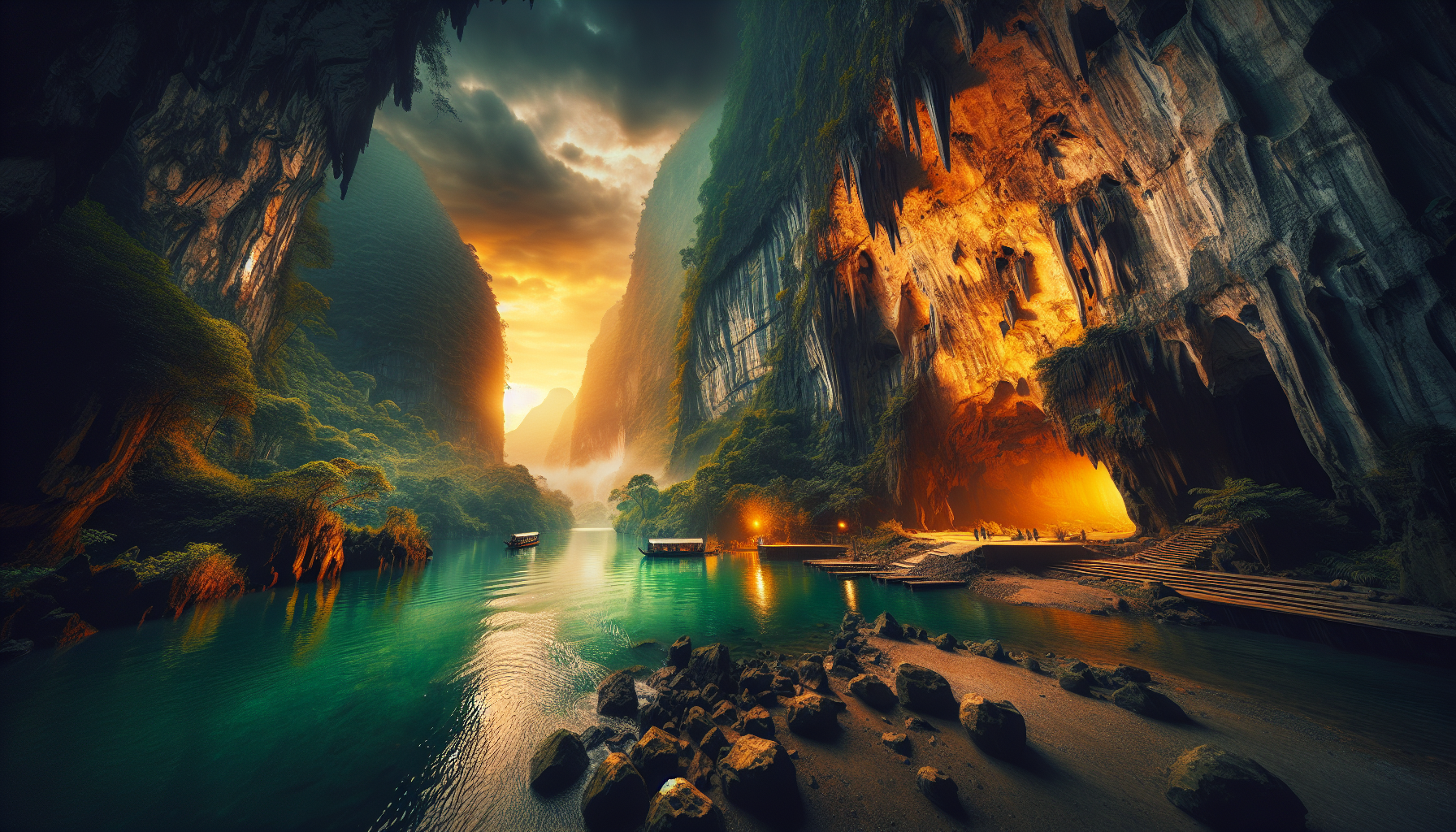
The Phong Nha travel guide you have been searching for begins with a single, staggering fact: beneath the limestone mountains of central Vietnam lies the largest cave on Earth. Phong Nha-Kẻ Bàng National Park is not merely a geological curiosity — it is a world of underground rivers, cathedral chambers, and prehistoric jungles that exists beyond ordinary imagination. If you have ever stood at the threshold of something truly overwhelming and felt the smallness of yourself, Phong Nha will give you that feeling, and it will never quite leave you.
This guide covers everything you need to plan your visit: the caves you absolutely must see, how to get here, when to come, where to stay, and how to make the most of one of Vietnam’s most extraordinary natural treasures.

Phong Nha Travel Guide: The Caves You Cannot Miss
Phong Nha-Kẻ Bàng is a UNESCO World Heritage Site containing over 300 surveyed caves and grottos — and scientists believe hundreds more remain undiscovered beneath the jungle. The park sits in Quảng Bình province, tucked into the Bố Trạch district, roughly midway between Hanoi and Ho Chi Minh City. What makes it singular is not just the number of caves but their extraordinary scale and age: the karst landscape here is over 400 million years old, making it one of the oldest of its kind in Asia.
For first-time visitors, Phong Nha Cave itself is the essential entry point. You reach it by a traditional wooden boat that drifts upstream on the Son River, past clifftops draped in jungle vines, into a cave mouth that swallows light whole. Inside, the cavern opens into vast chambers illuminated by coloured lights that feel almost theatrical against the ancient limestone — formations shaped over millions of years into curtains, columns, and pools of liquid crystal. The cave stretches for over seven kilometres, though tours take you through the most spectacular section. The boat ride alone, gliding through darkness with the sound of dripping water echoing off unseen walls, is one of those travel moments that feels genuinely cinematic.
Paradise Cave — Động Thiên Đường — is the other cave that no Phong Nha travel guide can overlook. Discovered in 2005 and opened to tourists in 2010, it runs for over 31 kilometres and contains some of the most breathtaking formations in the world. The entrance opens onto a boardwalk that winds through a chamber roughly the size of a cathedral, its vaulted ceiling hung with stalactites that look like frozen waterfalls. The light inside shifts as you move deeper, from pale silver to golden amber, and the silence is so complete it feels almost reverential. A standard tour covers the first kilometre, but adventurous visitors can book a longer trekking option that ventures deeper into the cave’s extraordinary interior.
Dark Cave — Động Tối — offers something entirely different: an adventure experience where visitors zip-line into the cave entrance, kayak through an underground river, and wade through a surreal mud pool inside the darkness. It is chaotic, joyful, and unlike anything else in Vietnam. If you are travelling with a group or simply want to swap awe for adrenaline for a few hours, Dark Cave earns its reputation.

Son Doong Cave: Standing Inside the World’s Largest Cave in Vietnam
To speak of Son Doong is to reach for words that feel inadequate. Discovered in 1991 by a local farmer who heard wind rushing from the jungle floor, and only fully explored by British cavers in 2009, Sơn Đoòng was confirmed as the world’s largest cave by volume — so vast that a Boeing 747 could fly through its main chamber. It has its own weather system. It contains a jungle. There are beaches inside it.
Standing at the Garden of Edam — a section where the cave ceiling has collapsed, allowing sunlight to pour in and an entire ecosystem of prehistoric-looking plants to grow in the middle of the mountain — you understand something essential about the planet’s capacity for secrets. The cave’s main passage stretches for nearly nine kilometres, reaching heights of up to 200 metres and widths of 150 metres. The stalagmites that rise from the cave floor are among the tallest ever found, some reaching 70 metres — taller than a 20-storey building.
Access to Son Doong is strictly controlled. Only Oxalis Adventure Tours holds the permit to lead expeditions inside, and the four-night, five-day jungle trek — which involves camping both inside and outside the cave — is capped at a limited number of visitors per year. The cost is significant (typically around USD 3,000 per person), and expedition dates are booked months in advance. If a Son Doong expedition is your dream, planning should start at least six to twelve months ahead.
For those who cannot secure a Son Doong permit or budget, Hang En Cave offers a taste of the same world. The third-largest cave on Earth, Hang En is reached via a two-day trek through jungle and river crossings, with a night camping on a sandy beach inside the cave itself, serenaded by the sound of swallows — the cave’s namesake — swooping through the chamber at dusk.
Getting to Phong Nha from Hue, Da Nang, and Hanoi
Phong Nha’s relative remoteness is part of its appeal — the journey here feels like an approach, a gradual withdrawal from the ordinary world — but it is more accessible than it once was. The nearest town is Đồng Hới, the capital of Quảng Bình province, which has its own domestic airport served by daily flights from Hanoi and Ho Chi Minh City. From Đồng Hới, Phong Nha is roughly 45 kilometres northwest — about an hour by taxi or motorbike.
The train is the most atmospheric option, especially from Hue or Da Nang. The route passes through some of central Vietnam’s most arresting scenery, crossing the Hải Vân Pass tunnel and hugging the coastline before heading inland. From Hue, the journey to Đồng Hới takes around three to four hours; from Da Nang, roughly five hours. If you are making your way down Vietnam’s coast and have already explored Da Nang’s beaches and marble mountains, the train north to Phong Nha is a seamless continuation of the adventure.
By bus, several open-tour operators run services from Hue, Da Nang, and Hanoi directly to Phong Nha town, which saves you the Đồng Hới transfer. Journey times range from four hours from Hue to around ten hours from Hanoi. Overnight sleeper buses from Hanoi are a popular option for budget travellers — you board, sleep, and arrive at dawn with a full day ahead.
Renting a motorbike for part of the journey is increasingly popular among the kind of travellers drawn to Vietnam’s wilder corners. The road from Đồng Hới to Phong Nha winds through rubber plantations and rice paddies, with limestone peaks appearing suddenly on the horizon — the kind of approach that makes arrival feel earned. If the Ha Giang Loop is Vietnam’s great northern ride, the road to Phong Nha is its quieter, southern counterpart. For more on exploring Vietnam by two wheels, the ultimate motorbike adventure guide has everything you need to plan a road trip.

Best Time to Visit Phong Nha and Kẻ Bàng National Park
Timing your Phong Nha visit requires some care, because the park’s position in central Vietnam means it sits in a climatic sweet spot that can quickly turn against you. The short answer: February to August is the best window, with the peak of the dry season falling between April and June.
During the dry season, river levels are low enough for cave boat tours to operate comfortably, jungle trek paths are passable, and the air carries that particular clarity that makes mountain landscapes feel razor-sharp. April and May bring vivid green to the jungle canopy — the rains of the previous season still flushing through the root systems — while remaining reliably dry underfoot.
The rainy season hits Quảng Bình province from September through January, and it hits hard. Central Vietnam’s geography funnels monsoon rains and typhoons directly into this coastal strip, and flash flooding can close cave tours, submerge trekking routes, and make the Son River impassable for days at a time. Some caves, including Phong Nha Cave itself, close entirely when water levels rise. That said, the off-season shoulder months — February and March — can be rewarding for visitors willing to accept occasional rain: the crowds thin dramatically, accommodation prices drop, and the landscape feels vivid and alive after the seasonal deluge.
If your goal is Son Doong, note that the expedition season runs from January to August, with the majority of groups going in April and May. Expedition permits for these months sell out far earlier than the cave’s logistical constraints might suggest — demand consistently outpaces supply.
Phong Nha’s national park is one of Vietnam’s most spectacular protected areas, and understanding the seasonal rhythms of its caves and jungles is as important as booking your accommodation. Plan around the weather, and the park will reward you generously.
Where to Stay in Phong Nha: Jungle Lodges, Homestays and Riverside Guesthouses
The town of Phong Nha — formally Son Trach — is a small riverside settlement that has evolved steadily to serve the growing stream of visitors drawn by the caves. It is not a resort town; it is a working village that happens to sit at the edge of one of the world’s great wilderness areas, and that quality — the everyday normality of it — is part of its charm.
Budget travellers will find a solid spread of guesthouses and hostels along the main road and riverfront, many family-run and offering excellent value. Rooms with river views, a fan, and a clean bathroom can be found for well under USD 20 a night. These places tend to be the best sources of local knowledge: the family who runs your guesthouse likely knows which cave guides are worth booking and which food stalls open earliest.
The mid-range is anchored by a handful of boutique hotels and eco-lodges that have emerged as Phong Nha’s reputation has grown. Several properties sit outside town proper, set into the jungle or along secondary rivers, where birdsong replaces traffic noise and the limestone peaks are framed by your breakfast window. These lodges often arrange their own cave and trekking tours, making them convenient if you prefer a managed itinerary.
At the top end, Phong Nha Farmstay — one of the area’s pioneering guesthouses, now expanded into a full resort — remains a benchmark for the region. Its pool, its knowledgeable team, and its longstanding relationship with the caving and trekking community make it a natural hub for serious cave explorers. Booking ahead is essential in peak season.
Wherever you stay, make sure to spend at least one evening at the riverside — the sun dropping behind the karst peaks turns the sky a succession of colours that defy easy description, and the reflection in the Son River holds the light long after the horizon has gone dark.
Conclusion: Why Phong Nha Stays With You
There is a particular quality to the Phong Nha experience that separates it from almost anywhere else in Vietnam. The country offers extraordinary things — the energy of Hanoi, the grace of Hoi An, the highlands of the north — but Phong Nha offers something more primal. The darkness of a cave chamber. The impossibility of Son Doong’s scale. The sound of a river disappearing into a mountain. These are encounters not just with nature but with deep time, with a planet that was building cathedrals long before any human ever thought to.
Whether you spend two days or two weeks in Phong Nha, you will leave with photographs that fail to capture what you saw and memories that persist precisely because no image could contain them. That, ultimately, is what the world’s greatest cave system offers: an experience that remains stubbornly, wonderfully beyond the frame.
How do I book a Son Doong Cave tour?
Son Doong expeditions are exclusively operated by Oxalis Adventure Tours, the only company licensed to enter the cave. Tours run from January to August and must be booked directly through Oxalis. Given the strictly limited number of participants per season, bookings should be made 6–12 months in advance. The full 5-day/4-night expedition costs approximately USD 3,000 per person.
What is the best cave to visit in Phong Nha for a first-timer?
For first-time visitors, the combination of Phong Nha Cave (reached by boat up the Son River) and Paradise Cave offers the most complete introduction to the park. Phong Nha Cave provides the classic river-cave experience, while Paradise Cave showcases some of the world’s most dramatic stalactite formations. Both can be visited in a single day.
Is Phong Nha suitable for families with children?
Yes — Phong Nha Cave and Paradise Cave are both accessible to children and involve minimal physical exertion. Dark Cave’s zip-line and mud pool are popular with older children and teenagers. The more challenging trekking expeditions (Hang En, Son Doong) require a reasonable level of fitness and are generally suited to adults. The town itself is small, safe, and family-friendly.
Is Phong Nha-Kẻ Bàng a UNESCO World Heritage Site?
Yes. Phong Nha-Kẻ Bàng National Park was inscribed as a UNESCO World Heritage Site in 2003 for its outstanding geological values, and the inscription was extended in 2015 to recognise its exceptional biodiversity. The park protects one of the world’s most significant karst landscapes and is home to numerous rare and endemic species. Full details are available at the UNESCO World Heritage site listing.
How many days should I spend in Phong Nha?
A minimum of two full days allows you to visit Phong Nha Cave, Paradise Cave, and Dark Cave comfortably. Three days lets you add a day hike into the national park or a longer cave experience such as the Hang Va or Nuoc Noc cave trek. The Hang En two-day trek requires two nights in the area, and Son Doong is a five-day commitment. Most independent travellers spend between two and five days in Phong Nha.
Leave a Reply