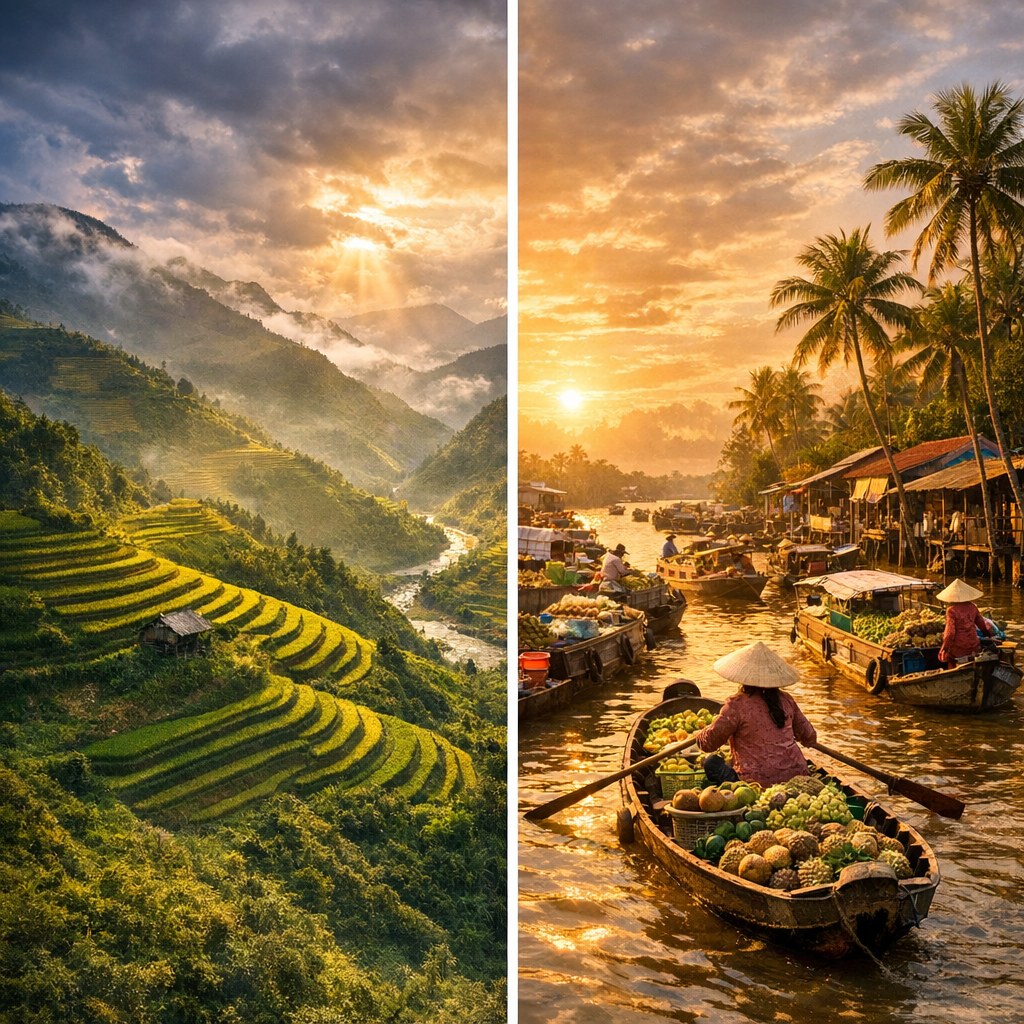
North vs South Vietnam is the first question every traveller wrestling with a limited itinerary has to answer. Do you spend your time in the misty highlands of Sapa, the ancient streets of Hanoi and the dramatic karst seascape of Ha Long Bay? Or do you lose yourself in the chaos and warmth of Ho Chi Minh City, drift through the Mekong Delta on a sampan and watch the sun set over a Hội An lantern-strewn canal? Both halves of Vietnam are extraordinary. They are also, in meaningful ways, different countries.
This guide doesn’t pretend there’s a universal right answer — because there isn’t. But it will give you the honest comparisons you need: landscapes, food, weather, costs, crowds and the kind of traveller each region suits best. By the end, you’ll know which half to visit first — or how to fit both into a single trip.
The Case for North Vietnam: Ancient Culture, Mountain Drama and Hanoi’s Soul
The north is where Vietnam feels oldest. Hanoi, the capital, is a city that wears its history visibly — French colonial villas shoulder up against crumbling tube houses in the Old Quarter, vendors in conical hats push carts through streets that have been commercial for a thousand years, and the smell of phở bò drifts from doorways before sunrise. This is the Vietnam of UNESCO heritage sites and imperial resonance, of lakes shrouded in morning mist and temples burning incense at the hour when the city wakes.
Beyond Hanoi, the north opens into landscapes of almost theatrical drama. Ha Long Bay needs little introduction — 1,600 limestone karst islands rising from jade-green water, best seen from the deck of a junk boat at dawn when the mist is still low and the bay belongs entirely to you. Further inland, the terraced rice fields of Sapa and the provinces of Hà Giang and Yên Bái offer some of the most spectacular agricultural landscapes in all of Asia. During harvest season (September to October), the stepped terraces glow gold from hillside to hillside. And the Ha Giang Loop — four days on a motorbike through the northernmost mountain provinces — is one of the most breathtaking road journeys on the continent.
The north also offers more immediate access to the ethnic minority cultures of Vietnam’s highland peoples — the Hmong, Dao, Tày and dozens of other groups whose embroidered clothing, silver jewellery and highland villages are living expressions of traditions that predate the Vietnamese state. Markets in Bắc Hà and Đồng Văn are genuinely extraordinary on Sunday mornings.
Northern food is more restrained than the south — less sweet, less abundant in herbs, more focused on the quality of a single base ingredient. Hanoi’s phở is considered the original and definitive version. Bún chả (grilled pork with rice noodles and dipping broth) is a northern staple. Chả cá Lã Vọng — turmeric fish grilled at the table on charcoal braziers — is a Hanoi institution worth building an itinerary around.
North Vietnam suits you if: you’re drawn to history and culture over beaches; you want mountain trekking and minority village homestays; you’re visiting in September–November (harvest season) or February–April; you appreciate a slower, cooler travel pace.
The Case for South Vietnam: Mekong Warmth, Beach Escapes and Saigon’s Energy
The south runs hotter in every sense. Ho Chi Minh City — still called Saigon by nearly everyone who lives there — is one of Southeast Asia’s great cities of momentum. It moves fast, eats late, stays loud until 2am and greets every foreigner with an energy that is simultaneously overwhelming and irresistible. The French colonial architecture hasn’t disappeared — the Post Office, the Notre-Dame Cathedral, the grand boulevards of District 1 — but it has been absorbed into something entirely Vietnamese: a roaring, honking, perpetually surprising megacity of 10 million people who seem to be having a better time than anyone anywhere.
The food in the south is more abundant and more varied than in the north. Everything comes with a larger plate of fresh herbs, everything is sweeter (coconut milk appears in unexpected places), and the portions are more generous. Hủ tiếu (pork noodle soup) is the southern answer to northern phở. Bánh mì sandwiches reached their fullest expression here. Bò lá lốt (beef wrapped in betel leaves), cơm tấm (broken rice with grilled pork) and a hundred street-corner variations keep visitors eating four times a day without effort or regret.
Beyond Saigon, the south offers its own landscape drama — just of a completely different register. The Mekong Delta is flat, lush and waterlogged, a vast alluvial plain threaded by canals and rivers where life is conducted largely by boat. Floating markets at Cái Răng and Phong Điền begin before sunrise; sampans piled with dragon fruit, pomelos and pineapples jostle for space at the water’s edge. Further south, the island of Phú Quốc has international-standard beaches and is growing rapidly as a resort destination. The province of Bình Thuận gives you Mui Ne — sand dunes, kitesurfing and some of the sunniest weather in Vietnam year-round.
South Vietnam suits you if: you’re energised by cities, street food and beach time; you want to see the Mekong Delta or Phu Quoc; you’re visiting in the dry season (November to April); you prefer warmth over altitude and culture over wilderness.

Central Vietnam: The Third Option Worth Considering
Many travellers frame this as a binary choice and overlook central Vietnam entirely — which is a significant mistake. The centre of the country contains some of its most compelling destinations, and it functions naturally as a bridge between north and south for those doing the full route.
Hội An is the jewel: a UNESCO-listed Ancient Town of perfectly preserved 15th-century merchant architecture, lantern-lit at night, cycling-accessible by day and surrounded by excellent beaches and fine tailors. Da Nang, 30km to the north, has transformed itself into Vietnam’s most liveable city — modern infrastructure, excellent restaurants, accessible marble mountain temples and the famous Dragon Bridge that breathes real fire on weekend evenings. Our Da Nang travel guide is a good starting point for planning time in the centre.
Huế, the former imperial capital, is gloomier and more melancholic than either Hội An or Da Nang — a deliberate, reflective city where the citadel, royal tombs and pagodas reward those who slow down and pay attention. The food here is also exceptional: Huế cuisine is considered Vietnam’s most refined and complex, a legacy of the royal court’s culinary ambitions.
Phong Nhã-Kẻ Bàng National Park — home to the world’s largest cave system — is technically in the centre-north and represents something available in neither the north nor the south: truly world-class caving and underground exploration at a scale that still manages to surprise even experienced travellers. Our Phong Nha travel guide covers the cave options in detail.
Weather and Seasons: How the Monsoon Shapes Your Decision
Vietnam’s geography means the north and south are not always in season simultaneously — a critical planning consideration that often gets overlooked.
The south has a straightforward two-season climate. The dry season (November to April) is consistently sunny, warm and excellent for travel. The wet season (May to October) brings afternoon downpours — heavy but often brief — and high humidity. Most of the south remains perfectly travelable year-round; the rain just requires slightly more flexibility.
The north is more complicated. Hanoi and the Red River Delta have a genuine winter (December to February) — cool, drizzly, occasionally cold enough for a jacket. The highlands around Sapa can see temperatures near freezing and occasional frost. But this is also when the mountains are most dramatically atmospheric, and when the spring flower season begins. March to May and September to November are generally considered the best windows for northern Vietnam.
Ha Long Bay is subject to typhoon risk from June to September, and the bay can be choppy during the northeast monsoon (November to January). The sweet spot for cruising is October–November and March–April.
The central coast — Hội An and Da Nang — has its own distinct seasonal challenge: heavy rain and occasional flooding from October to December, when the southwest monsoon turns northeast and dumps significant rainfall on the coastal provinces. Plan accordingly if your itinerary includes this region in late autumn.
Our comprehensive month-by-month weather and festival guide breaks down every region across all 12 months — essential reading before you book flights.
Costs, Crowds and Practicalities: North vs South
In pure cost terms, north and south Vietnam are broadly comparable for most travel categories. Accommodation, street food and local transport are similarly priced across the country — Vietnam remains one of Southeast Asia’s best value destinations, and our guide to travelling Vietnam on a budget shows how to do it comfortably for under $50 a day in either region.
Where differences emerge is in the tourist-to-local ratio. Hanoi’s Old Quarter and Hội An are heavily touristed and prices at cafes and restaurants aimed at visitors reflect this. Ha Long Bay cruise prices have risen significantly in recent years as quality operators have expanded. In the south, Ho Chi Minh City has a better ratio of visitor-facing and local-facing businesses than Hanoi, and the Mekong Delta — despite being easily accessible — sees far fewer foreign tourists than the northern highlights.
Getting between north and south is easy and relatively cheap. Vietnam Airlines, VietJet and Bamboo Airways all operate multiple daily flights on the Hanoi–Ho Chi Minh City route for $30–$80 depending on booking window. The Reunification Express train takes 30–35 hours for the full journey but stops at all major central destinations along the way and offers an extraordinary window-seat view of rural Vietnam. Our guide to getting around Vietnam covers every transport option in detail.

Can You Do Both? The Classic North-to-South Route
If you have two weeks or more, the answer is almost always: do both. The classic Vietnam itinerary runs from Hanoi in the north to Ho Chi Minh City in the south (or vice versa), stopping at Ha Long Bay, Hội An and the central coast along the way. This is one of the world’s great travel routes — varied enough to feel like three different countries, connected enough by cheap internal flights and good trains that the logistics rarely become burdensome.
Our two-week Vietnam itinerary maps out a day-by-day route that balances the highlights of both halves without rushing. For travellers with less time, the decision becomes more important: one week in the north gives you Hanoi and Ha Long Bay; one week in the south gives you Saigon and a Mekong day trip; one week in the centre gives you Hội An and Da Nang. None of these is a wrong choice.
The most common mistake is trying to cover the whole country in seven days — which means spending more time in transit than at destinations. Pick a region, go deep, and save the rest for the next trip. Vietnam is the kind of country that earns return visits effortlessly.
Whichever half you choose, consider your travel style honestly: if you want mountains, culture and history, start north. If you want cities, warmth, food abundance and beaches, start south. If you want the finest ancient town in Southeast Asia and some of the country’s most complex cuisine, go to the centre. And if someone tells you there’s a definitive answer to north vs south Vietnam — they haven’t travelled both halves properly.
Is north or south Vietnam better to visit?
Neither half is objectively better — they offer very different experiences. North Vietnam has more dramatic mountain landscapes (Ha Long Bay, Sapa, Ha Giang), a cooler climate, ancient culture and Hanoi’s historic depth. South Vietnam has warmer weather year-round, the Mekong Delta, livelier cities (Ho Chi Minh City), more beach options and a richer street food scene. Your choice should reflect your travel style and the time of year you’re visiting.
Should I start my Vietnam trip in Hanoi or Ho Chi Minh City?
Either works as an entry point. Flying into Hanoi and out of Ho Chi Minh City (or vice versa) is the most efficient approach for a full-country route, as it avoids backtracking. If you’re only visiting one region, choose the city that anchors your itinerary. Both have international airports with good regional connections.
How long do you need to see both north and south Vietnam?
Two weeks is the minimum to do both halves justice without feeling rushed. Three weeks allows a more comfortable pace with time for day trips, detours and slow mornings. A week is enough for one region only — trying to see the entire country in seven days results in too much time in transit and too little time at destinations.
Is northern or southern Vietnam more expensive?
Costs are broadly similar across Vietnam. Both regions have excellent budget options for food and accommodation. Ha Long Bay cruises and Sapa trekking packages in the north can add costs; resort-style accommodation in southern beach destinations like Phu Quoc also pushes prices up. City travel (Hanoi or Ho Chi Minh City) is comparably priced between north and south.
What is the best time of year to visit north Vietnam?
The best times for north Vietnam are March to May (spring — warm, drier, green landscapes) and September to November (autumn — harvest season in the rice terraces, cooler temperatures, fewer tourists). December to February brings genuine winter cold to Hanoi and the highlands. June to August is humid and hot, with typhoon risk on the coast.
Leave a Reply