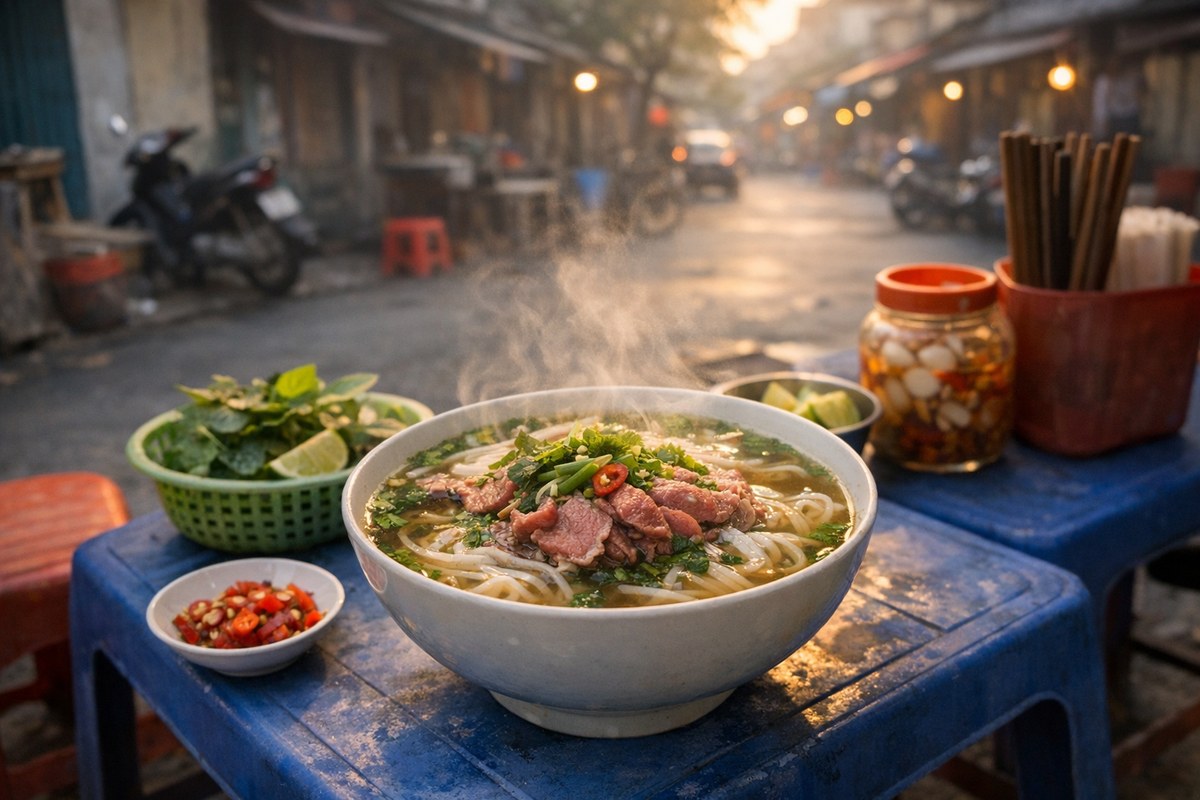
The best pho Vietnam has to offer is not found in a guidebook list but in a plastic stool at the edge of a pavement, as steam curls into the cool dawn air. This pho Vietnam guide walks you through the soup that made Vietnamese cooking famous worldwide: where it began, why Hanoi and Saigon argue over it, and how to eat a bowl the way locals do.
Pho (pronounced roughly “fuh”) is deceptively simple: rice noodles, thin slices of beef or chicken, and a broth that has simmered for hours. Yet a single spoonful can hold charred ginger, star anise, cinnamon, clove and the faint sweetness of slow-cooked bones. It is the sound of Vietnamese mornings, the clink of spoons and the hiss of ladles, and it deserves a place near the top of any Vietnam itinerary.
The Story of Pho: How Vietnam’s Famous Noodle Soup Began
Pho emerged in the northern Red River Delta in the late nineteenth and early twentieth centuries, most likely around Nam Dinh and Hanoi. Historians still debate its roots, which probably blend Vietnamese rice-noodle traditions with Chinese noodle soups and the French appetite for beef, a meat that was far less common in Vietnamese kitchens before colonial times. Some even link the name to the French pot-au-feu, though that theory is hotly contested.
What is certain is how pho travelled. Street vendors carried shoulder poles with a charcoal burner at one end and a pot of broth at the other, selling bowls to factory workers and rickshaw drivers. After 1954, northerners moving south brought their recipes to Saigon, where the soup evolved into the bigger, bolder, more garnished style found there today.
- Origin: northern Vietnam, early 20th century
- Influences: Vietnamese rice noodles, Chinese soups, French beef culture
- Spread: carried south in the mid-1950s and worldwide after 1975
Today pho is a point of national pride, and the government tourism board lists food among the reasons to visit; see the official Vietnam National Authority of Tourism for culinary and cultural highlights. Eating pho is the fastest way to understand a country in which nothing is wasted and everything is layered with flavour.
Pho Bo vs Pho Ga: Understanding the Types of Pho in Vietnam
Walk into any pho shop and you will see a short, confident menu. Learning a few words makes ordering effortless, and it is the first step to getting the bowl you actually want.
Pho bo is the beef version and the classic. Pho tai comes with rare slices of beef that cook gently in the hot broth at your table. Pho chin uses well-done brisket, pho nam is flank, pho gan adds tendon, and pho sach is for the adventurous, with tripe. Ask for pho dac biet, the “special” bowl, and you will usually receive a little of everything. Pho ga, made with chicken, has a cleaner, lighter broth and is a favourite for gentle stomachs and quiet evenings.
You will also meet variations on the theme. Pho cuon turns the noodles into fresh rolls wrapped around herbs and beef, a Hanoi speciality. Pho xao is stir-fried, the noodles blistered in a wok with beef and greens. Pho chien phong is puffed, golden fried noodle squares served with a rich topping.
- Beef bowls: tai (rare), chin (well-done), nam (flank), gan (tendon), dac biet (special)
- Chicken: pho ga, with a lighter broth
- Beyond soup: pho cuon (rolls) and pho xao (stir-fried)
Vegetarians are not forgotten either: look for pho chay at Buddhist vegetarian restaurants, especially around full-moon days, when temples and nearby cafes fill with meat-free versions.
Hanoi Pho vs Saigon Pho: A Friendly Rivalry

Ask a Hanoian and a Saigonese which pho is better and you will start a delightful argument. The truth is that they are two different dishes sharing one name.
Hanoi pho is elegant and restrained. The broth is clear and savoury, pulled from beef bones, roasted ginger and shallots, and finished with a little fish sauce. The noodles are wide and silky. The garnish is minimal: chopped spring onion, coriander, perhaps a few slices of raw onion and a spoon of fiery chilli. Many old-school northerners frown on adding sweet sauces, believing a great broth needs no help. If you are exploring the capital, our Hanoi travel guide points you to the Old Quarter lanes where these dawn bowls are served.
Saigon pho is generous and playful. The broth is a touch sweeter, often spiced more boldly, and the bowl arrives with a heaped plate of Thai basil, culantro, bean sprouts, lime wedges and chillies. A bottle of hoisin and a pot of chilli sauce sit on the table, and diners happily squirt both into a small dish for dipping meat. If your trip includes the south, the Ho Chi Minh City travel guide shows where to start.
- Hanoi: clear broth, wide noodles, minimal herbs, little to no sweet sauce
- Saigon: sweeter broth, plate of fresh herbs, hoisin and chilli at the table
- Central Vietnam: expect different noodle soups entirely, such as bun bo Hue
The honest advice is to try both. Our guide to north versus south Vietnam explains how food, climate and culture shift as you travel the length of the country.
How to Eat Pho Like a Local: Etiquette and Tips
A pho shop has its own quiet choreography, and a few habits will have the staff smiling at you. First, taste the broth before adding anything. A good cook has balanced it already, and the first sip is a small gesture of respect. Then add what you like: a squeeze of lime, a few slices of chilli, a dash of vinegar-soaked garlic if it is offered, and herbs torn into the bowl. Southerners tear basil and drop in sprouts; northerners often skip them.
Use chopsticks in your right hand for noodles and a spoon in your left to catch the broth. It is perfectly normal to slurp. Lift the noodles high, let them cool for a second, and bring a little broth with every mouthful. Finish the meat first if you like, but do not leave the soup; the last spoonfuls are the best.
Many pho stalls offer quay, long fried dough sticks, for dunking. They soak up broth like a sponge and are a delicious Hanoi tradition. A glass of iced tea (tra da) usually arrives free.
- Taste first, season second
- Slurping is encouraged; leaving broth behind is not
- Dip fried dough sticks (quay) in the soup in Hanoi
- Pay at the counter or when you leave; prices are usually posted
If you are nervous about street food, read our guide to Vietnam street food safety. The short version: choose a busy stall, check that the broth is steaming, and watch where the locals sit. Pho is also one of the most popular dishes of a classic Vietnamese breakfast, so rise early and join the crowd.
Where to Find the Best Pho in Vietnam

There is no single best pho in Vietnam, but there are neighbourhoods where it feels as though you cannot go wrong. In Hanoi, wander the Old Quarter and the lanes around Hoan Kiem Lake before 8am; the queue at a stall is usually the best review. Look for shops that do one thing, with a huge pot at the front and a steady rhythm of ladles and bowls. In Ho Chi Minh City, the streets of District 1 and the quieter districts to the north of the centre hold some of the city’s most beloved shops, many of them family businesses that have fed the same neighbourhood for decades.
Outside the two big cities, regional versions are worth the detour. In Nam Dinh, thought of as the birthplace of the dish, the broth is famously bold. In Hoi An, the cheerfully chaotic markets serve noodle bowls you will want to compare. Ha Giang, Sapa and the northern highlands offer comforting mountain pho on cold mornings, ideal after a day on the Ha Giang Loop.
How to spot a great stall:
- A short menu and a big, steaming pot
- Locals filling low stools, especially before 8am
- Fresh herbs on the table, not wilted
- Bones and charred ginger visible near the kitchen
Budget is no barrier either. A bowl from a local stall costs a few dollars at most, which is why pho features so often in our guide to travelling Vietnam on a budget. For a deeper appreciation, a hands-on lesson helps; see our guide to Vietnamese cooking classes.
Making Pho: Broth, Spices and Learning to Cook It

Behind every pho is a broth, and behind every broth is patience. Beef bones are blanched, rinsed and simmered for many hours, often overnight. Ginger and onions are charred over open flame until they smell smoky and sweet. A pouch of spices joins the pot: star anise, cinnamon, cloves, black cardamom, coriander seed and fennel. Rock sugar and fish sauce round out the flavour, and the cook skims the surface constantly so the broth stays clear.
The noodles, banh pho, are made from rice flour and sold fresh each morning. Slices of beef are cut paper-thin so they cook the moment hot broth hits them. Everything is assembled in seconds, which is part of the show.
If you want to bring the flavour home, book a class in Hoi An, Hanoi or Ho Chi Minh City. Most start with a market walk, where you will learn to pick herbs, spices and the right noodles, then finish with a bowl you made yourself. It is a memorable way to spend a morning, and a souvenir that lasts longer than a magnet.
- Key aromatics: charred ginger, onion, star anise, cinnamon, clove
- Simmer time: many hours, often overnight
- Best learned at: a market-to-table cooking class
Frequently Asked Questions
What is pho and how do you pronounce it?
Pho is a Vietnamese noodle soup of flat rice noodles in a long-simmered, aromatic broth, topped with beef (pho bo) or chicken (pho ga). It is pronounced roughly ‘fuh’, with a rising tone, rather than ‘foe’.
What is the difference between Hanoi pho and Saigon pho?
Hanoi pho is clear, subtle and served with spring onion and chilli, with few extras. Saigon pho is sweeter and richer, arrives with a plate of basil, bean sprouts, culantro and lime, and comes with hoisin and chilli sauce at the table.
How much does a bowl of pho cost in Vietnam?
Expect roughly 40,000 to 70,000 VND (about 1.60 to 2.80 USD) at a local street stall, and more at a restaurant or in a tourist area. Prices rise a little for extra beef or a special bowl.
When do Vietnamese people eat pho?
Traditionally for breakfast, but pho is eaten all day, and many famous stalls open before dawn and sell out by late morning. Some Hanoi shops also serve it late at night.
Is pho safe for travellers to eat?
Yes, for most people. Pick a busy stall with high turnover, where the broth is bubbling hot and the herbs are fresh, and the risk is low.
Plan Your Pho Pilgrimage
Pho is more than lunch. It is a daily ritual, a family business, a national treasure and a doorway into Vietnamese life. Start with a Hanoi dawn bowl, follow it with a lush Saigon plate of herbs, and let the contrast teach you how one country can hold so many tastes. Come hungry, arrive early, and let the steam lead you.
Ready to taste it for yourself? Start planning your Vietnam trip today, and leave room in your suitcase and your stomach.
Leave a Reply