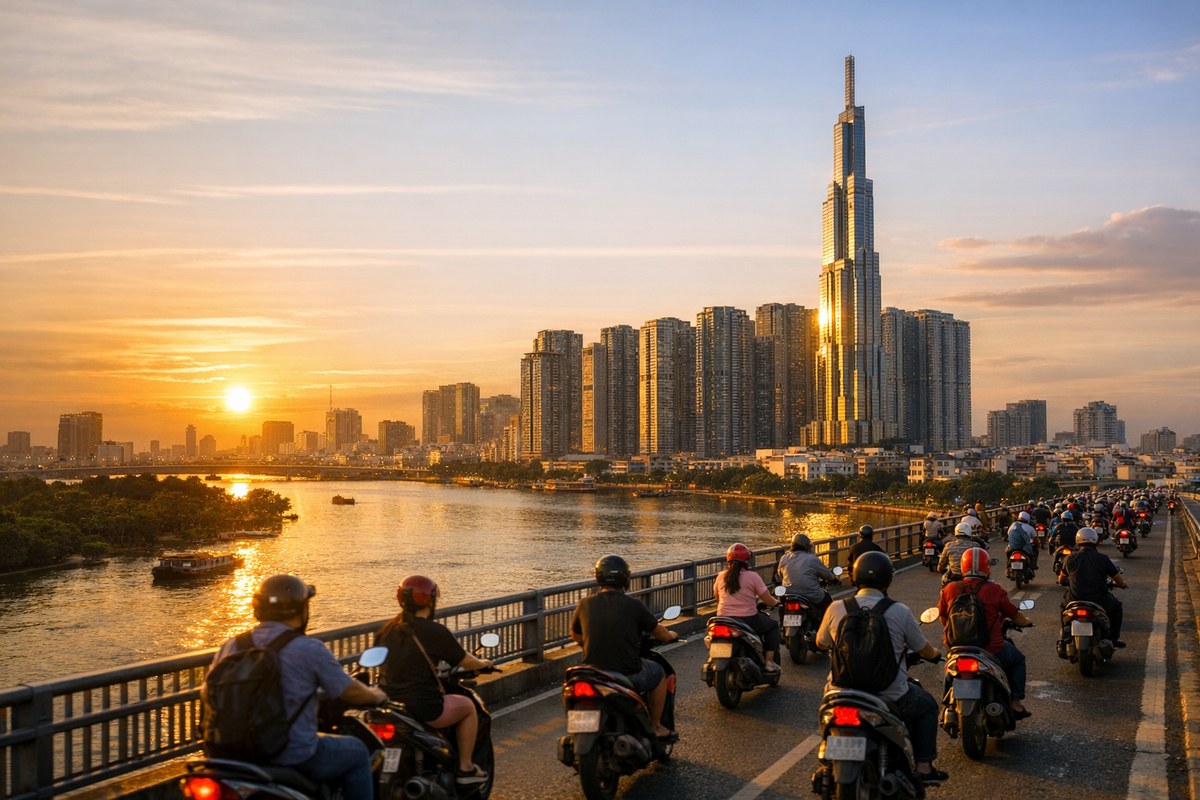
A Ho Chi Minh City 3 days itinerary should feel like Saigon itself: fast, delicious, a little chaotic and impossible to forget. This is Vietnam’s biggest city, a place where glass towers rise beside French colonial boulevards, where motorbikes pour through intersections like rivers and where a plastic stool on a pavement can serve the best meal of your trip.
Three days is enough to meet the city’s heart. You will wander the colonial core, confront the history of the war, eat your way through markets and, if you choose, escape to the tunnels or the Mekong. For wider context, see our full Ho Chi Minh City travel guide.
Ho Chi Minh City 3 Days Itinerary: Before You Go
A few decisions will shape your trip. First, where to stay: District 1 puts you within walking distance of most sights and puts the best street food on your doorstep. District 3 is calmer, with leafy streets and boutique cafes, while Thao Dien, in District 2 across the river, has a relaxed, international feel.
Second, when to come. The dry season, from December to April, is warm and sunny. The wetter months from May to November bring heavy but brief afternoon downpours; mornings are often clear, and the city is greener and cheaper. Our best time to visit Vietnam guide has a full month-by-month breakdown.
Third, how to move. Use ride-hailing apps for cars and motorbike taxis; they are cheap, and the price is shown before you go. Crossing the road is an art: walk slowly and steadily, never run, and let the motorbikes flow around you. For wider transport tips, read about getting around Vietnam.
- Base: District 1 for convenience, District 3 for calm
- Weather: dry season December to April, brief showers May to November
- Transport: ride-hailing apps, walking, taxis
- Cash and cards: carry small notes; see our Vietnam money guide
Day 1: Colonial Saigon and Old City Landmarks
Begin with the elegant heart of old Saigon. Start early, before the heat builds, at Notre-Dame Cathedral Basilica, built in the 1880s from bricks shipped from Marseille. Just across the square, the Saigon Central Post Office is a feast of arched ceilings, old maps and green-and-yellow tiles. Buy a postcard and send it home from a building designed in the French colonial era; our guide to Vietnam’s French colonial legacy explores this layer of the city further.
Continue down Dong Khoi Street, once Saigon’s grand shopping avenue, to the Opera House and the Ho Chi Minh City People’s Committee Building, lit beautifully at night. For a late-morning pick-me-up, climb the stairs of the Cafe Apartments at 42 Nguyen Hue, a former apartment block now stacked with coffee shops. A cup of ca phe sua da, coffee with condensed milk over ice, is the right fuel.
After lunch, visit the Reunification Palace, where the war effectively ended on 30 April 1975. Its 1960s architecture, underground war rooms and rooftop helipad are a time capsule. End the afternoon in the leafy lanes of District 3 and its quiet pagodas, then take dinner to the Ben Thanh Street Food Market area.
- Morning: Notre-Dame Cathedral, Central Post Office
- Midday: Dong Khoi, Opera House, Cafe Apartments
- Afternoon: Reunification Palace
- Evening: street food near Ben Thanh

Day 2: War History, Markets and Saigon Street Food
Day two is the most emotionally powerful. Begin at the War Remnants Museum, an honest and sometimes confronting account of the Vietnam War from the Vietnamese perspective. Give it at least ninety minutes and arrive when it opens to avoid the crowds. It is not an easy visit, but it deepens everything you see afterwards. For further context, read our guide to the Vietnam DMZ tour.
Shift gears with a walk through Ben Thanh Market, a century-old covered market that is pure sensory overload: dried mangoes, lacquerware, coffee beans, silk scarves and cheerful haggling. Prices are higher than at local markets, so bargain politely. For more local flavour, try Binh Tay Market in Cholon, the city’s Chinatown, where you can visit the grand Thien Hau Temple, thick with incense smoke.
In the late afternoon, switch to food. Saigon’s street food is legendary: banh mi sizzling with pate and pickles, com tam broken rice with grilled pork, banh xeo crispy sizzling pancakes, and fragrant bowls of pho. If this appeals, our deep dives on the banh mi and street food safety will help you eat boldly and well.
- Morning: War Remnants Museum
- Midday: Ben Thanh Market and lunch
- Afternoon: Cholon and Thien Hau Temple
- Evening: street food tour by motorbike or on foot

Day 3: Cu Chi Tunnels or the Mekong Delta Day Trip
For your final day, leave the city. You have two classic options, and both are easily arranged through hotels or tour agencies.
The Cu Chi Tunnels, about 70 kilometres northwest, are an underground network dug during the war, with living quarters, kitchens and hospitals hidden beneath the forest floor. You can crawl through a short, widened section, see booby traps and hear how people lived below ground for years. Go in the morning when it is cooler. Pair it with the colourful Cao Dai Temple in Tay Ninh on a longer excursion; see our Tay Ninh travel guide for details.
The Mekong Delta offers a softer contrast. Glide through narrow canals shaded by coconut palms, taste tropical fruit, listen to folk music and watch coconut candy being made. Ben Tre and My Tho are the closest points; our Ben Tre travel guide and Mekong Delta travel guide help you choose.
Return to the city for a final dinner. A rooftop bar with a skyline view is a fitting finale: watch the lights of the towers flicker on and the river glow beneath.
- Option A: Cu Chi Tunnels, half day
- Option B: Mekong Delta, full day
- Option C: Tay Ninh and Ba Den Mountain, long day
Saigon After Dark: Coffee, Rooftops and Night Eats
Saigon truly wakes up when the sun goes down. Evening is when the pavements fill with stools, the grills start smoking and the city’s famous energy peaks. Begin at the pedestrian boulevard of Nguyen Hue, where families stroll, couples pose for photos and buskers draw crowds. From there, wander toward the riverside to catch the last light on the Saigon River, then dive into the lanes of District 1 for dinner.
Seafood streets in District 4 are a local favourite: plates of clams in tamarind sauce, grilled scallops with scallion oil and chilli-salt crab, all washed down with cold local beer. For something quieter, find a rooftop terrace and watch the traffic swirl below in glowing ribbons. Cocktail bars hidden in old apartment buildings are a Saigon speciality; ask a local for the current favourite, since the scene changes quickly.
Coffee is a way of life here, not just a morning ritual. Southern Vietnamese coffee is typically sweet, strong and served over ice, and cafes stay open until late. Settle into a sidewalk seat, order a ca phe muoi, a salted coffee, or a coconut coffee, and watch the city pass. If you want to taste more of Vietnam’s coffee heritage, our guide to the coffee farm trail explains where the beans come from.
If you prefer culture to cocktails, check the schedule at the Opera House, where traditional and contemporary performances take place, or catch a water puppet show, a uniquely Vietnamese art form. Whatever you choose, you will rarely go to bed early in Saigon, and you will not want to.
- Stroll: Nguyen Hue walking street and the riverside
- Eat: seafood on the lanes of District 4, grilled snacks everywhere
- Drink: rooftop bars, hidden cocktail spots, salted and coconut coffee
- Watch: Opera House or a water puppet show
Saigon Practical Tips and Where to Go Next

Keep your phone and bag secure; snatch thefts from passing motorbikes happen. Carry a small bag across your body and keep your phone away from the kerb. Check the latest entry rules on the official Vietnam e-visa portal before you book, and see our Vietnam visa guide for a plain-English summary. Cover your shoulders and knees at pagodas and temples, and remove your shoes where asked.
When you are ready to move on, Ho Chi Minh City is the perfect launchpad. A short hop takes you to the beach at Vung Tau, while a flight north reaches Da Nang or Hanoi; read about domestic flights in Vietnam to pick an airline. If you are heading to the capital next, our Hanoi 3 days itinerary is the natural sequel.
- Dress: light clothing, modest at temples
- Money: ATMs are everywhere; carry small notes
- Safety: bag across your body, phone away from the road
Frequently Asked Questions
Is 3 days enough for Ho Chi Minh City?
Yes. Three days lets you see the main sights in District 1, take a half-day trip to the Cu Chi Tunnels or a day trip to the Mekong Delta, and eat well. Four or five days gives you a slower pace.
Where should I stay in Ho Chi Minh City for the first time?
District 1 is the most convenient base, close to major sights, restaurants and nightlife. District 3 is quieter and good for cafes, and Thao Dien in District 2 suits those who prefer an expat-friendly riverside feel.
What is the best time to visit Ho Chi Minh City?
The dry season from December to April is the most comfortable, with sunny days and little rain. May to November is wetter, but showers are usually short afternoon bursts.
How do I get around Ho Chi Minh City?
Ride-hailing apps for cars and motorbike taxis are the easiest and cheapest option. Walking works well in District 1, and taxis are plentiful. Avoid renting a motorbike unless you are experienced.
Is Ho Chi Minh City safe for tourists?
Generally yes, but watch for bag and phone snatching from passing motorbikes. Carry your phone away from the kerb and keep bags zipped and across your body.
Your Saigon Adventure Awaits
Saigon rewards the curious and the hungry. In three days you can watch history come alive, taste dishes you will dream about for years and feel the electric pulse of southern Vietnam. Pack light, bring an appetite and let the city carry you.
Whether you arrive for a quick weekend or a long southern adventure, Saigon will leave you with a stack of small, vivid memories: the scent of grilled pork drifting down an alley, the hush inside a cool pagoda, the thrum of a thousand motorbikes at dusk. Give the city room to surprise you, and it will.
Ready to go? Start planning your Ho Chi Minh City adventure today.
Leave a Reply