
Phu Yen travel guide starts with a geological wonder: Ghenh Da Dia, a stretch of hexagonal basalt columns packed so tightly they resemble a vast honeycomb pressed against the South China Sea. This is the image that has started drawing travellers to Vietnam’s “Sunrise Province” — a narrow coastal strip halfway between Quy Nhon and Nha Trang that remained almost entirely off the tourist trail until a Korean film crew discovered its cinematographic beauty.
The fame was well deserved. Phu Yen is the kind of place that stops you mid-thought: a fishing harbour where trawlers painted red and blue crowd the estuary at dawn, a mountain pass where the road clings to a cliff above turquoise water, a beach so long and empty you’ll feel like the first person to discover it. And unlike the resort towns of the Vietnamese coast, Phu Yen remains almost exclusively local — prices are low, English is limited, and the food is spectacular precisely because it’s still made for people who actually live here.
Why Phu Yen Is Vietnam’s Best-Kept Coastal Secret
Phu Yen sits between two of Vietnam’s better-known coastal destinations — Quy Nhon to the north and Nha Trang to the south — yet barely a fraction of the travellers passing through on the Reunification Express actually stop here. That is about to change.
The province’s capital, Tuy Hoa, is a compact and largely untouristy city at the mouth of the Da Rang River. Its beaches are excellent, its seafood markets are among the freshest on the coast, and its guesthouses cost half what you’d pay in Nha Trang for twice the space. But the real draw is the landscape in between: a 189 km coastline of alternating rocky headlands, long sandy bays, and lagoons backed by mountains so dramatically positioned they look like a film set.
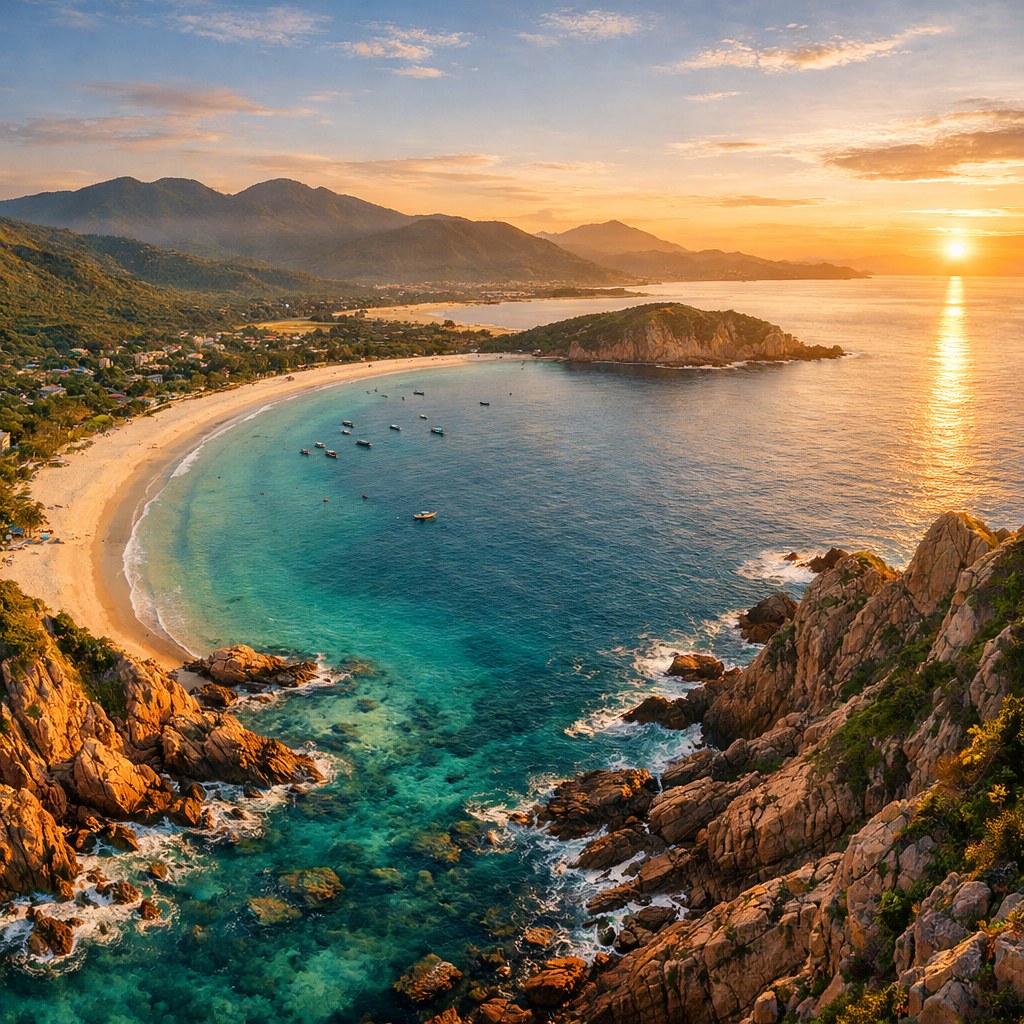
Phu Yen also offers something increasingly hard to find on the Vietnamese coast: genuine quiet. At Bai Mon beach on the Dai Lanh peninsula — where the coastline curves so completely that you can watch both sunrise and sunset from the same promontory — it is entirely possible to spend a morning without seeing another tourist. That will not last forever. The time to visit is now.
Ghenh Da Dia: Phu Yen’s Basalt Columns and Most Famous View

Ghenh Da Dia (also spelled Ganh Da Dia) is Phu Yen’s most photographed sight and its most extraordinary natural feature. The reef — about 50 metres wide and 200 metres long — is composed of volcanic basalt that cooled into near-perfect hexagons roughly 200 million years ago, stacked in columns three to five metres tall and worn to a dark, almost metallic sheen by centuries of wave action.
The effect is other-worldly. Walk out onto the reef at low tide and you feel like you’re standing on a giant’s tiled floor, the columns fitting together so precisely they seem deliberately engineered. The South China Sea crashes against the outer edge in white explosions, spray catching the light, while tidal pools trap small fish and sea anemones in their basalt bowls. At sunrise — and this is a spot worth waking before dawn for — the orange light transforms the dark columns into something almost copper, and sea mist softens the horizon into watercolour.
Ghenh Da Dia is located about 30 km north of Tuy Hoa, near the village of An Ninh Dong. There’s a small car park and an entry fee of around 20,000 VND. Visit at low tide for maximum exploration of the columnar reef, and bring good footwear — the basalt surface is uneven and slippery when wet. Early morning visits also avoid the midday heat and the modest but growing number of Vietnamese day-trippers who arrive by noon.
For photography enthusiasts, Ghenh Da Dia is one of the most compositionally compelling natural landscapes in central Vietnam — our Vietnam photography guide ranks it among the country’s unmissable shots.
Phu Yen Beaches: The Best Sand in Vietnam’s Sunrise Province
Phu Yen’s beaches are what keep travellers here longer than planned. The province has more than a dozen distinct beaches, ranging from the long urban strip fronting Tuy Hoa to remote coves accessible only by motorbike or boat.
Bai Xep has gained the most recognition. A small fishing village with a crescent of golden sand backed by coconut palms, it sits about 15 km south of Tuy Hoa via a scenic coast road. A handful of simple guesthouses and beach shacks have sprung up here over the past few years, but it remains blissfully low-key — the kind of place where you spend a day reading, swimming, and eating freshly grilled fish, then somehow decide to stay another three.
Bai Mon at the tip of the Dai Lanh peninsula is more dramatic. The beach curves for several kilometres around a bay of startling turquoise, with the Da Rang mountain range rising steeply to the west. The lighthouse at the peninsula’s tip sits almost at the 109th meridian east — technically the easternmost point of mainland Vietnam — meaning sunrise here is the first sunrise on Vietnamese soil each morning. That fact alone makes it worth a predawn drive.
Dam Cung Lagoon, a few kilometres north of Tuy Hoa, is less a beach destination and more an ecological spectacle: a brackish lagoon separated from the sea by a narrow sandspit, fringed with mangroves and alive with wading birds at dawn and dusk. Kayak rentals are available from a small outfitter near the lagoon’s south entrance. Our guide to hidden beaches in Vietnam covers similar undiscovered gems across the country.
Phu Yen Travel Guide: Getting There and Getting Around

Phu Yen is well connected by air, rail, and road — the challenge is simply that most travellers don’t think to stop here.
By air: Dong Tac Airport (UIH), 10 km north of Tuy Hoa, receives daily flights from Hanoi and Ho Chi Minh City on Vietnam Airlines and Vietjet. Flight times are around 1.5–2 hours and tickets are affordable when booked in advance.
By train: The Reunification Express stops at Tuy Hoa station, making Phu Yen accessible from Hanoi (about 18 hours on overnight express trains) and Ho Chi Minh City (about 10 hours). The train from Da Nang takes around 5–6 hours and passes through spectacular coastal scenery — including the famous Hai Van Pass — making the journey itself worthwhile.
By road: National Highway 1A connects Phu Yen to Quy Nhon (90 km north) and Nha Trang (110 km south). The coastal route via QL1D south of Tuy Hoa is slower but far more scenic, winding through fishing villages and over rocky headlands with the sea always in view. Our getting around Vietnam guide covers all transport options in detail.
Within Phu Yen: A motorbike is the only way to fully explore the province. Rentals are available in Tuy Hoa from around 100,000–150,000 VND/day. The coastal roads are excellent, traffic is light outside the city, and the scenery from a motorbike seat is incomparable.
What to Eat in Phu Yen: Seafood at Source
Phu Yen’s food is central Vietnamese coastal cooking at its most honest — simple preparations that let the ingredients speak, priced for a local market that hasn’t been inflated by tourist demand.
Bánh hỏi chả cá — thin vermicelli noodle cakes topped with grilled fish cake and served with fresh herbs, peanuts, and a bowl of anchovy dipping sauce — is Phu Yen’s defining dish. The version served at the Tuy Hoa morning market, where vendors set up before 6am and pack away before 9am, is as good as it gets. Get there early; the best stalls sell out by 7:30am.
Cá ngừ đại dương (Pacific bluefin tuna) is caught in the waters off Phu Yen and sold fresh at the Da Nai seafood market near the harbour. Local restaurants serve it grilled, in a tamarind broth, or sliced raw as Vietnamese-style sashimi. Prices are a fraction of what you’d pay for equivalent quality in Nha Trang or Da Nang.
Bún sứa is a Phu Yen speciality almost impossible to find outside the province: jellyfish noodle soup. The jellyfish is prepared to remove its sting, giving it a crunchy, almost cartilaginous texture, and the broth is light and fragrant with lemongrass. It sounds alarming but tastes remarkable. Our Vietnam on a Budget guide has more tips for eating well across the country for under $50 a day.
Tuy Hoa: The Quiet Capital at the River’s Mouth
Tuy Hoa deserves more than a single night. The city sits at the mouth of the Da Rang River — one of the widest estuaries on the central coast — with a long beach running along its eastern edge and a mountain backdrop to the west. It has the feel of a Vietnamese coastal city from 15 years ago: unhurried, friendly, deeply local, with a morning market that spills onto the sidewalks and a waterfront where families gather at dusk to watch the fishing boats cross the bar.
Nhan Mountain (Tháp Nhạn Tower), perched on a hill above the city, is a 14th-century Cham tower that offers panoramic views over the Da Rang delta and coastline in both directions. It’s a 20-minute walk from the city centre and rarely has more than a handful of visitors — a stark contrast to the crowded Cham sites at My Son Sanctuary further north. The tower is an active worship site, so dress modestly and tread quietly.
What is Phu Yen known for in Vietnam?
Phu Yen is known as Vietnam’s “Sunrise Province” and is famous for Ghenh Da Dia (hexagonal basalt columns on the coast), beautiful uncrowded beaches like Bai Xep and Bai Mon, and outstanding fresh seafood. It’s one of the last undiscovered coastal destinations on Vietnam’s central coast.
How do I get to Phu Yen Vietnam?
Fly to Dong Tac Airport (UIH) near Tuy Hoa from Hanoi or Ho Chi Minh City (1.5–2 hours). The Reunification Express train also stops at Tuy Hoa station. By road, Phu Yen is 90 km south of Quy Nhon and 110 km north of Nha Trang on Highway 1A.
What is Ghenh Da Dia and where is it?
Ghenh Da Dia (Ganh Da Dia) is a basalt reef of hexagonal rock columns about 30 km north of Tuy Hoa in Phu Yen province. The columns formed from volcanic cooling millions of years ago and bear a striking resemblance to the Giant’s Causeway in Ireland. Visit at low tide and sunrise for the best experience.
What is the best time to visit Phu Yen?
The dry season runs from January to August, making these the best months to visit. September to November brings the wet season with occasional typhoons. February to May offers the most reliable sunshine and calm seas for beach activities.
Is Phu Yen tourist-friendly?
Phu Yen is traveller-friendly but not heavily touristed. English is limited outside a handful of guesthouses in Tuy Hoa and Bai Xep. Prices are low, locals are welcoming, and a motorbike is essential for exploring beyond the city. It suits independent travellers who enjoy discovering places before the crowds arrive.
Phu Yen: Go Before Everyone Else Does
There’s a particular pleasure in arriving somewhere before it’s fully been discovered — when the guesthouses still outnumber the boutique hotels, when restaurants are priced for the people who live there, when a beach at midday still has more fishing boats than tourists on it. Phu Yen is that place right now. The basalt reefs are extraordinary, the coast is wild and varied, and the seafood is some of the best on the central coast. The train stops here. The road passes through. The question is simply whether you’ll get off.
Leave a Reply