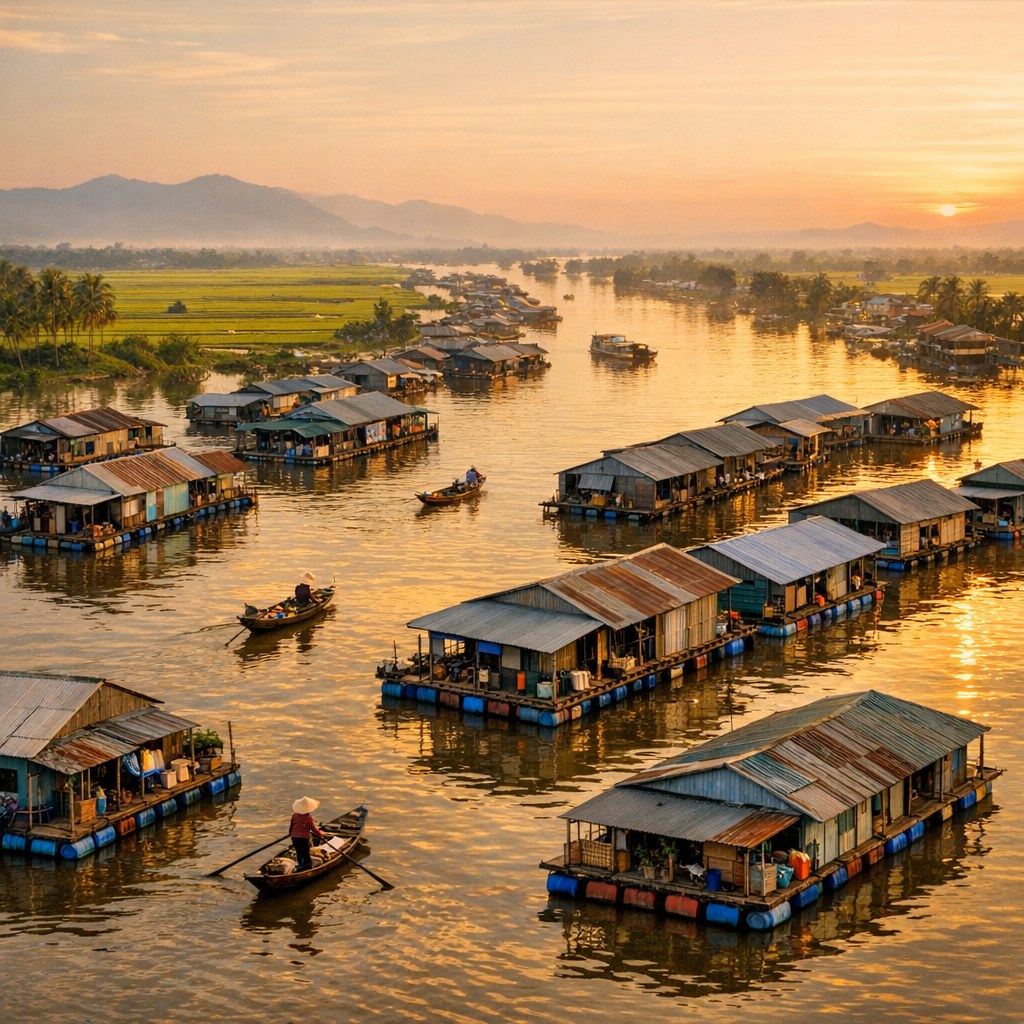

Chau Doc travel guide begins with a simple truth: this compact border town near the Cambodian frontier packs more colour, culture, and river life into its few kilometres than most Vietnamese cities three times its size. Perched where the Mekong splits into the Hau River, Chau Doc is a place where Vietnamese, Cham Muslim, Khmer, and Chinese communities share the same muddy riverbank — and where the water is quite literally someone’s home, shop, and livelihood all at once.
Most travellers pass through Chau Doc on the fast boat from Phnom Penh, glimpsing a cluster of floating houses from the deck before speeding on to Can Tho or Ho Chi Minh City. That is a mistake. Stay two nights and you’ll discover a town that rewards slow travel: languid morning boat rides through floating village lanes, a climb to a hill-top temple where incense smoke curls over the surrounding paddy, and evenings spent eating bowls of bún cá — the local fish noodle soup — at a plastic-stool café by the river.
Why Chau Doc Belongs on Your Mekong Itinerary
The Mekong Delta is one of Vietnam’s most visited regions, yet Chau Doc manages to feel genuinely unpolished. Where Can Tho — covered in our Can Tho Travel Guide — has smoothed its edges for tourism, Chau Doc remains a working town. Fishing boats crisscross the Hau River hauling catfish and pangasius destined for export. Market women balance baskets of freshwater shrimp on bamboo poles. The call to prayer drifts from the Mubarak Mosque in the Cham quarter, mingling with the scent of incense from the adjacent Vietnamese pagoda.
This religious patchwork is one of Chau Doc’s greatest attractions. Roughly 20,000 Cham Muslims live in and around the town, descendants of the ancient Champa kingdom who converted to Islam centuries ago. Their stilted mosques and colourful sarong markets line the opposite bank of the Hau River, easily reached by a two-minute sampan ride. The Khmer community has its own temples dotting the surrounding countryside, and Chinese merchant families have left their mark in the carved wooden shopfronts of the old market quarter.
Three things make Chau Doc worth the detour from the standard Mekong route: the floating villages, Sam Mountain, and the food. Together they fill two days effortlessly. Our Mekong Delta Travel Guide covers the broader region if you’re planning an extended journey through the south.
Chau Doc Floating Village: Life on the Hau River

The floating villages of Chau Doc are not a tourist attraction — they are a functioning community. More than a thousand families live on the Hau and Bassac rivers in wooden houses mounted on oil drums, navigating narrow water lanes by motorised sampan, sending children to school by boat, and raising hundreds of thousands of fish in cages directly beneath their kitchen floors.
The most rewarding way to see them is by hiring a small wooden boat from the Chau Doc riverside (expect to pay around 150,000–200,000 VND per hour). Head out just after dawn when the light is golden and the fishermen are hauling up the cages to check the day’s harvest. The smell is pungent — a rich, aquatic funk of river mud and fish feed — but the scenes are extraordinary: women frying bánh bao on floating stoves, children in school uniforms boarding a motorised canoe, men patching nets hung between the houses.
The main floating village, Chau Giang, lies on the western bank of the Hau River, a two-minute ferry ride from the town’s main jetty. Combine it with a visit to the Cham Muslim village on the same bank — pick up a woven sarong at the market and take in the slender minaret of the Al-Ehsan Mosque, one of the most elegant buildings in the delta. The ferry costs just 5,000 VND each way.
Fish farming is the economic engine of Chau Doc’s floating communities. The underwater cages hold mainly pangasius (basa) and snakehead fish destined for processing plants and export. Families live directly above their stock, monitoring water oxygen levels and feeding schedules around the clock. It is an intimate, industrious existence — and visitors who approach it with respect invariably find themselves welcomed warmly.
Sam Mountain: Pilgrimage Temples Above the Mekong Plain
If the floating villages show you Chau Doc’s river soul, Sam Mountain (Núi Sam) reveals its spiritual one. Rising steeply from the flat delta paddy about 5 km southwest of the town, this 284-metre hill is one of the most sacred pilgrimage sites in southern Vietnam. On its slopes and at its base huddle dozens of pagodas, shrines, and temples, the most famous of which is the Bà Chúa Xứ Temple (Temple of the Lady of the Realm).
Bà Chúa Xứ is dedicated to a female deity whose origins blend Vietnamese folk religion, Khmer animism, and Chinese goddess worship. The temple draws millions of pilgrims each year — particularly during the Vía Bà festival in the fourth lunar month, when worshippers crowd the courtyard bearing offerings of roast pig, incense, and flowers. Even outside festival time, the temple throbs with devotion: women prostrate themselves before the gilded goddess, monks chant in the side halls, and smoke from enormous incense coils drifts out over the paddy fields.
From the temple, a steep path — partially replaced by a cable car — climbs to the summit. The view justifies every step: the flat Mekong Delta stretches in every direction, a green and silver mosaic of rice paddies, rivers, and fish farms extending all the way to the Cambodian border. On a clear morning you can see the Cardamom Mountains of Cambodia rising to the northwest — a reminder of how close you are to the frontier.
At the mountain’s base, the Tây An Pagoda features an eclectic mix of Islamic domes and Vietnamese rooflines — a delightfully confusing architectural fusion that captures Chau Doc’s cultural mixing-pot energy. Nearby, the Tomb of Thoại Ngọc Hầu honours the Nguyễn dynasty mandarin who oversaw construction of the Vĩnh Tế Canal, an engineering feat of the early 19th century that still drains the delta today.
Chau Doc Travel Guide: Getting There and Getting Around

Chau Doc sits at the intersection of several important routes, making it reasonably straightforward to reach — though it requires some planning. Our guide to getting around Vietnam covers the full range of transport options.
From Ho Chi Minh City (230 km), the fastest option is a direct bus (4–5 hours, from 120,000–180,000 VND on operators like Phương Trang/FUTA). Night buses are popular and drop you at the central bus station by dawn. From Can Tho, it’s a simple 2-hour bus ride.
From Cambodia, the Phnom Penh–Chau Doc fast boat is one of the great border crossings in Southeast Asia. Boats follow the Mekong downstream for about 4 hours and arrive at Chau Doc’s riverside dock after clearing Vietnamese immigration at the Vinh Xuong border crossing. This is a legal point of entry for most nationalities holding a valid Vietnamese e-visa — check current requirements at Vietnam’s official e-visa portal. Full details on entering Vietnam from Cambodia are in our Vietnam Border Crossings guide.
Within Chau Doc, xe ôm (motorbike taxis) and Grab handle town transport easily. For Sam Mountain and the floating villages, rent a motorbike (around 100,000–150,000 VND/day) or hire a local boat from the riverside.
What to Eat in Chau Doc: Mekong Delta Flavours
Chau Doc’s food scene is one of the best arguments for spending extra time here. The town has a handful of dishes that rarely appear on menus elsewhere in Vietnam, and eating them in their hometown feels like a privilege.
Bún cá Châu Đốc is the signature dish: a light, clear broth made from snakehead fish and lemongrass, ladled over vermicelli noodles and served with fresh herbs, sliced banana flower, and a squeeze of lime. Unlike the richer broths of the north, Chau Doc’s bún cá is delicate and clean — the kind of soup that makes you understand why Vietnamese cooking is celebrated for its freshness. Find it at the riverside morning market for around 35,000 VND.
Mắm is the other Chau Doc speciality that divides travellers. This pungent fermented fish paste is produced in enormous quantities in the delta and used as a base for dozens of dishes: mắm kho (simmered mắm with pork belly and vegetables), mắm chưng (steamed mắm with minced pork and egg), and raw mắm served as a dipping sauce with fresh vegetables. The smell is aggressive but the flavour — funky, savoury, deeply complex — is addictive.
For an atmospheric evening, the riverside restaurants along Nguyen Huu Canh Street serve platters of fresh delta fish grilled over charcoal, accompanied by cold bia hơi and a view of the evening river traffic. Most mains come in under 80,000 VND. Our Vietnam on a Budget guide has more tips for eating well across the country for under $50 a day.
Day Trips from Chau Doc: Ha Tien and Tra Su
Chau Doc’s position near the Cambodian border makes it an ideal base for day trips into the surrounding region.
Ha Tien, 90 km to the southwest, is one of southern Vietnam’s most atmospheric small towns — a colonial-era port where limestone hills plunge into the Gulf of Thailand and the sea takes on an improbable emerald hue. The drive along the Vĩnh Tế Canal road is spectacular: perfectly flat, ruler-straight, with the canal on one side and rice paddies stretching to the horizon on the other. Visit the Mạc Cửu family tombs carved into a hillside, hire a boat to the nearby islands, or simply walk the seafront at sunset watching the fishing boats come home.
Closer to Chau Doc, the Tra Su Bird Sanctuary makes an excellent half-day trip between September and November, when the cajuput forest floods and thousands of herons, egrets, and cormorants nest in the treetops. Hire a small rowboat to glide silently through the flooded forest — the still water reflects the trees perfectly, and the birdsong is extraordinary.
For travellers continuing to Cambodia, ensure your Vietnamese e-visa is valid for the correct number of entries if you plan to re-enter Vietnam. Current requirements are listed on Vietnam’s official immigration portal. Our Vietnam Visa Guide 2026 covers all entry options in detail.
Is Chau Doc worth visiting?
Yes — Chau Doc is one of the Mekong Delta’s most rewarding stops. The floating villages, Sam Mountain temples, Cham Muslim quarter, and excellent local food make it worth a two-night stay. It’s especially good for travellers who want the delta away from the tourist trail.
How do I get from Ho Chi Minh City to Chau Doc?
Direct buses run daily (4–5 hours, around 120,000–180,000 VND). Operators like Phương Trang/FUTA are reliable. You can also arrive from Cambodia by fast boat from Phnom Penh (about 4 hours on the Mekong), entering at the Vinh Xuong border crossing.
What is the floating village in Chau Doc?
Chau Giang is the main floating village, where over a thousand families live on the Hau River in houses mounted on oil drums and raise fish in underwater cages beneath their homes. It’s reached by a two-minute ferry from Chau Doc’s town centre.
What is the best time to visit Chau Doc?
The dry season (November to April) is most comfortable. Visit in October–November for the Tra Su bird sanctuary at its best, or during the Vía Bà festival (4th lunar month, typically April–May) for the Sam Mountain pilgrimage at its most spectacular.
Do I need a visa to visit Chau Doc?
Yes, you need a valid Vietnam visa. Most nationalities can apply online at evisa.xuatnhapcanh.gov.vn. Chau Doc has an international border crossing at Vinh Xuong for those arriving from Cambodia by boat.
Chau Doc: Slow Down and Let the River In
Chau Doc doesn’t announce itself. There are no rooftop bars, no Instagram-famous bridges, no package tour buses pulling up outside colour-coordinated cafés. What it offers instead is something rarer: a glimpse into a way of life that moves at the pace of the river — slow, purposeful, and quietly spectacular. Come for the floating villages, stay for the bún cá, and leave having seen a side of Vietnam that most travellers miss entirely. In a country full of brilliant destinations, Chau Doc is the one that tends to stay with you longest.
Leave a Reply