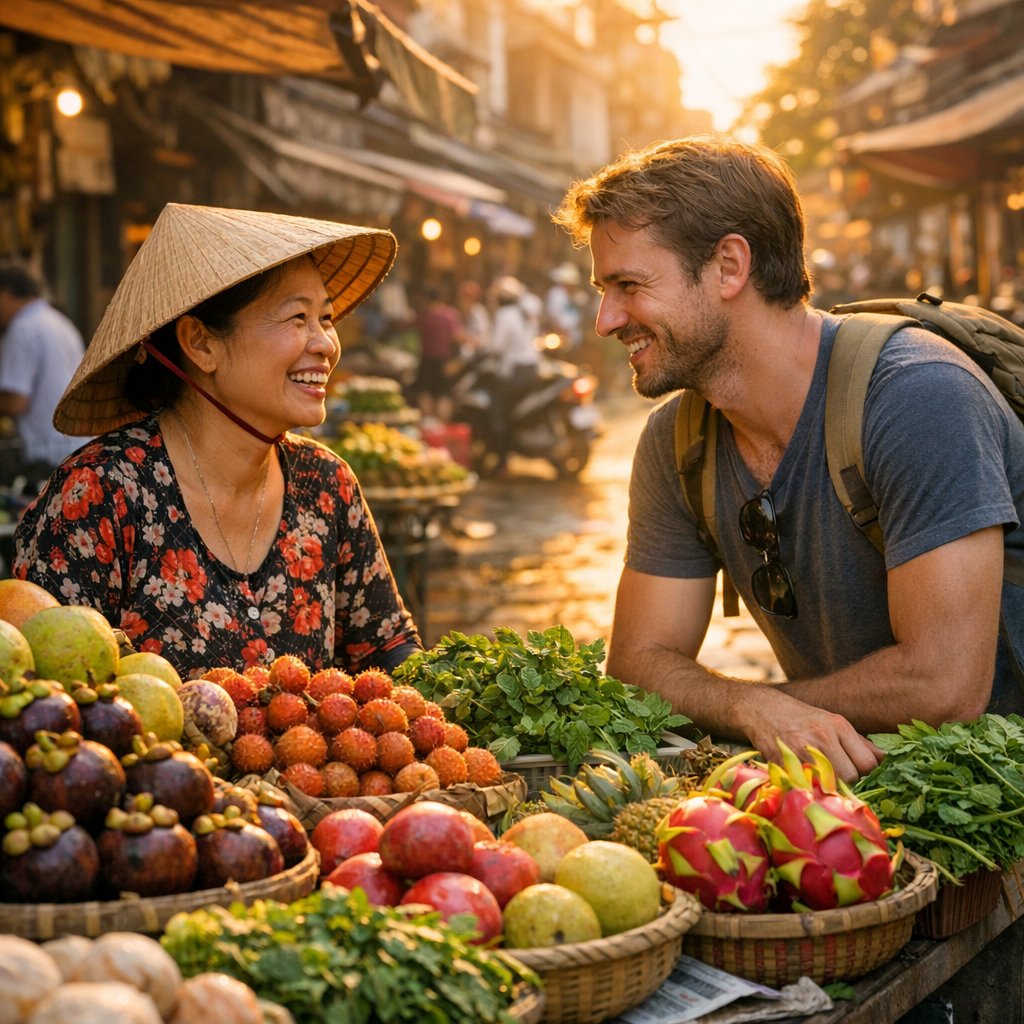
Learning Vietnamese phrases for travelers is one of the most powerful things you can do before your trip — and one of the most overlooked. You don’t need to master tones or memorise grammar rules. A handful of words delivered with a smile can transform how locals receive you: doors open, prices soften, and the warmth that Vietnam is famous for suddenly feels personal. This guide gives you every phrase you actually need, organised by situation, with pronunciation tips to help you sound halfway convincing.

Why Learning a Few Vietnamese Phrases Changes Everything
Vietnam draws millions of visitors a year, and most arrive armed with exactly zero Vietnamese words. Which means that the moment you greet a vendor with a genuine “xin chào” — however imperfect — you’ve already set yourself apart. Vietnamese people are extraordinarily gracious about foreigners attempting their language. A mispronounced syllable earns a laugh and a correction, not frustration. That exchange alone is worth more than any translation app.
The practical benefits are just as real. In smaller towns, local restaurants, and rural markets, English is limited or nonexistent. Knowing how to ask “bao nhiêu tiền?” (how much?) or navigate a dish order without dairy changes your entire dining experience. And when something goes wrong — you’re lost, sick, or robbed — having even basic emergency phrases can make a critical difference in how quickly help arrives.
Vietnamese is a tonal language with six tones in the north (fewer in the south), meaning the same syllable spoken with different pitches can carry different meanings. For travelers, the goal isn’t perfection — it’s communication and connection. Locals almost always understand intent, especially with context and gestures. Use the pronunciation guides below as a starting point, and don’t let fear of tones stop you from trying.
One final note: there are meaningful differences between northern Vietnamese (spoken in Hanoi) and southern Vietnamese (spoken in Ho Chi Minh City). The phrases in this guide work across both regions. If you’re planning a classic two-week north-to-south itinerary, you’ll naturally pick up both flavours along the way.
Essential Vietnamese Greetings and Basic Phrases for Travelers

Greetings in Vietnamese shift depending on the age and gender of the person you’re addressing. For travelers, keeping it simple with a general “xin chào” works in almost every situation. Here are the foundation phrases every visitor should know:
Hello / Hi: Xin chào — pronounced roughly “sin chow.” Use this for anyone, any time of day.
Thank you: Cảm ơn — “gam un” (north) or “cam un” (south). Say this constantly. Vietnamese hospitality deserves constant acknowledgment.
You’re welcome: Không có gì — “khong gaw zee.” Literally “it’s nothing.”
Sorry / Excuse me: Xin lỗi — “sin loy.” Use it to get attention, apologise, or squeeze past someone on a busy pavement.
Yes: Vâng (north) or Dạ (south) — “vung” / “ya.” Use “dạ” universally and you’ll never go wrong.
No: Không — “khong.” Say it with a gentle smile to avoid seeming rude.
My name is…: Tên tôi là… — “ten toy la…” People ask your name out of friendly curiosity — this goes a long way.
Nice to meet you: Rất vui được gặp bạn — “rut vwee duck gup ban.”
How are you?: Bạn có khỏe không? — “ban co khway khong?” Reply: Tôi khỏe, cảm ơn — “toy khway, gam un.”
Numbers one to ten: một, hai, ba, bốn, năm, sáu, bảy, tám, chín, mười — mot, hi, ba, bon, nam, saw, bay, tam, chin, mwi. Memorise these and you can negotiate prices, order quantities, and count change with confidence.
Vietnamese Phrases for Getting Around Vietnam
Vietnam is a long, narrow country with diverse transport options — from overnight trains to xe ôm (motorbike taxis). Knowing how to communicate a destination or ask for directions is essential for navigating beyond tourist hubs. If you’re still planning your transport strategy, our guide to getting around Vietnam covers every option in detail.
I want to go to…: Tôi muốn đi đến… — “toy mwan dee den…” Follow with the destination name.
Where is…?: … ở đâu? — “… uh dow?” E.g., “Nhà vệ sinh ở đâu?” — Where is the toilet?
How much to go to…?: Đi đến … bao nhiêu tiền? — “dee den … bow nyew tyen?” Essential for negotiating taxi fares.
Turn left: Rẽ trái — “ray try.” Turn right: Rẽ phải — “ray fie.” Go straight: Đi thẳng — “dee tung.”
Stop here: Dừng đây — “dung day.” Your most-used two words in any taxi or ride-share.
Is it far?: Có xa không? — “co sa khong?”
I’m lost: Tôi bị lạc — “toy bee lac.”
Slow down: Đi chậm thôi — “dee chum thoy.” Invaluable on the back of a motorbike taxi.
Always show your destination on a maps app rather than relying solely on spoken phrases. Combine words with the phone screen and you’ll almost never end up in the wrong place.
Vietnamese Phrases for Ordering Food and Eating Out

Eating in Vietnam is one of the great pleasures of travel in Southeast Asia. Navigating local eateries, pho stalls, and bustling market kitchens requires a bit of linguistic courage. These phrases unlock the full menu, not just the English tourist version. Pair them with what you learn in a Vietnamese cooking class and you’ll understand the dish names too.
I’d like…: Cho tôi… — “cho toy…” Your go-to order phrase. “Cho tôi một phở bò” — one beef pho, please.
Without…: Không có… — “khong co…” E.g., “Không có hành” — no onion.
Not spicy: Không cay — “khong guy.” A little spicy: Ít cay thôi — “it guy thoy.” Very spicy: Cay nhiều — “guy nyew.”
Delicious!: Ngon quá! — “ngon kwa!” The single best thing you can say to a cook.
I’m vegetarian: Tôi ăn chay — “toy an chay.” Many Vietnamese dishes contain fish sauce; add “không cá, không tôm” (no fish, no shrimp).
The bill, please: Tính tiền — “tin tyen.”
One more, please: Thêm một nữa — “tem mot nyua.”
Iced coffee: Cà phê sữa đá — “ca fay swa da.” One of the great drinks of civilisation.
In local eateries, pointing at what other customers are eating is always an acceptable ordering strategy. Combine it with “cho tôi cái đó” — “give me that one” — and you’ve ordered like a local.
Shopping and Bargaining Phrases in Vietnamese
Vietnam’s markets are sensory overloads of colour, scent, and sound — and bargaining is part of the experience at street stalls and souvenir markets. Approach it as a friendly game, not a conflict, and you’ll get better prices and more fun. For a full picture of travel costs, see our Vietnam budget travel guide.
How much is this?: Cái này bao nhiêu? — “guy nay bow nyew?” Your most-used shopping phrase.
Too expensive: Đắt quá — “dat kwa.” Say it with a smile and a slight head shake.
Can you go lower?: Giảm giá được không? — “yam ya dwuk khong?”
I’ll give you… (price offer): Tôi trả… thôi — “toy tra… thoy.” Fill in the number.
I’ll take it: Tôi lấy cái này — “toy lay guy nay.”
I’m just looking: Tôi chỉ xem thôi — “toy chi sem thoy.” Vital for browsing without being followed.
Do you have a larger size?: Có cỡ lớn hơn không? — “co kuh lun hun khong?”
Always smile when negotiating. Raising your voice or showing frustration is deeply counterproductive in Vietnam. The bargaining ritual is meant to be enjoyable for both sides — meet somewhere in the middle and everyone wins.
Emergency Vietnamese Phrases Every Traveler Needs
Vietnam is a remarkably safe country for travelers — petty theft is the primary concern, serious violence against tourists is rare. But knowing emergency phrases is preparedness, not pessimism. Before you travel, ensure your visa and documents are in order via Vietnam’s official e-visa portal. And for a full overview of entry requirements, our Vietnam visa guide 2026 covers everything you need to know.
Help!: Cứu tôi với! — “koo toy voy!” Shout this and people will respond.
Call the police: Gọi cảnh sát — “goy can sat.” Emergency number: 113.
Call an ambulance: Gọi xe cấp cứu — “goy say cap koo.” Medical emergency: 115.
I need a doctor: Tôi cần bác sĩ — “toy gun bac see.”
Where is the hospital?: Bệnh viện ở đâu? — “ben vyen uh dow?”
I lost my passport / wallet: Tôi bị mất hộ chiếu / ví — “toy bee mut ho chyew / vee.”
I’ve been robbed: Tôi bị cướp — “toy bee kwup.”
I don’t understand: Tôi không hiểu — “toy khong hyew.”
Can you speak more slowly?: Nói chậm hơn được không? — “noy chum hun dwuk khong?”
Do you speak English?: Bạn có nói tiếng Anh không? — “ban co noy tyeng an khong?”
Save these emergency numbers before you travel: Police 113 · Fire 114 · Ambulance 115. In major tourist cities, tourist police offices near popular areas often have English-speaking staff.
Practical Tips for Using Vietnamese as a Traveler
A few final strategies to make your Vietnamese phrases land effectively. Download the Vietnamese language pack in Google Translate before departure — the camera translation mode works surprisingly well on menus. Carry a small card with key phrases written in Vietnamese script; locals can read it even when your pronunciation is off, making it especially useful for dietary restrictions and addresses.
Learn numbers one to twenty and the multiples of ten first — they unlock prices, addresses, times, and quantities. Focus on vowel sounds before perfecting tones; “cảm ơn” said flat will still be understood and deeply appreciated. And embrace the laughter when you mispronounce something: it’s warmth, not mockery — an invitation to try again.
If you’re planning your packing list alongside language preparation, our guide on what to pack for Vietnam covers everything from rain gear to power adaptors. And for solo travelers in particular, our solo Vietnam travel guide has practical tips on staying safe and connected across the country.
Is Vietnamese hard to learn for travelers?
Vietnamese is tonal, which makes pronunciation complex, but for basic travel communication you don’t need to master tones. Learning 30–50 key phrases with rough pronunciation is enough to significantly improve your experience. Most Vietnamese people are patient and encouraging toward travelers who make the effort.
Do Vietnamese people speak English?
English is widely spoken in tourist areas, hotels, and restaurants in Hanoi, Ho Chi Minh City, and Hoi An. In smaller towns, rural areas, and local markets, English is much less common. Having a few Vietnamese phrases and a translation app makes a significant difference outside major tourist zones.
Should I learn northern or southern Vietnamese?
The phrases in this guide work across both regions. Northern Vietnamese has six tones and more distinct consonants; southern Vietnamese is slightly softer. Most Vietnamese people understand both dialects, so focus on whichever region you’re visiting first.
What is the most important Vietnamese phrase to know?
If you learn just one phrase, make it “Cảm ơn” (thank you — “gam un”). Gratitude expressed in someone’s native language creates instant warmth. Close behind: “Xin chào” (hello) and “Bao nhiêu tiền?” (how much?).
Can I get by in Vietnam without speaking any Vietnamese?
Yes — especially on well-worn tourist trails. English is spoken in most tourist-facing businesses, and translation apps handle most situations. But getting by is different from fully experiencing Vietnam. Even ten Vietnamese words will open conversations, lower prices, and earn you moments no app can replicate.
Leave a Reply