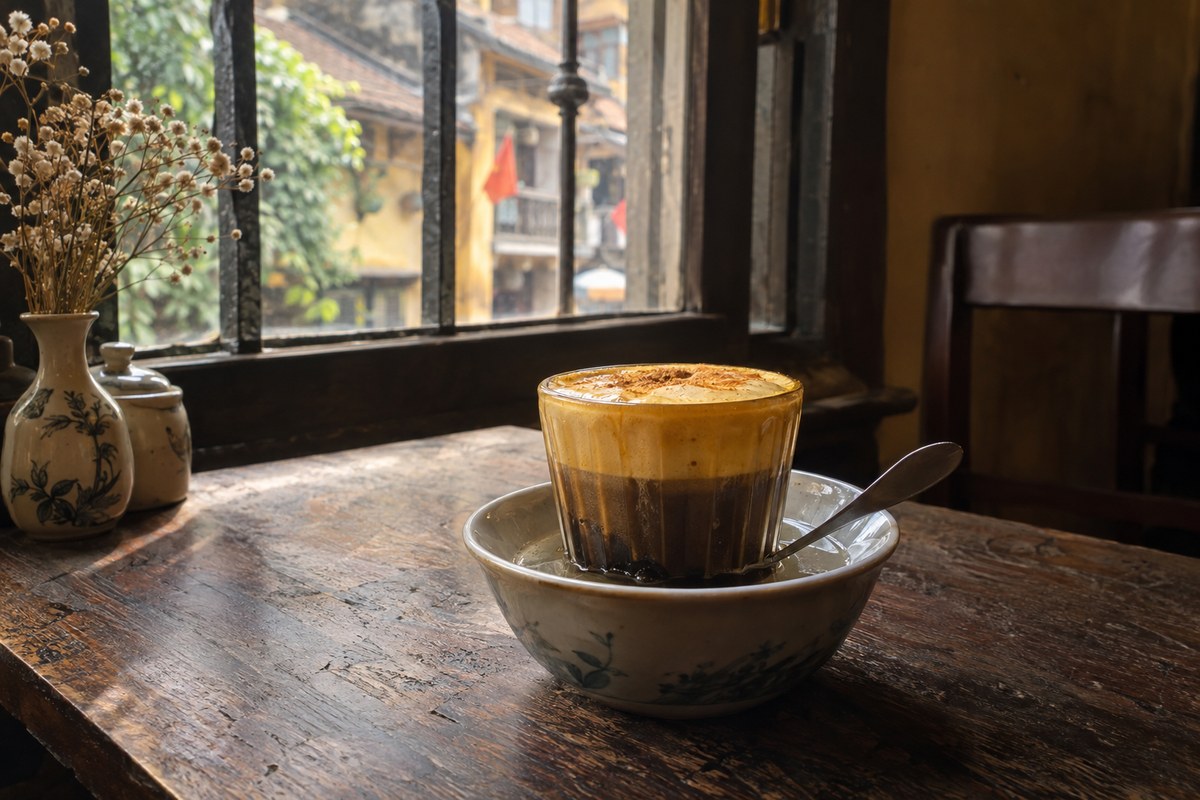
Egg coffee Vietnam style sounds like a dare: raw yolks whisked with sugar and sweetened condensed milk until they bloom into a pale, silken cloud, then spooned over a shot of dark, bittersweet robusta. Yet one sip, and the dare turns into devotion. Think of tiramisu in liquid form, warm and custard-soft on top, bold and bracing beneath. Born in the narrow lanes of Hanoi, cà phê trứng is now one of the most beloved drinks in all of Vietnam, and a pilgrimage for coffee lovers from every continent.
This guide tells the story of the drink, shows you where to taste the finest cups, explains how to order like a local, and even teaches you to whisk your own at home. Bring an appetite and a little curiosity.
The Story Behind Egg Coffee in Vietnam
Every great drink has a creation myth, and egg coffee’s is grounded in hardship and ingenuity. In 1946, during the turbulent years of war, fresh milk was almost impossible to find in Hanoi. A young bartender named Nguyen Van Giang, working at the grand Sofitel Legend Metropole hotel, is said to have reached for a substitute: egg yolk. He beat it with sugar until it turned thick and creamy, and found that it mimicked the richness of frothed milk almost perfectly. Poured over strong coffee, it became something entirely new.
After leaving the hotel, Giang opened a small cafe of his own in the heart of the Old Quarter, and the drink travelled with him. Customers queued for it. His family kept the recipe close, and the cafe that bears his name remains one of the most revered addresses in the city. Other cafes soon began making their own versions, each with its own whisking technique, its own ratio of yolk to sugar and its own closely guarded secret ingredient, from a splash of butter to a spoonful of vanilla.
- Origin: Hanoi, around 1946, as a clever response to milk shortages.
- Core ingredients: egg yolk, sugar, sweetened condensed milk and strong Vietnamese robusta coffee.
- Cultural role: a symbol of Hanoi’s resourcefulness, and a staple of its slow-sipping cafe culture.
Understanding the drink also means understanding the coffee beneath it. Vietnam is one of the largest coffee producers on Earth, and most of it is robusta, a hardy bean with a bold, chocolatey, slightly smoky character. That punch is exactly why egg coffee works: the sweet, airy cream tempers the bitterness without hiding it. If you want to meet the beans at their source, our guide to the Vietnam coffee farm trail and our profile of Buon Ma Thuot, the coffee capital are the perfect companions.
What Egg Coffee Tastes Like (and How to Order It)
First-time drinkers often brace themselves for an eggy taste. It never arrives. Properly made egg coffee smells of vanilla and warm custard, and the foam is dense, glossy and gently sweet. Underneath, the coffee is strong and slightly bitter, which is why the two layers balance so well. Most people describe it as somewhere between a dessert and a latte, and many cafes serve it with a small spoon so you can eat the cream before you drink the coffee.
Presentation is part of the ritual. The classic way is a small cup placed inside a bowl of hot water, which keeps the drink warm while you sip slowly. Do not rush. Stir gently if you like a more blended flavour, or leave the layers separate and enjoy the contrast, sip by sip.
- Order: ask for cà phê trứng (kah feh chung). A hot cup is traditional; many cafes also serve it iced.
- Variations: cocoa egg, matcha egg, coconut egg, and even egg beer or egg yoghurt coffee in more adventurous spots.
- Price: typically very affordable, often well under a few dollars, even in popular cafes.
A tip from locals: have it in the afternoon rather than first thing in the morning. It is rich enough to double as a small dessert, and pairs well with a long, lazy conversation. For a lighter start to the day, our guide to Vietnamese breakfast explains what the city eats before 8am.
A note on food safety: traditional recipes use raw yolk, though many busy cafes whisk their cream over gentle heat or use pasteurised eggs. If you are pregnant, immunocompromised or simply cautious, ask how it is prepared or choose a cafe with a good reputation. Our guides to street food safety in Vietnam and the Vietnam health guide offer more reassurance and practical tips.

Where to Drink the Best Egg Coffee in Hanoi
You can find egg coffee all over Vietnam now, but nothing beats drinking it in the city that invented it. Hanoi’s best cafes tend to hide in plain sight: up steep staircases, down narrow alleys or behind shopfronts that look like nothing from the street. Half the pleasure is the hunt.
Giang Cafe, tucked in a small lane near Hoan Kiem Lake, is the spiritual home of the drink and the place most coffee pilgrims head first. The room is small and simple, and the cups arrive in their bowls of hot water exactly as they have for decades. Another classic is Cafe Dinh, a few steps from the lake, reached by a narrow passage and a creaky staircase that leads to a balcony overlooking the water. Cafe Pho Co, found through a silk shop and up several flights, rewards you with a rooftop terrace and a sweeping view across Hoan Kiem Lake, perfect at golden hour.
- Giang Cafe: the original and the benchmark; expect a queue at peak times.
- Cafe Dinh: a lakeside classic with a retro, lived-in feel.
- Cafe Pho Co: hidden entrance, sweeping views and a long list of variations.
Opening hours and exact locations can change, so check before you set out, and be prepared to ask for directions. Most of these cafes cluster within a short walk of one another, so you can compare two or three in a single afternoon. Pair your coffee crawl with a wander through the Hanoi Old Quarter, then dive deeper into the city with our Hanoi travel guide or our three-day Hanoi itinerary.
Egg Coffee Beyond Hanoi: Saigon, Hue and Da Lat
The drink has long since slipped out of the capital. In Ho Chi Minh City, trendy cafes in District 1 and 3 now serve their own interpretations, often with a modern twist such as cold-brew bases, salted foam or coconut cream. In Hue and Da Nang, small family cafes make versions closer to the Hanoi original. In cool, misty Da Lat, a warm egg coffee on a chilly evening is a small miracle.
Each city brings its own accent. Saigon’s versions tend to be sweeter and icier, matching the heat. In the highlands, where much of the country’s coffee is grown, the drink often sits beside just-roasted beans and slow phin drippers on the menu. Wherever you end up, ask the staff what they recommend. Cafe owners love to show off, and you may find yourself with an unexpected house special.
- Saigon: look for specialty cafes mixing egg cream with cold brew or coconut milk.
- Hue and Da Nang: smaller, more traditional versions that taste closest to the original.
- Da Lat: warm, comforting cups ideal for the cool mountain air.
For travellers eating their way across the country, egg coffee makes a splendid companion to a steaming bowl of noodles. Our pho guide comparing Hanoi and Saigon will help you plan a day of slurping, sipping and strolling.

How to Make Vietnamese Egg Coffee at Home
Once you have fallen in love, you will want to recreate the magic at home. The method is simple, though it rewards patience and a good whisk.
Start with strong coffee, ideally a robusta brewed through a small Vietnamese phin filter, which drips slowly and produces a thick, concentrated cup. In a bowl, whisk two fresh egg yolks with a tablespoon or two of sweetened condensed milk and a teaspoon of sugar until the mixture is pale, thick and doubled in volume, usually a few minutes with an electric whisk. Pour the hot coffee into a small cup, spoon the cream generously on top, and serve with the cup resting in a bowl of hot water.
- Use the freshest eggs you can find, and consider pasteurised yolks if you have any health concerns.
- Add a few drops of vanilla or a pinch of salt to deepen the flavour.
- Bring home a small phin filter and a bag of Vietnamese robusta as souvenirs; our souvenir guide shows what else is worth packing.
Authentic equipment and beans make a surprising difference, which is why so many travellers return from Vietnam with a suitcase full of coffee. For general visitor information and regional events, the national tourism site vietnamtourism.gov.vn is a reliable starting point for planning.
Conclusion: Sip Slowly, Stay Curious
Egg coffee is more than a novelty. It is Hanoi’s gift to the world, a drink invented by necessity, perfected through decades of pride and shared one small cup at a time. Climb the narrow staircase, find a seat by the window, wait for the bowl of hot water to arrive and let the first spoonful of cream melt on your tongue. You will understand why travellers cross continents for it. Add a cafe crawl to your Vietnam plans, and let the city teach you to slow down.
Frequently Asked Questions About Egg Coffee in Vietnam
What is egg coffee in Vietnam?
Egg coffee, or cà phê trứng, is a Hanoi specialty made by whisking egg yolks with sugar and sweetened condensed milk into a thick cream, then pouring it over strong Vietnamese coffee. It tastes like a rich custard-style dessert coffee.
Where was egg coffee invented?
Egg coffee was created in Hanoi in the 1940s by Nguyen Van Giang, a bartender at the Sofitel Legend Metropole hotel, who used egg yolk as a substitute for scarce fresh milk.
Is Vietnamese egg coffee safe to drink?
It is widely enjoyed by locals and visitors, but traditional versions use raw yolk. Choose reputable cafes, ask how it is prepared, and avoid it if you are pregnant or have a weakened immune system unless the cafe uses pasteurised or heated eggs.
Where can I try egg coffee in Hanoi?
Popular choices near Hoan Kiem Lake include Giang Cafe, Cafe Dinh and Cafe Pho Co. Check current opening hours and locations before you go, as small cafes can change.
Does egg coffee taste eggy?
No. Well-made egg coffee tastes of sweet custard and vanilla rather than egg, with a strong, slightly bitter coffee base that balances the creamy foam.
Images in this article were generated using AI.
Leave a Reply