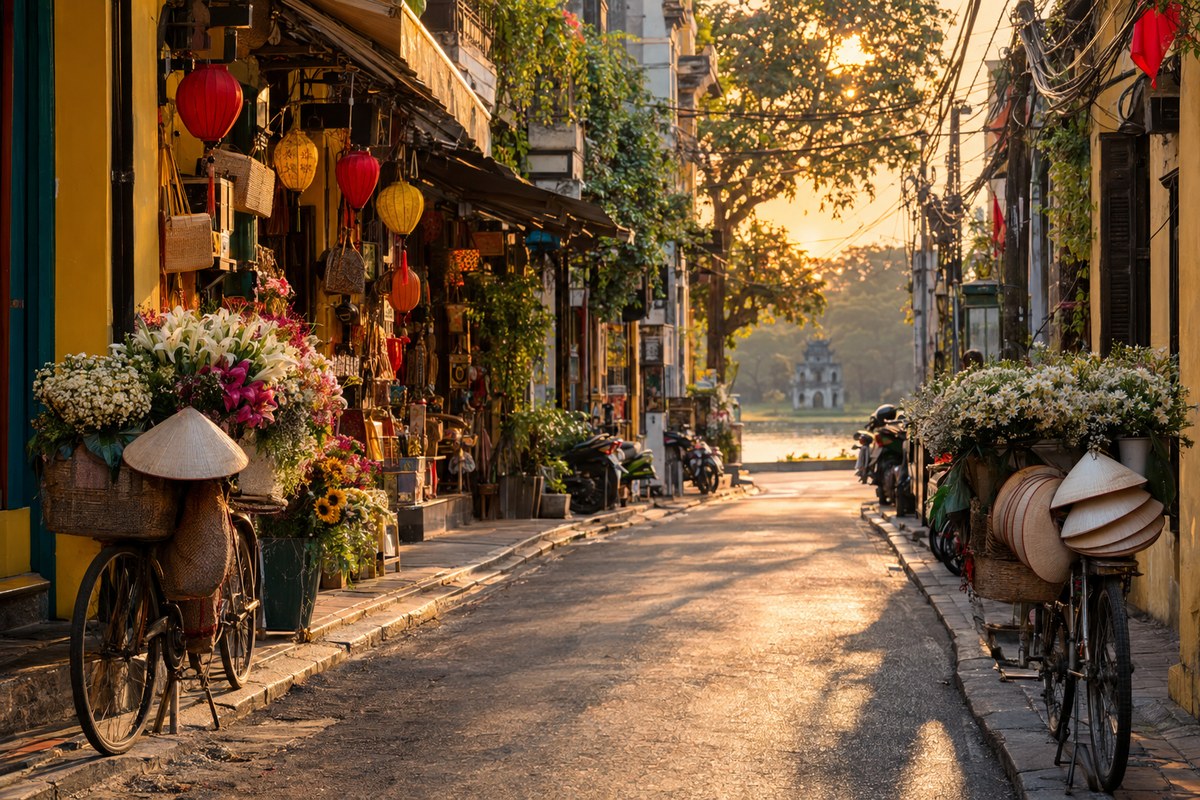
The Hanoi Old Quarter is the part of Vietnam’s capital where the country’s heartbeat is easiest to hear: a tangle of narrow lanes, shopfronts stacked like ribbons, motorbikes flowing like rivers and the aroma of grilled pork drifting from every corner. For a thousand years, craftspeople and traders have crowded into this small district beside Hoan Kiem Lake, and the result is a living museum that never closes. This guide shows you how to explore the Old Quarter with curiosity and confidence, from the logic of its famous 36 streets to the bowls of noodles, cups of egg coffee and quiet temples that reward the wanderer who slows down.
If you are planning a wider stay, pair this article with our full Hanoi travel guide and the Hanoi 3 days itinerary, which show how the Old Quarter fits alongside museums, lakes and day trips.

Hanoi Old Quarter 36 Streets: How the Maze Makes Sense
At first glance the Old Quarter looks like pure chaos, but there is a hidden order. Centuries ago, artisans from surrounding villages gathered here and organised themselves into guilds, each clustering on its own street and selling a single type of goods. The word hang in many street names simply means merchandise, which is why you will find Hang Bac, the street of silver, Hang Gai, the street of silk and hemp, Hang Ma, the street of paper votive offerings, and Hang Quat, where fans and ceremonial banners were once made. Not every street still sells its namesake, but many do, and the pattern gives the area a delightful logic.
The “36 streets” figure is poetic rather than literal. The district grew organically, and the number refers to the traditional guild streets rather than a modern count. Walk slowly and you will notice that the streets vary in mood. Hang Ma glows red and gold during festivals, with paper lanterns and decorations hanging in layers. Hang Bac is lined with jewellers and the odd tiny temple. Lan Ong smells of herbal medicine, with sacks of dried roots and bark piled outside shops. Hang Dao is where fabrics and fashion collide, and it becomes the beginning of the weekend night market.
The architecture is its own storyline. Look for the famous tube houses, narrow and deep, sometimes only a few metres wide but stretching dozens of metres back, with internal courtyards that let light and air in. These were shaped by historic taxation based on street frontage, and they give the quarter its distinctive skyline of thin, colourful facades. Overhead, bundles of cables sag like jungle vines, a photogenic if chaotic backdrop. Our guide to Vietnam’s French colonial legacy explains how the French-era buildings on the district’s edges differ from these older merchant homes.
- Start early: The quarter is calmest and most atmospheric between 6am and 8am, when locals exercise, shop and sip coffee.
- Use the lake as your anchor: Hoan Kiem Lake is on the southern edge, a handy landmark if you lose your bearings.
- Give yourself permission to wander: Maps help, but the best discoveries happen on side lanes.
What to See: Temples, Heritage Houses and Markets
Between the shopfronts, the Old Quarter hides a surprising number of historic sites. Bach Ma Temple, said to be among the oldest in the city, is dedicated to a white horse spirit that guided the founding of the ancient citadel. Its dark wooden doors open onto a hush of incense and carved beams, a stark contrast to the street outside. Nearby, small communal houses known as dinh honour the guild patrons of each street, often tucked behind everyday shops so that you might walk past without noticing.
For a deeper look at how families once lived, visit one of the restored heritage houses, such as the one on Ma May Street. Step inside and the noise falls away. You will find carved wooden furniture, a sunlit courtyard and displays that explain the rhythms of a merchant household, from the ancestral altar to the family kitchen. It is a quiet, atmospheric stop that gives context to everything you see on the street.
Dong Xuan Market, the district’s largest covered market, is a bustling world of fabrics, household goods, dried foods and wholesale trade. Go on a weekday morning for the full local energy, and keep an eye on your belongings in the crush. Smaller neighbourhood markets, spilling onto the pavement with fresh herbs, live fish and baskets of tropical fruit, are even more atmospheric if you arrive early.
The Old Quarter also makes a natural starting point for exploring Hanoi’s deeper past. Just beyond its western edge lies the UNESCO-listed Imperial Citadel of Thang Long, which you can read about in our Thang Long Citadel guide, and you can learn more about the site on the official UNESCO World Heritage Centre page. Together, they sketch a thousand years of history within a short walk.
Where to Eat: Hanoi Old Quarter Street Food Guide
The food is the reason many travellers fall for the quarter, and the best way to experience it is on foot, one small plate at a time. Start the day the way locals do, with a steaming bowl of pho. Hanoi’s version is delicate and clear, with a fragrant beef broth, silky noodles and a scatter of spring onion. If you want to understand the differences between northern and southern styles, our pho guide explains exactly what to order and why. For other early options, browse our list of what locals eat for breakfast.
Lunchtime belongs to bun cha, grilled pork patties in a sweet-sour dipping broth served with rice vermicelli and a mountain of fresh herbs. You will smell the charcoal before you see the shopfront. Another northern classic is cha ca, turmeric-marinated fish sizzled with dill and spring onions at the table, associated with a single street in the quarter that is named after it. For lighter snacks, look for nem ran, crisp fried spring rolls, and banh cuon, delicate steamed rice rolls filled with minced pork and mushrooms.
No visit is complete without egg coffee, a Hanoi invention that tastes like liquid tiramisu. Egg yolk is whisked with sugar and condensed milk into a thick, velvety cream, then poured over strong Vietnamese coffee. Several long-running cafes serve it in narrow upstairs rooms reached by steep stairs, which adds to the sense of discovery. Order it hot, in a small bowl of warm water, so the cream stays silky.

If you worry about stomachs, a few simple habits make a big difference: choose busy stalls with high turnover, watch food being cooked fresh, and carry hand sanitiser. Our street food safety guide has all the practical advice you need to eat adventurously and well. For something portable, our banh mi guide explains how to choose the best sandwich of your trip.
Hanoi Old Quarter at Night: Weekend Market and Evening Streets
As dusk settles, the Old Quarter changes personality. Neon signs flicker on, plastic stools multiply along the pavements, and smoke curls from tiny grills. On Friday, Saturday and Sunday evenings, a pedestrian-only night market typically stretches from Hang Dao toward Dong Xuan Market, with stalls selling clothes, souvenirs, accessories, toys and snacks. It is crowded, noisy and joyful, and it is a perfect place to practise polite bargaining. Our souvenir guide lists the best things to buy and how to spot quality.
Around the lake, the roads close to traffic at weekends, and families, couples and street performers fill the space. It is one of the most pleasant times to stroll, with cooling air, laughter and the glow of lamps reflecting on the water. Further into the quarter, the intersection of Ta Hien and Luong Ngoc Quyen streets is famously known as a beer corner, where travellers perch on tiny stools with glasses of fresh, light draught beer for a few thousand dong. It is lively and fun, though it can be rowdy, so choose a spot that matches your mood.
Cultural evenings are also on offer. Traditional water puppet shows, where wooden figures dance on a shallow stage to live folk music, are staged at a theatre beside the lake and make a delightful, family-friendly introduction to northern Vietnamese storytelling. Book tickets in advance during busy seasons.
Whatever you do at night, watch the traffic. Crossing a street here is a skill: walk at a slow, steady pace, never stop suddenly, and let the motorbikes flow around you. Keep bags zipped and phones tucked away. For more on staying alert without becoming anxious, see our travel safety and scams guide.
Practical Tips: Where to Stay, When to Go and How Long to Spend
The Old Quarter is the most popular area for visitors, and it is easy to see why. You can step from your doorstep into a noodle shop, a temple and a coffee house within minutes. Boutique hotels and guesthouses are packed into narrow tube houses, often with steep stairs and tiny lifts, and rooms range from simple budget cells to polished, antique-filled suites. Streets away from the main nightlife corners are quieter, so request a room at the back if you are a light sleeper.
The best months for comfortable walking are October to December, when the air is cool and dry, and March to April, when the weather is mild. Summer can be hot and humid, with sudden storms, while January and February bring a chilly drizzle, called mua phun, that adds mood but demands a jacket. For a month-by-month breakdown, consult our best time to visit Vietnam guide.
Plan at least one full day, and ideally two half-days, for the quarter. Spread your visits across the morning, when the streets feel local, and the evening, when they turn electric. Wear comfortable shoes, because pavements are uneven and often occupied by parked motorbikes and food stalls, forcing you to walk on the road. Carry small bills for street food and coffee, and keep an eye on your phone and bag when photographing in crowds.

For photography, the golden hours are fantastic. Early morning light slants through the lanes, catching steam from soup pots, while sunset turns tube-house rooftops amber. Our Vietnam photography spots guide shares more shots worth chasing. For official information about visiting the capital, you can also consult the Vietnam National Authority of Tourism.
Frequently Asked Questions About the Hanoi Old Quarter
What is the Hanoi Old Quarter famous for?
It is famous for its centuries-old guild streets, narrow tube houses, temples, street food, egg coffee and lively night markets. It is the historic trading heart of Hanoi.
How many days do you need in the Hanoi Old Quarter?
One full day covers the highlights, but two half-days spread over morning and evening let you see both its local and nightlife sides. Food lovers may want longer.
Is the Hanoi Old Quarter safe at night?
Generally yes, and it is busy until late. Watch for pickpockets and bag snatchers in crowds, be careful crossing roads, and avoid leaving phones on tables near the street.
When does the Hanoi night market run?
The weekend night market typically runs on Friday, Saturday and Sunday evenings along the streets from Hang Dao toward Dong Xuan Market. Hours and routes can change, so check locally.
What should I eat in the Old Quarter?
Try pho, bun cha, cha ca, banh cuon and egg coffee. Choose busy stalls and eat where locals eat.
Lose Yourself in Hanoi
The Old Quarter does not reveal itself in a checklist. It reveals itself in small moments: a grandmother pouring tea on a stoop, the clang of a metalsmith’s hammer, a bowl of noodles slurped on a plastic stool as the evening cools. Give it a day, a good appetite and a little patience, and it will give you the kind of memory that makes Vietnam feel like home. Pack comfortable shoes and an open mind, and let the streets lead the way.
Images in this article were generated using AI.
Leave a Reply