Getting your head around money in Vietnam is one of those small travel victories that makes everything else feel easier. The first time you hand over a crisp note covered in zeroes for a bowl of steaming pho, you may feel like a millionaire, and the first time you misjudge a note you may feel like a fool. This Vietnam money guide walks you through the currency, ATMs, exchange rates, cards, tipping and haggling, so the only thing you have to worry about at the market stall is whether to order a second helping.

Vietnamese Dong Explained: Understanding the Currency
The currency of Vietnam is the dong, written VND or simply “d”, and it comes with a delightfully generous number of zeroes. Depending on the exchange rate at the time, one US dollar is worth roughly 25,000 dong, which means a bowl of street noodles can cost 40,000 to 60,000 VND and a comfortable hotel room a few million. Checking a live rate before you travel is wise, but the mental shortcut most travellers adopt is simple: drop three zeroes and multiply by about four to get a rough figure in US cents, or just divide by 25,000 for dollars.
Banknotes are made of polymer, which means they are waterproof, hard to tear and surprisingly resilient to a humid Saigon afternoon. Denominations run from 1,000 to 500,000 dong. Coins exist but are rarely used in daily life. The notes you will handle most are 10,000, 20,000, 50,000, 100,000, 200,000 and 500,000. Every note carries a portrait of Ho Chi Minh on the front, so you must rely on colour and the number to tell them apart.
That is where the most common beginner mistake happens. The 20,000 note and the 500,000 note are both blue, and the 10,000 and 200,000 notes share a similar earthy hue. In the dim light of a taxi at night, or after a long dinner, it is easy to hand over 500,000 when you meant 20,000. The fix is simple. Say the amount out loud as you pay, count the zeroes twice, and keep your denominations sorted in separate pockets or a small wallet compartment. Many seasoned visitors keep small notes in a front pocket for coffee and street food, and large notes tucked away for hotels and restaurants.
It also helps to understand the way prices are spoken. Vendors often say “fifty” meaning 50,000 dong, dropping the thousands entirely. If a vendor holds up three fingers and says “ba muoi”, they probably mean 30,000, not 30. Learn the numbers in Vietnamese and you will move through markets with far more confidence, and our guide to essential Vietnamese phrases for travelers will give you a head start on numbers, greetings and polite bargaining.
Finally, it is technically illegal for businesses to price goods in foreign currency, though some hotels, tour operators and airports still quote in US dollars. Paying in dong is nearly always the better deal, because merchants who accept dollars usually apply a generous rounding of their own. Keep a small reserve of crisp US dollars for emergencies if you like, but plan on living in dong.
ATMs in Vietnam: How to Withdraw Cash Without Surprises
For most travellers, an ATM is the easiest way to get dong. Machines are everywhere in cities, towns and tourist hubs, and you will find them in convenience stores, bank branches, airports and shopping malls. Major Vietnamese banks such as Vietcombank, BIDV, Techcombank, VPBank, ACB and TPBank commonly accept Visa, Mastercard, Maestro and Cirrus cards, which covers most international debit cards.
The catch is the withdrawal limit. Many machines cap each transaction at somewhere between 2 and 5 million dong, which is only about 80 to 200 US dollars. Banks also charge a fee per withdrawal, commonly 20,000 to 55,000 dong, and your home bank may add its own on top. If your card permits, withdrawing the maximum each time keeps fees down. Some travellers find that certain banks, including Techcombank and a few others, allow larger limits, so it is worth trying a second machine if the first refuses a bigger amount.
When the ATM asks whether you want to be charged in your home currency or in dong, always choose dong. This is called dynamic currency conversion, and the rate offered by the machine is almost always worse than the rate your own bank would give. Declining it can save a few percent on every withdrawal. It is also smart to tell your bank you are travelling, so your card is not frozen the moment it appears at a machine in Da Nang.
For safety, use machines inside bank branches or well-lit, busy spots, and shield the keypad when typing your PIN. Card skimming is rare but not unheard of, and it is worth checking your statements after your trip. Keep a back-up card in a separate bag, because the sinking feeling of a swallowed card at a quiet ATM in Ha Giang is not one you want to feel without a plan B.

Remote regions deserve extra planning. If you are heading out on the legendary Ha Giang Loop, or trekking near Sapa, withdraw enough cash in the last big town, as machines are few and sometimes out of service. Homestays, village cafes and local markets in the highlands are almost entirely cash-based.
Where to Exchange Money in Vietnam for the Best Rates
If you are arriving with foreign cash, you have several options, and the difference between them is real. Airport exchange counters are convenient for a small amount to cover a taxi or a SIM card, but their rates are usually among the weakest. Hotels are similar. Banks offer fair, transparent rates, but you will need your passport and sometimes patience, and some branches only change certain currencies.
The best rates often come from licensed gold and jewellery shops, which have long operated as informal exchange points. In Hanoi, the area around Ha Trung Street is well known for this, and in Ho Chi Minh City you will find similar shops near Ben Thanh Market. They tend to give better rates than banks, although it is wise to compare two or three before you hand over notes, and to count your dong carefully before leaving the counter. Only use shops that display their rate clearly and conduct the transaction in plain sight.
Condition matters. US dollars should be clean, crisp and ideally newer series, as torn, marked or old notes are often rejected or discounted. Larger US denominations such as 50 and 100 dollar bills generally earn a better rate than small ones. Other major currencies, including the euro, Australian dollar, Singapore dollar, British pound, Japanese yen and Korean won, are accepted in cities, though the rate can vary.
You should never exchange money with strangers on the street. Aside from being unlicensed, this is a classic setup for short-changing or swapping notes. If someone approaches you outside a tourist site offering a “special rate”, politely decline and walk on. Likewise, be cautious with the standard taxi-scam pattern of a driver “accidentally” returning a lower note than you handed over. Say the denomination aloud when you pay, and take a moment to check the change.
Try not to leave Vietnam with a pocketful of dong. It is a restricted currency, meaning it is hard to exchange outside the country at a good rate, and you may be unable to convert it back at all. Plan a final meal, a coffee and some souvenirs to use up what is left. Our souvenir guide offers plenty of inspiration for spending the last of your notes.
Cards, QR Codes and Digital Payments
Vietnam is racing toward a cashless future, and you will notice it quickly. In big cities, upscale restaurants, hotels, shopping malls, supermarkets and chain cafes accept Visa and Mastercard readily, and contactless payments are common. Some places add a surcharge of two to three percent on foreign cards, so it is worth glancing at the receipt before you sign.
Locals, meanwhile, pay with QR codes. Almost every shop, from a Hanoi coffee stand to a Mekong floating-market boat, displays a small QR code linked to a bank account or an e-wallet such as MoMo or ZaloPay. Foreign travellers can use these only in limited cases, since most local wallets require a Vietnamese bank account or phone number. A few international options and tourist-oriented apps are slowly expanding access, and some Vietnamese banks allow foreign visitors to open accounts, but for a short stay you should not count on QR payments. Treat them as something to admire, not rely upon.
Cash remains king in the places that make Vietnam magical. Street food stalls, village markets, small family restaurants, local buses, xe om motorbike taxis, and rural homestays will almost always want dong in hand. A good rule of thumb is to carry a minimum of 500,000 to 1,000,000 dong in cash at all times, in a mix of small and mid-sized notes, and to keep your cards for larger purchases, hotels and tours.
If you book accommodation or tours online, check whether the price is quoted in dong or foreign currency and whether your card will be charged in your home currency. Booking platforms often hold your card details but collect payment at check-in in local currency, which means exchange rates and your bank’s foreign transaction fees apply. A card with no foreign transaction fee is a quiet hero in this setting.
Tipping, Bargaining and Everyday Etiquette
Tipping is not a deeply rooted custom in Vietnam, but it is increasingly appreciated, especially in tourism. In a local eatery, nobody expects a tip, and rounding up the bill is a perfectly kind gesture. In upscale restaurants, a service charge of five to ten percent is often already added to the bill, in which case no extra tip is necessary. Tour guides and drivers on private tours, spa therapists and hotel porters will all gratefully accept a tip, and a few dollars equivalent goes a long way. For a day trip guide, 100,000 to 200,000 dong per person is a thoughtful gesture, and more for a multi-day trek.
Bargaining is part of the rhythm of market life. At tourist markets, souvenir stalls and with some street vendors, the first price quoted is often higher than the local price. Start by offering around half to two-thirds of the asking price, keep a smile on your face, and be ready to walk away if you cannot agree. Walking away often brings the best offer. Do not haggle in supermarkets, convenience stores, restaurants, cafes or anywhere with printed prices, and never haggle so hard that it ruins a stallholder’s day over a difference of a few cents. Remember that a few thousand dong means little to you and a lot to them.
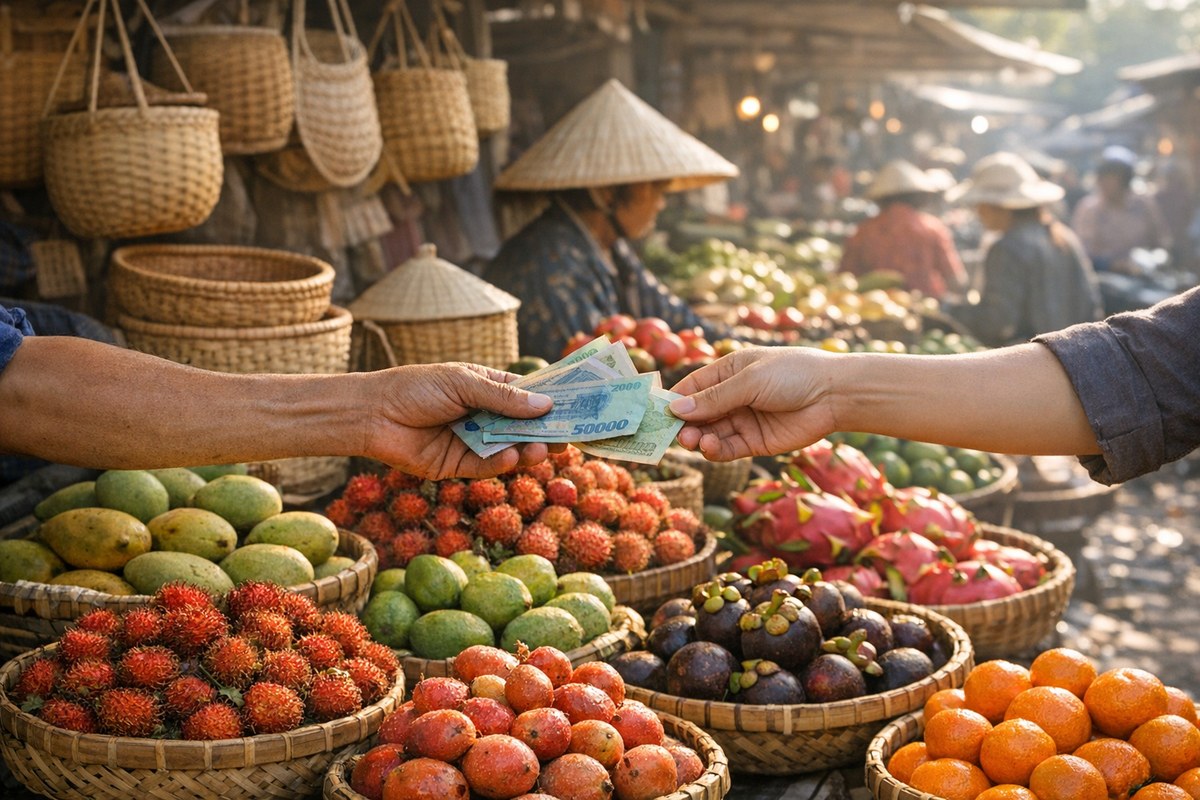
For anything involving a metered service, such as a taxi or ride-hailing trip, agree on the method before you start. Apps such as Grab show the price up front and handle payment in cash or by card, which largely removes the guesswork. If you take a regular taxi, choose a recognised company and insist on the meter. Beyond bargaining, a few small habits help: hand over and receive money with both hands or with your right hand supported at the elbow, which signals respect, and avoid flashing large wads of cash in public.
Daily Costs and Budgeting Tips for Your Trip
Money in Vietnam stretches remarkably far. A bowl of pho or a banh mi sandwich costs a dollar or two, a glass of fresh sugarcane juice less, and a cold local beer at a streetside plastic stool is often under a dollar. Dorm beds are inexpensive, private rooms with air conditioning are modest, and even boutique hotels cost much less than their equivalents in Europe or North America. If you are watching your spending, our guide to travelling Vietnam on a budget for under $50 a day breaks down costs by category and region.
Prices rise in places with many tourists. Hoi An’s old town, Phu Quoc’s beach resorts and Ha Long Bay cruises cost more than the same service in a regional town. Domestic flights and train tickets are best booked in advance, especially around Tet, the Lunar New Year, when prices spike and seats vanish. Our getting around Vietnam guide explains the options, costs and booking tips for each type of transport.
To keep spending under control, set a daily cash budget, withdraw once or twice a week rather than daily, and keep a small emergency stash, perhaps 100 US dollars, separate from your wallet. Travel insurance that covers theft is worth its weight in dong. And keep an eye on those zeroes. A short pause at the till will save you from the most common money mistake in Vietnam, which is accidentally paying ten times what you meant to.
Handled with a little preparation, money in Vietnam is easy, friendly and inexpensive. Now all that is left is to decide how many bowls of noodles your budget can bear. Pack your cards, tuck in some small notes, and let the road do the rest.
Vietnam Money Guide: Frequently Asked Questions
What currency do I need in Vietnam?
Vietnam uses the Vietnamese dong (VND). Although some hotels and tour operators quote prices in US dollars, you will get the best value and the widest acceptance by paying in dong.
Are ATMs easy to find in Vietnam?
Yes, ATMs are widespread in cities, towns and tourist areas. Withdrawal limits per transaction are often low (about 2 to 5 million dong) and fees apply, so withdraw larger amounts when possible and decline the machine’s currency conversion.
Can I use credit cards in Vietnam?
Visa and Mastercard are accepted at hotels, malls, supermarkets and many restaurants in major cities. Street food, markets, rural homestays and local transport are mostly cash-only, so carry dong as well.
Do I need to tip in Vietnam?
Tipping is not required, but it is appreciated, especially for guides, drivers and spa staff. Many upscale restaurants already add a service charge, so check your bill before adding more.
Where is the best place to exchange money in Vietnam?
Banks and licensed gold or jewellery shops usually offer better rates than airports and hotels. Bring clean, undamaged notes, compare rates and avoid street changers.
Leave a Reply