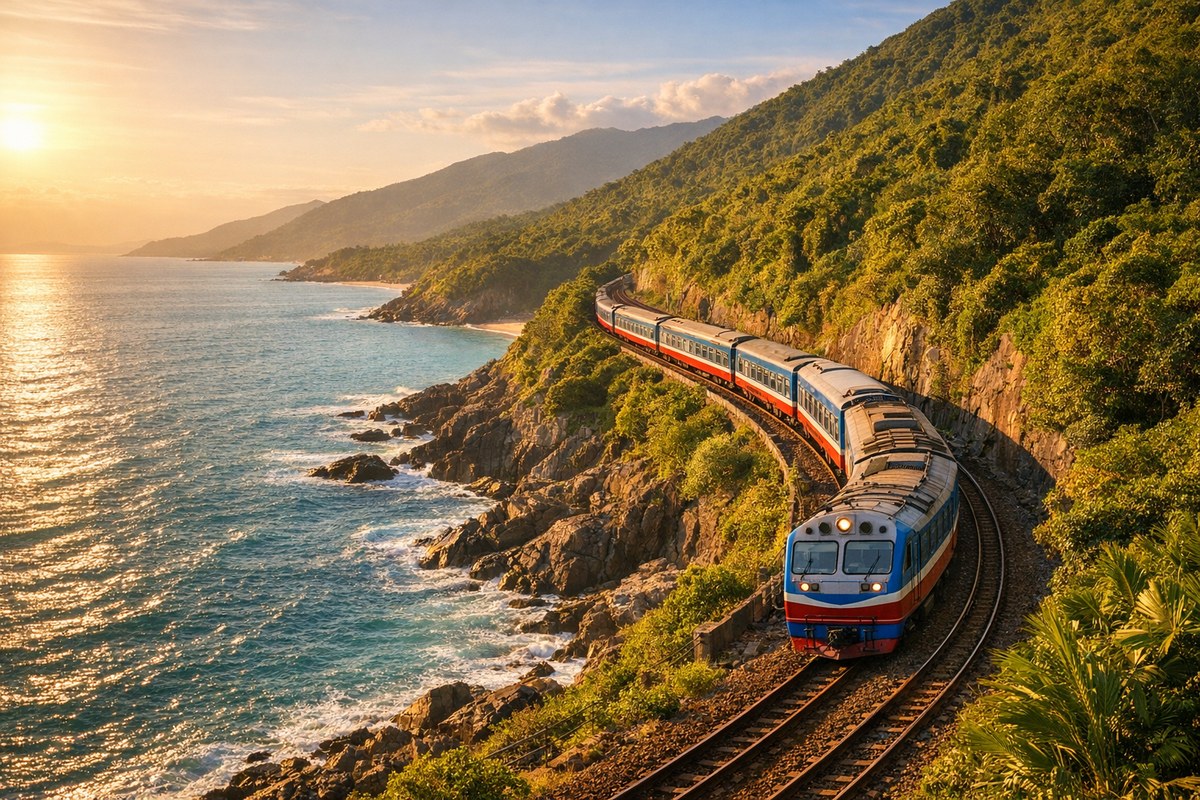
Vietnam train travel is slow, romantic and quietly magical. The rattling Reunification Express stitches the country together along 1,700 kilometres of track, from the capital’s old quarter to the glittering south, passing rice paddies, fishing villages, mountain passes and some of the best coastal views in Southeast Asia. If you want to see Vietnam as it unfolds, rather than as it is glimpsed from a plane window, this is how to do it.
This guide covers routes, ticket classes, booking, onboard life and the stretches worth staring out the window for. Compare it with our overview of getting around Vietnam to decide where the train fits into your plans.
Vietnam Train Travel Basics: The Reunification Express Explained
The north-south mainline, opened to through-traffic after the country’s reunification in 1976 and known as the Reunification Express (Tau Thong Nhat), links Hanoi and Ho Chi Minh City. Several daily trains run the full route, with the faster SE-series services taking roughly 30 to 33 hours and slower services longer. Almost nobody rides it end to end in one go; the pleasure lies in hopping off at Ninh Binh, Dong Hoi, Hue, Da Nang, Quy Nhon, Nha Trang and beyond.
Other lines are well worth knowing. The Hanoi to Lao Cai night service serves the gateway to Sapa, and the Hanoi to Hai Phong route reaches the port city and the ferries to Cat Ba. A branch line serves Da Lat’s heritage railway station for a short scenic ride to Trai Mat.
Services are run by Vietnam Railways, and a handful of private carriages attached to trains on the Hanoi to Lao Cai route offer more comfort at a higher price. For official information, the Vietnam National Authority of Tourism at vietnamtourism.gov.vn is a good starting point.
- Main route: Hanoi to Ho Chi Minh City, around 1,700 km
- Popular branches: Hanoi to Lao Cai (Sapa), Hanoi to Hai Phong, Da Nang to Hue
- Typical full journey: 30 to 33 hours on faster trains
Train Classes and Sleeper Berths: What to Book
Choosing the right ticket class makes or breaks the experience. On overnight trains, the choice is between hard seats, soft seats and berths. Hard seats are basic wooden benches, cheap and cheerful but tiring over long hours. Soft seats are padded and air-conditioned, ideal for daytime sections such as Da Nang to Hue.
The real stars are the sleeper berths. A hard sleeper has six berths per compartment, in three tiers, and is the budget option. A soft sleeper has four berths in two tiers, with cleaner bedding and more space. Lower berths are easiest to reach and are priced higher; upper berths are cheaper but you lose a bit of headroom and can see less out of the window. Some trains also offer VIP cabins with two berths and extra comforts.
Onboard, you will find clean-enough toilets, boiling water for instant noodles and tea, and trolleys selling snacks and meals. Bring your own water, snacks, a small blanket, earplugs and a charger; sockets are not guaranteed in every class. Air-conditioning can run very cold overnight, so a light jumper helps.
- Hard seat: cheapest, best for short hops
- Soft seat: comfortable for daytime legs
- Hard sleeper: six berths, budget overnight
- Soft sleeper: four berths, most popular for comfort

How to Book Train Tickets in Vietnam
Booking is straightforward once you know your options. You can buy tickets on the official Vietnam Railways website or app, at station ticket counters, or through reputable local travel agencies and online platforms that add a small service fee. Tickets usually go on sale around a month or more in advance, and popular sleeper trains sell out quickly around public holidays and weekends. If you plan to ride during the Lunar New Year, read our guide to Tet 2027 in Vietnam and book as early as possible.
Carry your passport, as you will be asked for ID when buying tickets and sometimes when boarding. Tickets carry your name and passport details, so keep them safe. Arrive at the station at least thirty minutes before departure; station platforms are not signed in English everywhere, so check your carriage and berth number on the ticket and ask staff if unsure.
When comparing trains with flights and buses, consider time as well as cost. A flight between Hanoi and Da Nang takes about an hour and a half, and our guide to domestic flights in Vietnam will help you compare. On a tight schedule, fly long sections and take the train for the scenic ones. On a budget, the train sits in the middle of the price range and saves you a night’s accommodation. For trip budgeting, see Vietnam on a budget.
- Where to book: official website or app, stations, reputable agencies
- When to book: as early as possible, especially for holidays and weekends
- What to carry: passport, printed or digital ticket
The Most Scenic Train Journeys in Vietnam

The Reunification Express is full of postcard moments, but a few sections stand out. The finest is the run from Hue to Da Nang. The tracks climb above the sea around the Hai Van Pass, sweeping past green headlands, tiny bays and fishing boats bobbing in turquoise water. It takes about three hours and, in clear weather, it is one of the most beautiful rail rides in Asia. If you prefer to see the area by road, read our Hai Van Pass guide for the motorbike alternative.
Another favourite is the section between Quy Nhon and Nha Trang, where the line threads past quiet beaches and rice fields. Further north, the stretch around Ninh Binh brings you close to limestone karsts that rise from the paddies like sleeping dragons; see our Ninh Binh travel guide for stops worth making. The Hanoi to Lao Cai night train gently rocks you towards the mountains, delivering you to rice terraces and misty valleys at dawn.
For a smaller dose of adventure, ride the Da Lat to Trai Mat heritage train, with its old wooden carriages and views of flower farms and pine forests.
- Hue to Da Nang: coast and Hai Van Pass
- Quy Nhon to Nha Trang: beaches and paddies
- Ninh Binh area: karst scenery
- Hanoi to Lao Cai: overnight to the mountains
Tips for a Smooth Vietnam Train Journey
A little preparation turns a good train ride into a great one. Start with timing: overnight trains typically leave in the evening and arrive in the early morning, which saves a hotel night but can mean an awkward dawn arrival. If you land at 4am, ask your accommodation whether you can check in early or at least store your bags. Daytime trains are slower to fill and reward you with views, so choose them for scenic legs.
Food is part of the fun. Vendors walk the carriages with boxed rice, grilled snacks, fruit and instant noodles, and stations bring a parade of hawkers at every long stop. Local travellers share food generously, and a friendly gesture often earns you a tangerine or a sticky rice parcel. If you prefer to be selective, pack your own sandwiches, nuts and fruit; our guide to Vietnam street food safety has advice that applies equally on the move.
Think about luggage too. Soft sleeper cabins are compact, so a backpack or small suitcase fits more easily than a giant case. Use a cable lock to secure bags to the rack at night, and keep your passport, phone and money on your person. If you are heading north to the mountains afterwards, check our Vietnam packing guide for the right layers.
Finally, give yourself time and patience. Trains can run late, especially in the rainy season, when floods and storms occasionally delay services. Avoid tight connections with flights on the same day, and build in a buffer. The reward is a journey that feels like a slow film of Vietnam rolling past your window.
- Arrival: ask your hotel about early check-in for dawn trains
- Food: try boxed rice from trolleys or bring your own snacks
- Luggage: pack light and lock bags to the rack
- Buffer: leave slack before flights or tours
Hanoi Train Street and Stops Worth Making

No article about Vietnam train travel would be complete without Hanoi’s famous Train Street, a narrow residential lane where trains squeeze past cafe tables and front doors just a few centimetres away. Access rules have changed repeatedly over the years, and authorities sometimes restrict visitors for safety, so check the current status before going. If it is open, sip a coffee at a nearby cafe and wait for the rumble. Never stand on the tracks. For more of the capital’s sights, see our Hanoi travel guide.
Plan your stops to maximise the journey. A classic route is Hanoi to Ninh Binh, then Hue, Da Nang and Hoi An, Nha Trang and finally Ho Chi Minh City. Our two-week Vietnam itinerary follows a similar path and can easily be adapted to rail. Break up long overnight legs with a hotel night, and you will arrive rested rather than frazzled.
- Pack: snacks, water, earplugs, charger, light layer
- Safety: lock luggage in cabins, keep valuables on you
- Etiquette: be friendly and share a smile; fellow passengers are curious and warm
Frequently Asked Questions
How long does the train from Hanoi to Ho Chi Minh City take?
The fastest Reunification Express services take roughly 30 to 33 hours for the full 1,700-kilometre journey. Most travellers break it up with stops in Hue, Da Nang, Hoi An and Nha Trang.
How do I book train tickets in Vietnam?
Book through the official Vietnam Railways website or app, at station ticket counters or via reputable local agencies. Book early for Tet, summer weekends and popular sleeper trains.
Which class of train ticket is best?
For overnight trips, a soft sleeper berth in a four-berth air-conditioned cabin is the best balance of comfort and price. For daytime trips, soft seats are perfectly fine.
What is the most scenic part of the Vietnamese railway?
The stretch between Hue and Da Nang, crossing the Hai Van Pass along the coast, is widely considered the most beautiful section.
Is train travel in Vietnam safe?
Yes, it is generally safe and a favourite with travellers. Keep valuables close, lock your luggage in sleeper cabins and watch your belongings during station stops.
Ready to Ride Vietnam’s Rails?
There is a particular pleasure in watching Vietnam slide past a window: a buffalo in a flooded paddy, a child waving from a crossing, a green mountain ridge dissolving in mist. The train will not get you anywhere fast, but that is precisely the point. Book a berth, pack a few snacks and let the country roll by.
Even a single leg, such as the coastal ride between Hue and Da Nang, will show you why so many travellers call the railway the soul of the trip. Bring patience, curiosity and a camera, and you will step off the train with stories that no flight could ever give you.
Start planning your Vietnam rail adventure today.
Leave a Reply