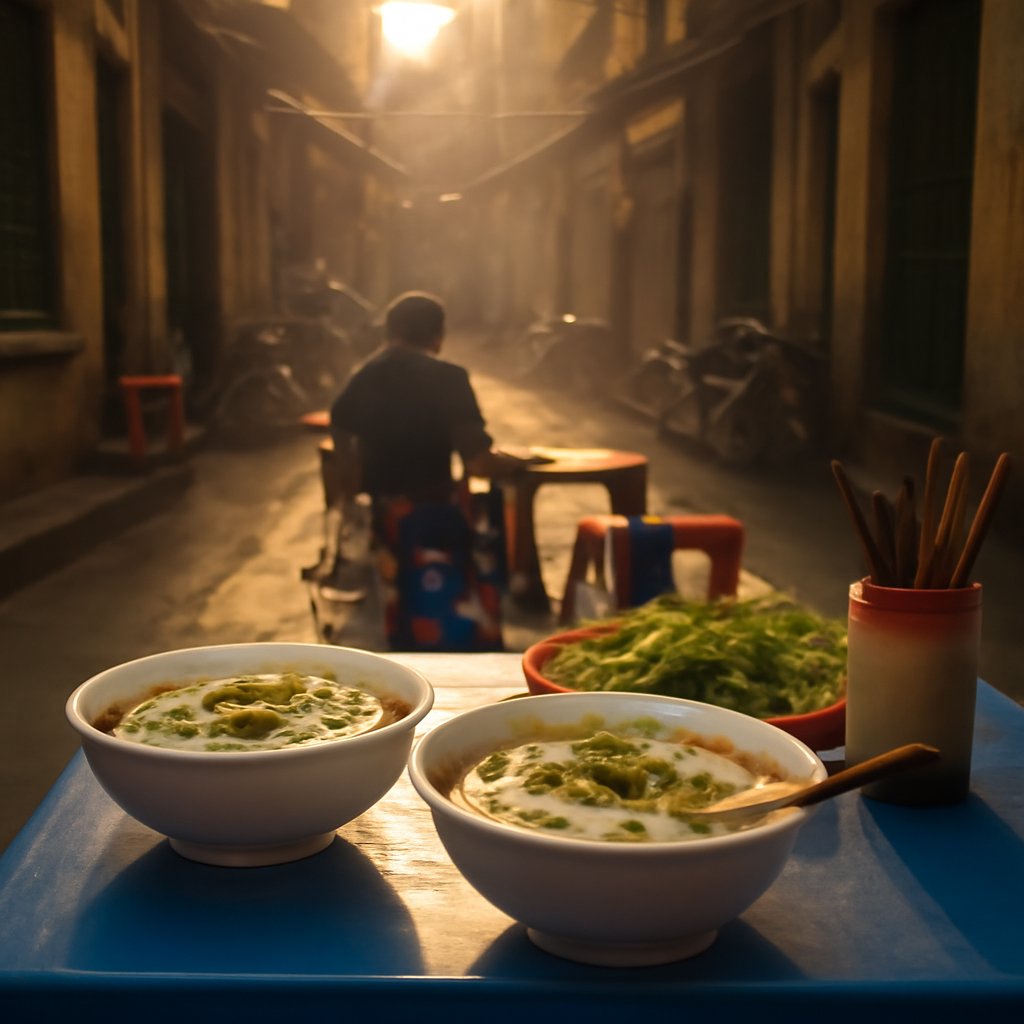
Vietnamese breakfast is unlike anything else in the world. Before the sun has fully cleared the rooftops, the streets of Hanoi, Hoi An, and Ho Chi Minh City are already alive with the clatter of ladles, the hiss of broth, and the quiet ritual of people beginning their day over a steaming bowl. To eat breakfast in Vietnam is to understand something fundamental about this country: here, food is never an afterthought. It is ceremony, community, and soul — served piping hot before 8am.
Whether you’re a first-time visitor or a seasoned traveller returning for more, knowing what locals eat for breakfast in Vietnam will transform how you experience the country. Forget hotel buffets. Step outside at dawn, follow the smoke and the smell, and pull up a plastic stool. This guide covers the essential Vietnamese breakfast dishes, where to find them, and how to eat them properly.

Vietnamese Breakfast Culture: Why Morning Is the Best Meal
In Vietnam, breakfast is the meal that defines a neighbourhood. Walk down any residential lane at 6am and you’ll pass family-run eateries that have been serving the same dish for decades — sometimes for generations. There are no menus, no explanations. You sit, you get what they make. That’s the entire concept.
This culture of hyper-specialisation is part of what makes Vietnamese breakfast so extraordinary. A good bún bò Huế stall doesn’t also serve phở. A bánh cuốn vendor is not trying to be everything to everyone. The cook has spent years, perhaps a lifetime, perfecting one dish. The result is food of startling depth and precision.
Breakfast in Vietnam is also the cheapest meal of the day. A bowl of phở from a street stall rarely exceeds 50,000 VND (about $2 USD), and a cup of strong Vietnamese coffee costs a fraction of what you’d pay in a café anywhere in the West. This combination — extraordinary quality at almost no cost — makes the morning meal one of the country’s great joys. If you’re travelling Vietnam on a budget, starting your day at a street stall is both the most economical and most authentic choice you can make.
The social dimension matters too. Vietnamese people rarely eat breakfast alone. Colleagues meet before the workday begins. Grandmothers bring grandchildren. Motorbike drivers fuel up mid-route. The pavement stool and the communal table are the great levellers of Vietnamese society, and breakfast is when you feel it most acutely.
Phở: Vietnam’s Breakfast Broth That Conquered the World
No discussion of Vietnamese breakfast is complete without phở — perhaps the country’s most recognised culinary export. A Vietnamese breakfast classic, phở is a fragrant broth of star anise, cinnamon, charred ginger, and beef bones, ladled over silky flat rice noodles and topped with thinly sliced raw beef (phở bò) or chicken (phở gà). It comes to the table as a canvas: a pile of fresh herbs, bean sprouts, chilli, and lime on the side, for you to customise at will.
The broth is everything. A proper pot of phở simmers for six to eight hours minimum, coaxing marrow and collagen into a liquid that is simultaneously clear and profound. In Hanoi, the classic birthplace of the dish, phở broth is subtler and cleaner. In Ho Chi Minh City, the southern version arrives with a sweeter, more complex base and a generosity of fresh herbs that feels like the bowl is about to overflow.
The ritual of eating phở matters as much as the soup itself. You tear the herbs into the broth. You squeeze a wedge of lime. You taste before you add anything — and then you add what you need. Then you lift the bowl closer to your face and, if the broth is truly exceptional, you understand why Vietnamese people have been eating this for breakfast every day for well over a century.
Phở is typically eaten before 9am, after which many stalls sell out entirely and close. Don’t wait for it. Go early, find the place with the longest queue of local motorbikes parked outside, and take your cue from everyone else at the table. If you’d like to learn how to make it yourself, seek out one of Vietnam’s outstanding Vietnamese cooking classes — most include phở as a foundational recipe.
Bánh Mì and Bánh Cuốn: The Other Breakfast Essentials

While phở holds the crown, Vietnam’s morning repertoire is far richer than one dish. Two other breakfasts deserve equal attention: bánh mì and bánh cuốn.
Bánh mì is Vietnam’s famous baguette sandwich — a legacy of French colonial influence repurposed into something wholly Vietnamese. For breakfast, the fillings tend toward the simple: pâté, butter, a fried egg, a scatter of spring onions and fresh chilli. The baguette itself is extraordinary — lighter and crispier than its French ancestor, with a shell that shatters into crumbs the moment you bite and a centre as soft as a cloud. Eaten warm from a street cart at 7am, it costs less than a dollar and is arguably one of the best breakfasts on earth. We’ve written an entire guide to bánh mì in Vietnam if you want to explore the full history of this iconic sandwich.
Bánh cuốn is less well-known but equally worth seeking out. Thin sheets of fermented rice batter are steamed on a cloth over boiling water, then filled with a mixture of minced pork and wood ear mushrooms, rolled into soft parcels, and served with fried shallots, fresh herbs, and a light dipping sauce fragrant with fish sauce and lime. The process of making bánh cuốn is mesmerising to watch — the batter spreads across the cloth in seconds, steam billows, and the vendor peels each sheet with a practiced flick of the wrist. The result is breakfast as textile art: translucent, silky, impossibly delicate.
In Hanoi’s Old Quarter, you can find dedicated bánh cuốn spots operating from as early as 5:30am, often run by women who have been doing this since before dawn. In central Vietnam, particularly around Hue and Hoi An, variations abound — thinner, wider sheets served with different accompaniments. It is the kind of dish that rewards the curious traveller who walks past the obvious and into the neighbourhood behind it.
Regional Breakfasts: What Vietnam Eats from North to South
One of the great discoveries of travelling Vietnam from north to south is realising that breakfast changes as dramatically as the landscape. The country spans over 1,600 kilometres and encompasses dozens of distinct regional cuisines, and nowhere is that variety more vivid than at the morning table.
In Hanoi, breakfast is an exercise in clarity. The broth is light, the flavours are precise, and the emphasis is on quality ingredients left to speak for themselves. Alongside phở, you’ll find bún ốc (noodles with snails), cháo (rice porridge, eaten particularly when someone is under the weather), and the extraordinary xôi — glutinous sticky rice topped with everything from fried shallots and mung bean paste to pulled chicken and Chinese sausage.
In Hue, the former imperial capital, breakfast carries a refinement that echoes the city’s royal history. Bún bò Huế is the signature morning bowl: thick round noodles in a complex broth of lemongrass, shrimp paste, and chilli, topped with slices of beef shank, pork knuckle, and congealed pork blood. It is bold, aromatic, and intensely satisfying — quite different from the gentler profile of Hanoi’s phở. When you visit Hoi An and the surrounding central region, keep an eye out for mì Quảng — a turmeric-yellow noodle dish served with just a splash of rich broth, an abundance of toppings, and a rice cracker for crumbling on top.
In Ho Chi Minh City, the morning energy is louder, faster, and more diverse. The southern capital absorbs culinary influences from across the country and from neighbouring Cambodia and China, meaning breakfast might be phở, but it might equally be hủ tiếu (a clear-brothed noodle soup with pork and shrimp), a plate of bánh ướt (wet rice paper rolls), or a cơm tấm plate of broken rice with grilled pork, a fried egg, and pickled vegetables — technically a lunch dish elsewhere, but in Saigon, perfectly acceptable at 7am.
Vietnamese Coffee: The Essential Breakfast Companion

No Vietnamese breakfast is complete without coffee. Vietnam is the world’s second-largest coffee producer, and the coffee culture here is one of the most distinctive on the planet. It is slow, deliberate, and absolutely non-negotiable.
Cà phê đen (black coffee) and cà phê sữa đá (iced coffee with condensed milk) are the two national standards. Coffee is brewed through a small metal phin filter that sits directly on top of your glass, dripping slowly into a layer of sweetened condensed milk below. You wait — sometimes five or ten minutes — watching the drops fall. Then you stir, add ice if desired, and drink something that is genuinely unlike coffee anywhere else in the world: intensely strong, slightly sweet, with a chocolatey depth that comes from the robusta beans that dominate Vietnamese blends.
In Hanoi, you can also find cà phê trứng — egg coffee — a local invention of the 1940s made by whipping egg yolk with condensed milk into a thick, meringue-like foam that floats on top of strong black coffee. It sounds improbable. It tastes extraordinary. Drink it in a tiny café overlooking Hoan Kiem Lake at sunrise and you will not easily forget it.
The ritual of Vietnamese coffee is an invitation to slow down. Street-side plastic stools, a glass of iced tea brought automatically alongside your order, the morning traffic streaming past. This is how Vietnam takes its time in a country that otherwise moves quickly. If you want to understand the full story behind where this coffee comes from — from highland farm to cup — the coffee farm trails around Da Lat offer one of the most rewarding experiences in the country.
How to Find the Best Breakfast in Vietnam: Practical Tips
Finding great Vietnamese breakfast requires only one skill: following the locals. The rule is simple — the more plastic stools, the better the food. The best stalls operate on reputation, word of mouth, and the loyalty of the same customers who’ve been coming for years. They don’t need signs or menus. If a stall is busy with Vietnamese people at 6:30am, it’s worth sitting down.
A few practical pointers for making the most of breakfast in Vietnam:
Go early. The best stalls sell out. Phở is often gone by 9am. Bánh cuốn may wrap up at 10. Set your alarm and be out the door by 7am at the latest.
Look for specialisation. The stall that serves only one dish almost always serves it better than the one offering six options. This is a country of culinary specialists.
Point and smile. If the language barrier feels daunting, remember that most Vietnamese breakfast orders involve exactly one decision — which size bowl, or whether you want it with beef or chicken. The vendor has seen thousands of travellers. You’ll be fine.
Bring small bills. Most street breakfasts cost between 25,000 and 60,000 VND. Paying with a 500,000 note for a 30,000 VND bowl of phở is technically possible but considered poor form. Keep small denominations ready.
Don’t skip the sides. The pile of fresh herbs, the chilli, the lime — these aren’t garnishes. They are half the dish. Tear them in, squeeze liberally, taste as you go.
For those planning a longer trip around the country, our Vietnam two-week itinerary maps out a north-to-south route that ensures you encounter the full range of regional breakfast traditions, from Hanoi’s delicate phở to Saigon’s chaotic, glorious cơm tấm carts.
Conclusion: Start Every Day Like a Local
Vietnamese breakfast is one of the most rewarding experiences this country offers, and it costs almost nothing. It is the point at which the visitor and the local share the same pavement, the same bowl, the same slow morning ritual. If you eat breakfast at your hotel each day in Vietnam, you will return home having missed something essential.
Step outside before 8am. Follow the steam. Sit down wherever the locals are sitting. Order whatever they’re having. This is how you taste Vietnam at its most honest — and most delicious.
What do Vietnamese people typically eat for breakfast?
Vietnamese people commonly eat phở (beef or chicken noodle soup), bánh mì (baguette sandwiches), bánh cuốn (steamed rice rolls), bún bò Huế (spicy lemongrass noodle soup), xôi (sticky rice), or cháo (rice porridge) for breakfast. The most popular choice varies by region — phở dominates in Hanoi, while Ho Chi Minh City has a wider variety including cơm tấm (broken rice).
Is phở eaten for breakfast in Vietnam?
Yes — phở is primarily a breakfast dish in Vietnam, especially in Hanoi where it originated. Most street phở stalls open from around 5:30am and sell out before 10am. Many locals eat phở daily as their morning meal before work.
What is the best time to eat street breakfast in Vietnam?
The best time is between 6am and 8am. This is when stalls are freshest, broth is at its peak, and the atmosphere is most vibrant. Many of the best stalls — particularly phở and bánh cuốn vendors — sell out entirely by 9am or 10am and close for the day.
How much does breakfast cost in Vietnam?
A street breakfast in Vietnam typically costs between 25,000 and 60,000 VND (approximately $1–$2.50 USD). A bowl of phở is usually 40,000–55,000 VND, a bánh mì 20,000–35,000 VND, and a Vietnamese iced coffee around 20,000–30,000 VND. It is one of the most affordable meals in the country.
What is egg coffee (cà phê trứng) in Vietnam?
Egg coffee (cà phê trứng) is a Hanoi speciality invented in the 1940s. It is made by whipping egg yolk with condensed milk and a little sugar into a thick, custard-like foam, which is then spooned on top of strong black coffee. The result is sweet, rich, and surprisingly light — somewhere between a dessert and a morning drink. It is best enjoyed warm, in a tiny café in Hanoi’s Old Quarter.
Leave a Reply