Vietnam’s French colonial legacy is visible in almost every city in the country — in the baguettes sold from bicycle baskets at dawn, in the yellowed plaster of government buildings, in the coffee culture that took root when French planters first brought beans to the central highlands. For 67 years, from 1887 to 1954, Vietnam formed the heart of French Indochina, and that presence reshaped the country’s architecture, cuisine, language and urban form in ways that are still vivid today. This is a guide to finding, understanding, and appreciating that legacy as a traveller.
The French colonial period in Vietnam is complex and contested — a story of extraction and resistance as much as architecture and croissants — but its material and cultural footprint is undeniable. Walking through the streets of Hanoi’s French Quarter, eating pho made with techniques that owe something to French pot-au-feu, ordering a cà phê sữa đá in a café where the espresso machine sits beside a Confucian calendar: this is what layered history feels like when it stays in the body of a country rather than retreating into textbooks.
Vietnam’s French Colonial History: A Story in Brief
France’s involvement in Vietnam began with missionaries in the 17th century and escalated into military conquest in the 1850s and 1860s, when the French seized Saigon and then the Mekong Delta. By 1887, the Indochinese Union formally incorporated Vietnam (divided into Cochinchine, Annam and Tonkin), Cambodia and Laos into a single administrative entity governed from Hanoi.
The colonial project was shaped by the mission civilisatrice — the “civilising mission” — a self-serving ideology that framed French domination as enlightenment brought to “backward” peoples. In practice, it meant rubber and rice plantations worked by Vietnamese labourers, heavy taxation, suppression of traditional governance, and an export economy that largely served Paris. Resistance was continuous: nationalist movements, peasant uprisings, strikes and intellectual dissent built throughout the first half of the 20th century.
The Japanese occupation during World War II weakened French authority fatally. When Ho Chi Minh declared Vietnamese independence in Ba Dinh Square in Hanoi on 2 September 1945, France refused to accept it, and eight years of the First Indochina War followed. The decisive French defeat at the Battle of Dien Bien Phu in 1954 ended colonial rule. The Geneva Accords that followed temporarily divided Vietnam at the 17th parallel — a partition that eventually led to the American War.
What remains today is a physical and cultural inheritance that the Vietnamese have thoroughly adapted and made their own. The French Quarter in Hanoi is now lined with Vietnamese restaurants and government ministries. The baguette became bánh mì. Coffee filtered through the French drip method became Vietnam’s own obsession, served sweet and slow. Understanding this transformation — how a colonised people absorbed, adapted and ultimately overcame a colonial culture — makes exploring Vietnam’s French legacy one of the more intellectually rewarding things a traveller can do.
French Colonial Architecture in Vietnam: Buildings That Stopped Time

The cities of Vietnam contain some of the finest surviving French colonial architecture in Asia — better preserved in many cases than comparable buildings in France’s African or Caribbean territories. Three cities hold the greatest concentrations.
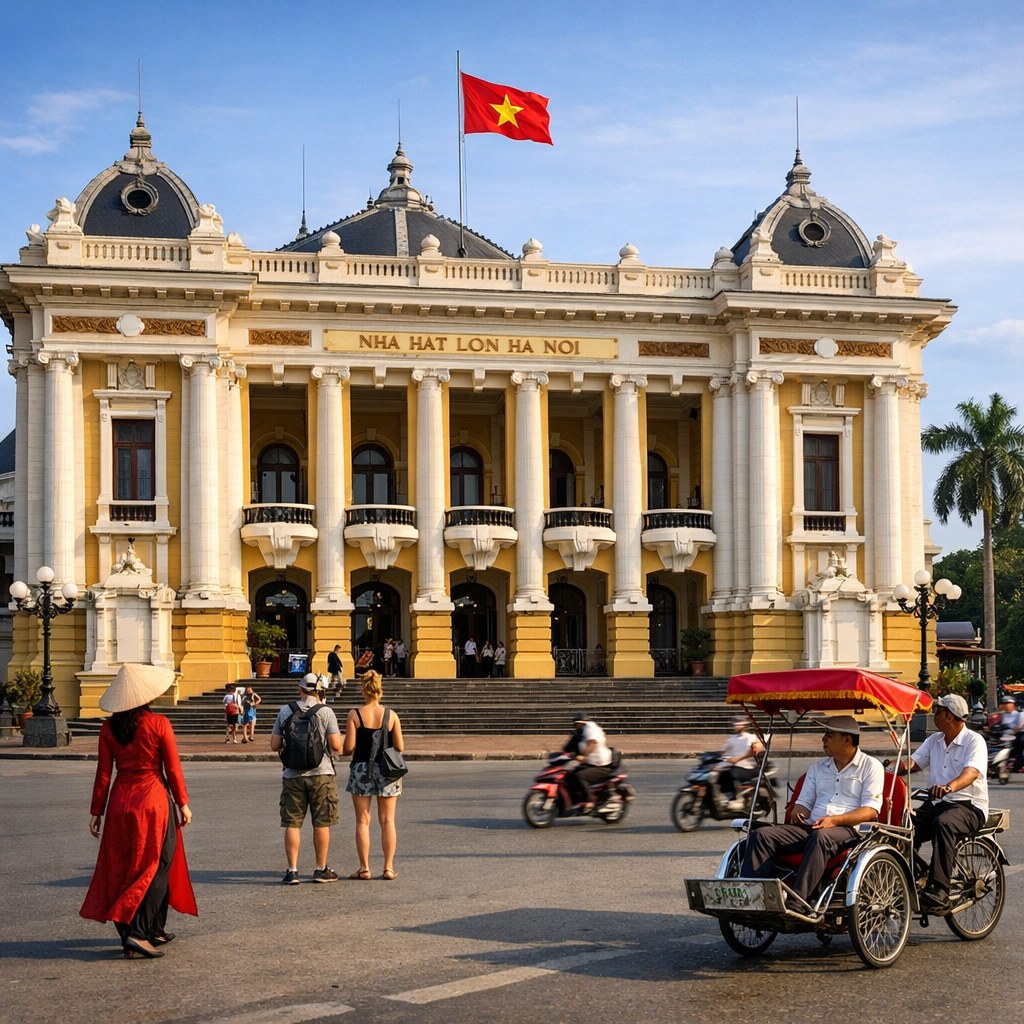
Hanoi was the capital of French Indochina and received its most ambitious architectural investments. The French Quarter, between Hoan Kiem Lake and the train station, is a grid of wide tree-lined boulevards — modelled on Haussmann’s Paris — lined with mustard-yellow villas, neoclassical public buildings and wrought-iron balconies. The Hanoi Opera House (1911) is the centrepiece: a miniature version of the Paris Opera Garnier with its green copper roof and tiered neoclassical facade. Still in active use, it hosts concerts and performances throughout the year. The Presidential Palace (1906) — originally the Governor-General’s Residence — is set in manicured grounds in the Ba Dinh quarter and can be viewed from outside. The Long Bien Bridge (1902), designed by the Gustave Eiffel engineering firm, stretches across the Red River and still carries pedestrians, cyclists and a single rail track.
Ho Chi Minh City (Saigon) has the most architecturally diverse French colonial stock. The Saigon Central Post Office, completed in 1891, is the building most travellers encounter first: its cavernous vaulted interior, all iron arches and mosaic floor, was also associated with Gustave Eiffel’s firm and has the quality of a grand European railway station transplanted to the tropics. Directly opposite, Notre-Dame Cathedral Basilica of Saigon (1880) rises in red-brick neo-Romanesque above a roundabout that still channels motorbikes in chaotic orbit. The City Hall (1908), the Reunification Palace (1966, built on the site of the original Norodom Palace), and the Jade Emperor Pagoda — built by the Chinese community but in a neighbourhood shaped by French urban planning — all reward exploration.
Hoi An, though primarily celebrated for its Chinese trading quarter, has a significant French colonial layer visible in its riverside boulevards and a handful of civic buildings from the late 19th and early 20th centuries. The blend with the town’s older Vietnamese and Japanese architecture creates something unique — a genuinely multicultural townscape that the Hoi An travel guide explores in depth. For the full context of Vietnam’s UNESCO-recognised heritage, our guide to Vietnam’s UNESCO World Heritage Sites covers all five designations.
French Food Influence in Vietnam: From Bánh Mì to Café Culture

No aspect of Vietnam’s French colonial legacy is more delicious than its food influence. The French introduced wheat bread, pâté, butter, coffee, beer, and the technique of making stock-based broths — and the Vietnamese took all of it and made something entirely their own.
Bánh mì is the most celebrated example. The baguette arrived in Vietnam with the French, and for decades it was a mark of colonial status — wheat rather than rice, European rather than Asian. After independence, the Vietnamese transformed it. A proper bánh mì contains pâté, cold cuts or grilled pork, pickled daikon and carrot, fresh cucumber, coriander, chilli and a slick of mayonnaise — all in a baguette made from a mix of wheat and rice flour that gives it a lighter, crispier shell than any French original. Our dedicated bánh mì guide tells the full story of how this sandwich became one of the world’s great street foods.
Vietnamese pho owes a more contested debt to France. The clear beef broth, the use of bone marrow and tendon, the garnishing technique — all bear resemblance to French pot-au-feu. Vietnamese food historians argue about this ceaselessly, and the truth is probably that pho emerged from the intersection of Chinese noodle traditions, Vietnamese rice-based cuisine, and French butchery and broth-making methods that made beef newly available in the north. Whatever its origins, it is now definitively, irreversibly Vietnamese.
Coffee is perhaps the most transformative French introduction of all. French planters established coffee farms in the Da Lat highlands in the 1850s, and Vietnam’s coffee industry has grown to make it the world’s second-largest coffee exporter. The Vietnamese adapted the French drip filter (phin) to produce a slow, intensely strong brew that they mixed with sweetened condensed milk — cà phê sữa đá — because fresh milk was scarce and expensive. The result is one of the world’s great coffee experiences: thick, sweet, caffeinated, served over ice. Our Vietnam coffee trail guide follows the journey from highland farms to city cups.
French baking also left bread rolls, croissants and a thriving pastry culture that survives in both Vietnamese bánh (a word that now means any bread, cake or pastry) and in the remarkable number of European-style bakeries operating in Vietnamese cities. The French introduced beer brewing, and Vietnam now has a thriving beer culture — bia hơi, fresh draught beer served from aluminium kegs at pavement stalls, is the most Vietnamese expression of a European tradition.
French Colonial Cities Today: How to Explore the Legacy
The best way to experience Vietnam’s French colonial legacy is to walk it. In Hanoi, begin at the Metropole Hotel — opened in 1901 as the Grand Hôtel Métropole, it has hosted Charlie Chaplin, Graham Greene and Barack Obama and still operates as the Sofitel Legend Metropole. Walk east along Ngo Quyen Street, past the Governor’s Palace, to the Hanoi Opera House. Then south down Trang Tien Street — Hanoi’s equivalent of the Champs-Élysées — past the Hoan Kiem Lake and into the French Quarter’s grid of residential streets. On Phan Chu Trinh and Ly Thuong Kiet streets, the architectural density of surviving colonial villas is remarkable.
In Ho Chi Minh City, the French Quarter concentrates around Dong Khoi Street (once the Rue Catinat, the social spine of colonial Saigon) and the area between Notre-Dame Cathedral and the river. A walking tour from the cathedral to the Central Post Office, south along Dong Khoi to the Continental Hotel (1880), then to the river quay takes about two hours and covers the colonial core. The Museum of Vietnamese History and the History Museum are both housed in French colonial buildings worth entering for the architecture as much as the exhibits.
Dalat, in the central highlands, offers a different dimension of the colonial experience: the entire city was conceived as a hill station retreat from tropical heat, and its architecture ranges from French Alpine chalets to Art Deco villas to the extraordinary Bao Dai Palace — the summer residence of Vietnam’s last emperor, built in French Modernist style in 1933. Our Da Lat travel guide covers this remarkable city in full.
If you’re planning a broader journey through Vietnam with time allocated to understanding its layered history, our 2-week Vietnam itinerary shows how to structure a north-to-south route that hits the key architectural and cultural sites. Budget travellers will find that entrance fees to museums and historic buildings are remarkably low — our Vietnam budget travel guide covers costs across the country.
Vietnam’s French Language Legacy
French was the official language of French Indochina and remained, for decades, the language of education, law and culture for Vietnam’s elite. Vietnamese intellectuals of the colonial period — including Ho Chi Minh himself, who spent years in Paris — wrote in French as well as Vietnamese, and the engagement with French literary and political thought shaped the nationalist movement profoundly.
Today, French is spoken by a small percentage of older Vietnamese — those educated before 1954 in the north, before 1975 in the south — and is occasionally encountered in provincial towns where the Alliance Française has maintained a presence. Vietnam joined the Organisation Internationale de la Francophonie in 1970, and French is still taught in some schools, though English has overwhelmingly displaced it as the foreign language of aspiration and opportunity.
The most visible French linguistic legacy is in Vietnamese itself. Hundreds of loan words entered Vietnamese during the colonial period: cà phê (café), bánh mì (from pain de mie), ga (gare, railway station), xi lanh (cylindre), bơ (beurre, butter), sô cô la (chocolat). These borrowings are now so thoroughly embedded in Vietnamese that most speakers no longer register them as foreign — which is perhaps the most accurate summary of Vietnam’s relationship with its French colonial legacy: thoroughly absorbed, thoroughly transformed, thoroughly Vietnamese.
Which city has the most French colonial architecture in Vietnam?
Hanoi has the most extensive and best-preserved concentration of French colonial architecture in Vietnam. Its French Quarter covers several square kilometres of neoclassical and Art Deco buildings, wide tree-lined boulevards and grand civic structures including the Opera House, the Presidential Palace (formerly the Governor-General’s Residence) and the Metropole Hotel. Ho Chi Minh City has the most architecturally diverse examples, including the Central Post Office and Notre-Dame Cathedral. Da Lat offers the most unusual expression — a highland hill station with alpine chalet aesthetics.
How did France influence Vietnamese food?
France introduced wheat bread (leading to bánh mì), pâté, butter, coffee cultivation, beer brewing, and broth-making techniques to Vietnam. The Vietnamese adapted all of these into their own cuisine — the baguette became the lighter, crispier bánh mì filled with Vietnamese ingredients; the French drip coffee method became cà phê sữa đá with condensed milk; beef broth techniques influenced pho. The result is a cuisine that carries French DNA while being entirely and distinctively Vietnamese.
When was Vietnam a French colony?
France began conquering Vietnam in the 1850s, seizing Saigon in 1859 and the Mekong Delta in the 1860s. The Indochinese Union was formally established in 1887, incorporating all of Vietnam (as Cochinchine, Annam and Tonkin), Cambodia and Laos. French colonial rule effectively ended in 1954 following the defeat at Dien Bien Phu and the subsequent Geneva Accords, though France maintained political influence in the south until 1956.
What are the best examples of French colonial buildings in Vietnam?
The finest examples include: Hanoi Opera House (1911), Hanoi’s Metropole Hotel (1901), Long Bien Bridge (1902), the Presidential Palace in Hanoi (1906), Ho Chi Minh City’s Central Post Office (1891), Notre-Dame Cathedral Basilica of Saigon (1880), the Continental Hotel in Ho Chi Minh City (1880), and the Bao Dai Summer Palace in Da Lat (1933). For a walking tour of colonial Hanoi, the French Quarter between Hoan Kiem Lake and the train station contains the highest density of surviving buildings.
Can you visit French colonial sites on a budget in Vietnam?
Yes, absolutely. Most of the finest French colonial architecture in Vietnam can be appreciated from the street for free — the Hanoi Opera House, Notre-Dame Cathedral, the Central Post Office and the facades of the French Quarter villas all require no entry fee to admire. Museums housed in colonial buildings typically charge 30,000–60,000 VND ($1–2.50 USD). The Bao Dai Palace in Da Lat charges around 40,000 VND. Walking tours of colonial districts in Hanoi and Ho Chi Minh City are self-guided and cost nothing beyond your own curiosity.
Vietnam’s French colonial legacy is not a museum exhibit — it’s a living thread woven through the fabric of daily life. It’s in the steam rising from a bowl of pho, in the baguette a woman balances across her bicycle basket at 6am, in the shuttered yellow villas where bougainvillea has grown across the ironwork balconies. Understanding it deepens everything you see. And in Vietnam, there is a great deal to see.
Leave a Reply