Vietnam travel etiquette is less a rulebook than a rhythm: a softer voice, a slower smile, a willingness to take your shoes off at the door and let the day unfold. Learn that rhythm before you land, and the country answers back in kind, with an extra spoonful of broth, an invitation to sit on the family stool, a grandmother pressing fruit into your hands. This guide gathers the customs that matter most, from pagoda steps to market stalls, so you can arrive with confidence and leave with friendships rather than faux pas.
Vietnam Travel Etiquette: The Golden Rules Before You Land
Almost every custom in Vietnam grows from three roots: respect for elders, the importance of harmony, and the idea of “saving face”. Vietnamese people tend to avoid open confrontation, so a raised voice, a pointed finger or a public complaint can feel far more jarring than it would at home. If something goes wrong, such as a wrong order or an overcharged fare, smile, stay calm and ask quietly. You will get further with a gentle “xin loi” (excuse me) than with a lecture, and everyone keeps their dignity.
Greetings are warm but modest. A nod and a smile are perfectly acceptable, and handshakes are common in business and tourism settings, though some women, especially older ones, may prefer a nod. When you meet someone older, offer your greeting first, and use both hands when handing over or receiving anything, from a business card to a cup of tea. It is a small gesture that says a great deal. Learning even three phrases helps enormously; our guide to essential Vietnamese phrases for travelers will have you saying “xin chao” and “cam on” within an afternoon.
- Keep your voice low and your temper lower; patience is currency in Vietnam.
- Use both hands, or support your right forearm with your left, when giving or receiving.
- Avoid touching people’s heads, which are considered the most sacred part of the body.
- Beckon with your palm facing down, not up; the upturned finger-crook is used for animals.
Politics deserves a gentle word, too. Many Vietnamese people are happy to talk about history, family and food, but a visitor casually criticising the government or making jokes about the war years can quickly close a conversation. Listen first, and let your hosts decide where the talk goes. If you want to understand the layers of the past before you go, our piece on the DMZ and Vinh Moc tunnels is a thoughtful place to begin.
Temple and Pagoda Etiquette in Vietnam
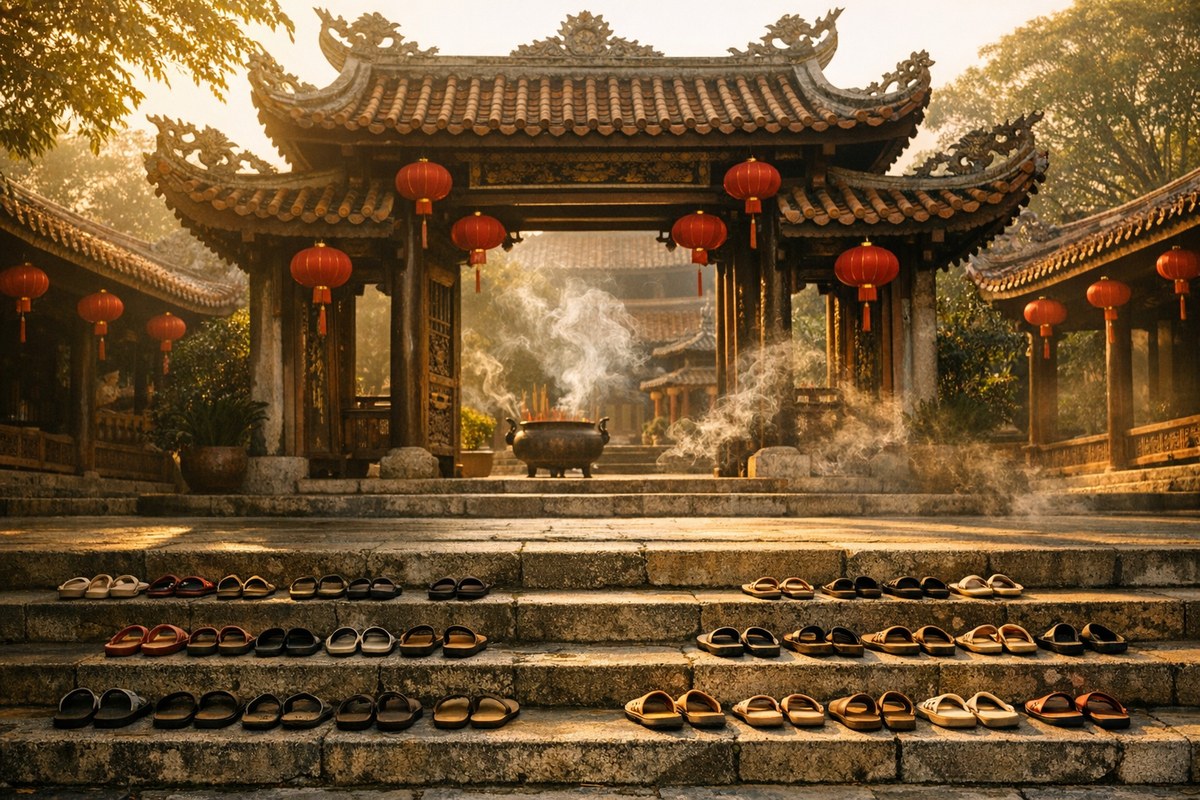
Step through a pagoda gate at dawn and you will understand why etiquette matters here. Incense spirals into the rafters, a monk’s low chanting drifts across the courtyard, and a pile of sandals waits patiently on the stone steps. These are living places of worship, not museums, and the rules are simple: dress modestly, remove your shoes where others do, and lower your voice the moment you cross the threshold.
Modest dress means covering shoulders and knees. A light linen shirt or a scarf stashed in your daypack solves the problem in seconds, and it is wise to carry one on any temple-hopping day. Inside the main hall, walk around rather than in front of people who are praying, never point your feet at an altar or a Buddha statue, and avoid touching sacred objects. Photography is usually fine in courtyards but often discouraged inside the hall; if in doubt, look for signs or simply ask with a gesture.
Leaving a small donation in the box is appreciated, and lighting incense is a lovely way to take part. Hold the sticks in both hands, bow three times, and place them gently in the burner without blowing out the flame; wave it out instead. If you are visiting the extraordinary Cao Dai Holy See, the ritual noon service has its own rules about where visitors may stand, which we cover in our Tay Ninh travel guide. And for a deeper look at what these spaces mean, you may enjoy our essay on the spiritual significance of Vietnam’s pagodas.
The same spirit of reverence applies at national memorials. At Ho Chi Minh’s Mausoleum in Hanoi, visitors are expected to dress conservatively, keep their hands out of their pockets, stay silent and follow the guards’ directions. Opening days and hours change, so check the latest information from the official Vietnam National Authority of Tourism before you go.
Dining Etiquette in Vietnam: Chopsticks, Shared Plates and Toasts
Meals in Vietnam are communal, noisy and joyful. Dishes arrive in the middle of the table, rice is served in individual bowls, and everyone reaches in with chopsticks or a shared spoon. Wait for the eldest person to start eating, and offer to pour for others before filling your own glass. If you are the guest, expect your host to keep adding food to your bowl; a polite, steady pace of eating signals appreciation, and leaving a little rice in the bowl tells the host you are full.

The single most important chopstick rule is never to stand them upright in a bowl of rice. The image resembles incense sticks planted for the dead and is considered deeply unlucky. Rest them across the bowl or on the chopstick holder instead. Avoid passing food from chopstick to chopstick, and do not point with them or stab food. Slurping noodles, on the other hand, is perfectly normal, and a satisfied slurp over a steaming bowl of pho is practically a compliment. If you want to taste the real thing, our pho guide to Hanoi and Saigon bowls will point you toward the best.
When the beer arrives, expect toasts. “Mot, hai, ba, dzo!” (one, two, three, cheers) echoes through restaurants across the south, and clinking glasses is serious business. Younger people tilt their glass lower than elders’ as a mark of respect, and it is polite to wait for the senior person to drink first. You are never obliged to finish your glass; a sip and a smile is enough, and “toi khong uong” (I don’t drink) is understood without offence.
- Never stick chopsticks upright in rice; lay them across the bowl.
- Wait for elders to begin, and pour for others before yourself.
- Try a little of everything; refusing every dish can read as rude.
- Keep an eye on hygiene without making a show of it; our street food safety guide shows you how to eat boldly and sensibly.
Bills are rarely split to the dong. Whoever invited usually pays, and offering to pick up the bill is a gracious gesture; arguing noisily over it is a loved local sport. Tipping is never mandatory, and the full picture is in our Vietnam money guide.
Vietnam Travel Etiquette in Markets, Shops and Bargaining
A Vietnamese market at seven in the morning is a masterpiece of controlled chaos: pyramids of dragon fruit, baskets of lemongrass, a vendor slicing a pineapple in one smooth spiral. Bargaining is part of the dance in markets and with many street sellers, but it should be good-humoured. Smile, ask the price, and if it sounds high, counter with roughly sixty to seventy percent and meet somewhere in the middle. Walking away politely is a legitimate tactic and often brings the final price down on its own.

There are limits, though. Do not haggle in restaurants, supermarkets, or shops with clearly displayed prices, and never bargain hard over a few thousand dong; the difference is pocket change to you and meaningful to a stallholder. Once you agree on a price, the deal is done. If you choose to start a negotiation, be prepared to buy. For a sense of what is worth buying and how much it should cost, see our souvenir guide, and for custom clothing the Hoi An tailor guide explains how to agree on fittings and fabric without friction.
Taxis and motorbike taxis follow their own etiquette. Use metered cabs or ride-hailing apps, confirm the fare before you board if there is no meter, and keep small notes handy for change. A simple “cam on” at the end of the ride goes a long way. If you ever feel pressured, remain calm and polite; our common scams guide covers the handful of situations worth watching for.
Dress Code, Gestures and Photography Etiquette
Vietnam is warm, humid and relaxed about fashion, but modesty still matters outside the beach towns. In cities, shorts and tank tops are fine for sightseeing; in temples, government buildings and rural villages, cover shoulders and knees. On the beach, swimwear is normal, though topless sunbathing is not acceptable. Pack light, breathable layers; our seasonal packing guide shows how to cover every region without overpacking.
Small gestures can speak loudly. Pointing with a single finger is considered impolite; use an open hand instead. Crossing your arms while listening can come across as arrogance or defiance, and standing with hands on hips may be read as anger. Public displays of affection are tolerated in cities but best kept modest elsewhere. Feet are the lowest part of the body, so avoid pointing the soles at anyone or at an altar, and do not step over people’s legs or food.
Photography is one of the great joys of travelling here, and the single golden rule is to ask. A smile and a raised camera usually gets a nod or a laugh from a street vendor, but always ask before photographing monks, children, or anyone in ethnic minority dress. Respect restrictions at military sites, border zones and some government buildings, and check the current rules before flying a drone. For the best places to point your lens, see our list of 20 unmissable photography spots.
Visiting Homes and Ethnic Minority Villages
If you are invited into a Vietnamese home, you are being paid a real compliment. Remove your shoes at the door, accept the offered tea or fruit, and bring a small gift such as fruit, sweets or a box of pastries; hand it over with both hands. Do not be surprised if your hosts decline it at first. Modesty is part of the ritual, and a gentle second offer is expected. Avoid giving gifts in sets of four, as the number sounds like the word for death.
In the highlands around Sapa, Ha Giang, Mai Chau and Pu Luong, homestays offer the most memorable travel moments of all: sleeping on stilted floors, sharing rice wine with the family, waking to roosters and mist. A few extra courtesies help. Ask before entering a house, remain quiet near ancestral altars, never touch the altar, and be careful about handing out sweets or money to children, which can encourage begging. A better gift is buying handwoven textiles or paying fairly for guides and meals. Our guides to Mai Chau and Pu Luong show how to visit gently and well.
Timing matters as well. At Tet, the Lunar New Year, visiting etiquette becomes even more elaborate, with red envelopes, first-footing superstitions and many businesses closing for days. If you are travelling then, read our Tet 2027 guide before booking anything.
Frequently Asked Questions About Vietnam Travel Etiquette
Is tipping expected in Vietnam?
Tipping is not mandatory in Vietnam, but it is appreciated in tourism settings. Rounding up a taxi fare, leaving a small amount for a guide or driver, or tipping hotel staff is a kind gesture. Many upscale restaurants add a service charge, so check your bill first.
What should I wear when visiting temples in Vietnam?
Cover your shoulders and knees, remove your shoes where others do, and keep your voice low. A lightweight scarf or long-sleeved shirt in your daypack makes it easy to dress appropriately at short notice.
Is it rude to haggle in Vietnam?
Haggling is normal in markets and with street vendors, as long as it stays friendly. Do not bargain in shops with fixed prices, restaurants or supermarkets, and avoid arguing over very small amounts.
Why shouldn’t I stick chopsticks upright in rice?
Upright chopsticks resemble incense sticks burned for the deceased, so the gesture is considered bad luck. Rest your chopsticks across the bowl or on a holder when you pause.
Travel Gently, Travel Well
The beauty of Vietnam travel etiquette is that nobody expects perfection. A genuine smile, a willingness to learn and a readiness to laugh at your own mistakes will carry you through nearly every situation. Remove your shoes, lower your voice, accept the second cup of tea, and the country will meet you with a generosity that lingers long after the trip ends. Your itinerary is waiting: start planning with our two-week first-timer’s route and arrive ready to be welcomed.
Images in this article were generated using AI.
Leave a Reply